
The car needed new tires. The water heater gave out. The annual insurance bill arrived — the one you knew was coming, somehow, and still were not ready for. If any of that sounds familiar, you are not bad with money. You are just missing one simple system.
Most of us budget for the monthly bills and then get blindsided by the non-monthly ones. They are not emergencies — emergencies are things you cannot predict. These are things you can predict perfectly and still get caught by, because they do not show up every month. The car will need maintenance. The holidays will come. The tires will wear out. The only surprise is that we keep acting surprised.
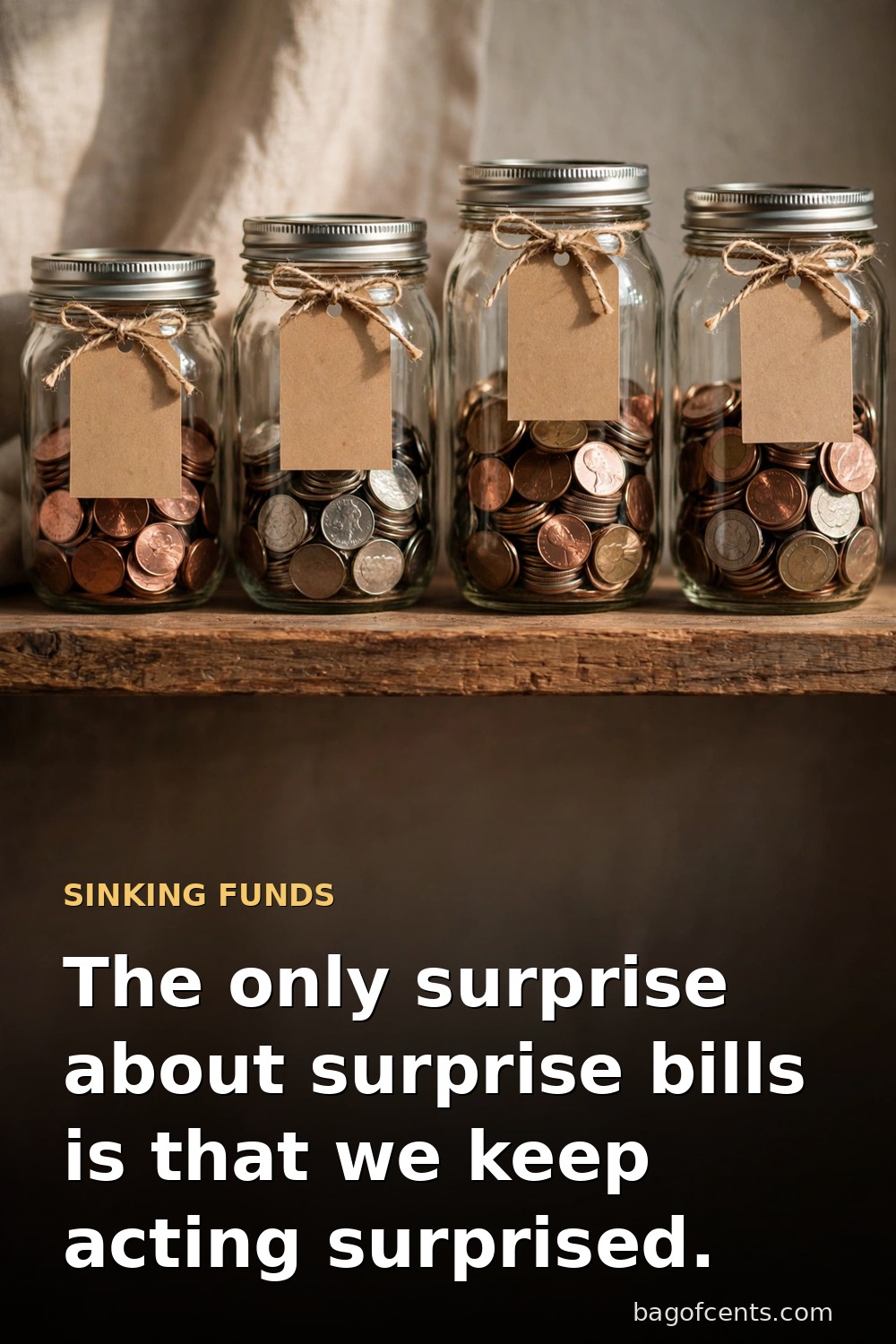
There is a fix, and it is beautifully simple: sinking funds. A sinking fund is just a small amount of money you set aside every month for a specific future expense. That is the whole trick. But do it consistently, and those “surprise” bills stop being surprises forever.
I started using sinking funds years ago after one too many $600 car repairs landed on my credit card. Within a year, the stress around irregular bills was just… gone. Not because I earned more, but because the money was already sitting there waiting. Let me show you exactly how it works.
What Are Sinking Funds?
A sinking fund is money you save a little at a time for a known future expense. The name sounds fancy, but the idea is something your grandparents probably did with envelopes in a drawer: a little for the car, a little for the holidays, a little for home repairs.
Here is how it works in practice. Say your car insurance costs $900 once a year. Instead of scrambling when the bill arrives, you set aside $75 a month into a “car insurance” fund. Twelve months later, the bill arrives and the money is already there. No stress, no credit card, no scrambling.
The key word is known. Sinking funds are not for mysteries — they are for expenses you can see coming if you look ahead:
- Car maintenance and repairs
- Annual or semi-annual insurance premiums
- Holiday gifts and travel
- Home maintenance and appliance replacements
- Medical and dental costs (checkups, glasses, prescriptions)
- Subscriptions billed yearly
- Vacations
- Kids’ school expenses, sports fees, or summer activities
- Pet care (annual vet visits, grooming)
Any expense that is irregular, infrequent, or lumpy is a candidate. If it does not fit neatly into your monthly budget, it belongs in a sinking fund.
Sinking Funds vs. Emergency Fund vs. Regular Savings
People mix these up, so let us get clear. They are three different tools for three different jobs.
An emergency fund is for true surprises — the job loss, the medical emergency, the roof that caves in during a storm. You cannot predict these, so you keep a cushion of several months of expenses that you hope to never touch. (If you do not have one yet, that is a separate project worth starting — but it is not what this article is about.)
A sinking fund is for predictable irregular expenses. You know the car will need tires eventually. You know the holidays come every year. There is nothing surprising about these bills except our failure to plan for them. Sinking funds turn big irregular expenses into small regular ones.
Regular savings is money set aside for goals and the future — a down payment, retirement, a dream trip you are choosing to take. It is about building toward something, not covering something you already know is coming.
Think of it this way:
- Emergency fund = “I hope this never happens, but I am ready.”
- Sinking fund = “I know this will happen, so I am ready.”
- Savings = “I want this to happen, so I am building toward it.”
When people skip sinking funds, their emergency fund ends up covering predictable bills — and then a real emergency arrives and the cushion is gone. Sinking funds protect your emergency fund by giving predictable expenses their own home.
How to Set Up Your Sinking Funds, Step by Step
Setting this up takes one focused afternoon. Here is the whole process.
Step 1: List Your Irregular Expenses
Grab a notebook and brainstorm every non-monthly expense you can think of. Look back through the last year of bank and credit card statements — that is where the truth lives. Write down everything: the annual subscriptions, the vet bill, the holiday spending, the car registration, all of it.
Do not filter yet. The goal is a complete list. Most people find between five and twelve items. If your list is short, you probably forgot something — check those statements again.
Step 2: Estimate the Yearly Cost of Each
Next to each item, write what it costs per year. Use last year’s actual numbers where you have them — they beat guesses every time. For things that vary, like car repairs, use a reasonable average. A good starting point for car maintenance is $75 to $100 a month ($900-$1,200 a year) for an older car, less for a newer one under warranty.
Be honest here, not optimistic. Underestimating is the number one reason sinking funds fall short. If holiday spending was $800 last year, write $800 — not the $400 you wish it had been.
Step 3: Divide by 12 (or by the Months Remaining)
Take each yearly total and divide by 12. That is your monthly contribution for that fund.
If a bill is due in fewer than 12 months, divide by the months you have left instead. A $600 insurance bill due in 4 months means $150 a month for 4 months. Next year, once you are on the full cycle, it drops to $50 a month. The first year is the hardest — after that, you are just maintaining.
Step 4: Add Them Up and Sanity-Check the Total
Add all the monthly amounts together. That is your total monthly sinking fund contribution.
Now be real with yourself: can your budget absorb that number? If it feels impossibly high, do not abandon the system — prioritize. Fund the most urgent ones first (the bill due soonest), and add the rest as you free up room. A partial sinking fund system beats none at all.
This step also delivers a powerful insight: that total is roughly what those “surprise” bills were already costing you — you were just paying for them with stress and credit card interest instead of planning.
Step 5: Give Every Fund Its Own Home
This is the step people skip, and it matters. If all the money sits in one pile, it is too easy to “borrow” from the car fund for a weekend trip and promise to pay it back. (You will not pay it back.)
Separate the money. Options that work:
- A high-yield savings account with sub-accounts or “buckets.” Many online banks let you create named buckets inside one account — “Car,” “Holidays,” “Home Repairs” — with no fees. This is the cleanest option.
- A separate savings account per fund. More accounts, more clarity, slightly more hassle.
- A simple spreadsheet or app tracker. If you prefer one account, track the allocations carefully so you always know how much belongs to each fund.
The method matters less than the separation. Every dollar needs a name and a job.
Example Categories and Sample Monthly Amounts
Numbers make this real. Here is what a typical household’s sinking funds might look like — adjust every line to your own life:
| Fund | Estimated yearly cost | Monthly set-aside |
|---|---|---|
| Car maintenance & repairs | $1,200 | $100 |
| Car insurance (paid annually) | $900 | $75 |
| Holiday gifts & travel | $800 | $67 |
| Home maintenance | $1,200 | $100 |
| Medical/dental/vision | $600 | $50 |
| Pet care | $480 | $40 |
| Annual subscriptions | $240 | $20 |
| Vacation | $1,500 | $125 |
| Kids’ school & activities | $600 | $50 |
| Total | $7,520 | $627 |
That $627 a month might look like a lot — until you realize it replaces $7,520 a year of “surprise” bills that used to land on credit cards. And remember, you do not have to start with all of them. Begin with the three that stress you out most. You can build the rest over time.
A few notes on common categories:
- Car: This is the big one for most people. Tires, brakes, oil changes, the inevitable mystery rattle — budget for it all. If your car is older, budget more, not less.
- Home: The rule of thumb is 1% of your home’s value per year for maintenance. Even renters benefit from a small home fund for things landlords do not cover.
- Holidays: Be honest about what you actually spend, including travel, food, and decorations — not just gifts.
- Medical: Even with insurance, copays, dental work, glasses, and prescriptions add up. Look at last year’s total and divide.
How to Automate the Whole Thing
A system you have to remember is a system that will fail. Automate it.
1. Automate the transfer. Set up an automatic transfer from checking to savings on payday for your total monthly sinking fund amount. Pay your future bills first, the same way you would pay any other bill. What you do not see, you will not spend.
2. Automate the split. If your bank supports buckets or sub-accounts, set up automatic rules that divide the transfer among your funds. If not, do a quick manual split once a month — put it on your calendar for payday and treat it like a bill.
3. Automate the bills themselves. Wherever possible, put the actual bills on autopay from the account holding the fund. Insurance, subscriptions, the vet’s wellness plan — autopay means the money flows out exactly when it should, with zero effort and zero late fees.
4. Review twice a year. Expenses change. The car gets older, the kids’ activities change, you drop a subscription. Twice a year, spend twenty minutes reviewing your funds: Are the amounts still right? Is anything missing? Is anything overfunded? Adjust and move on.
Once this is running, the whole thing takes maybe ten minutes a month. The bills arrive, the money is there, and you barely think about it. That is the goal: a system so boring you forget it exists.
Common Mistakes to Avoid
- Raiding the funds. The car fund is not a vacation fund. If you borrow from a sinking fund, write down exactly when you will repay it — and do it. Better yet, do not borrow at all.
- Forgetting to start early enough. A bill due in two months needs aggressive saving now. The system works best when every fund gets a full 12-month cycle, so start today even if the first year is catch-up.
- Setting it and forgetting it forever. Life changes; your funds should too. That twice-a-year review is non-negotiable.
- Keeping it all in one unlabeled pile. Money without a name gets spent. Separate it, name it, protect it.
- Trying to fund everything on day one. Start with your top three funds. Momentum beats perfection.

Final Thought
Sinking funds will not make you rich overnight, and they are not exciting. Nobody brags about their car insurance fund at parties. But here is what they do: they end the cycle of surprise bills, credit card float, and financial anxiety over expenses you could see coming all along.
That peace of mind — knowing the money is already there — is one of the most underrated feelings in personal finance. It is the difference between reacting to your money and directing it.
Start today. List your irregular expenses, do the math, and set up that first automatic transfer. A year from now, when the bills arrive right on schedule and you do not even flinch, you will wonder why you did not do this sooner.
If this helped you, share it with someone who is always getting blindsided by “unexpected” bills. And if you set up your first sinking fund this week, I would love to hear about it.
Happy Budgeting!
Stanley
Leave a Reply