
Doing nothing with your money has a price tag. For $50,000 left sitting still for two decades, the honest math puts it at roughly $138,000 in foregone growth — and over a slightly longer horizon, it sails past $197,000.
Nobody sends you a bill for leaving money in a savings account. There’s no statement line that reads “cost of not investing: $11,400 this year.” That’s exactly why it’s so dangerous — the most expensive financial mistake most people make is the one that never shows up anywhere.
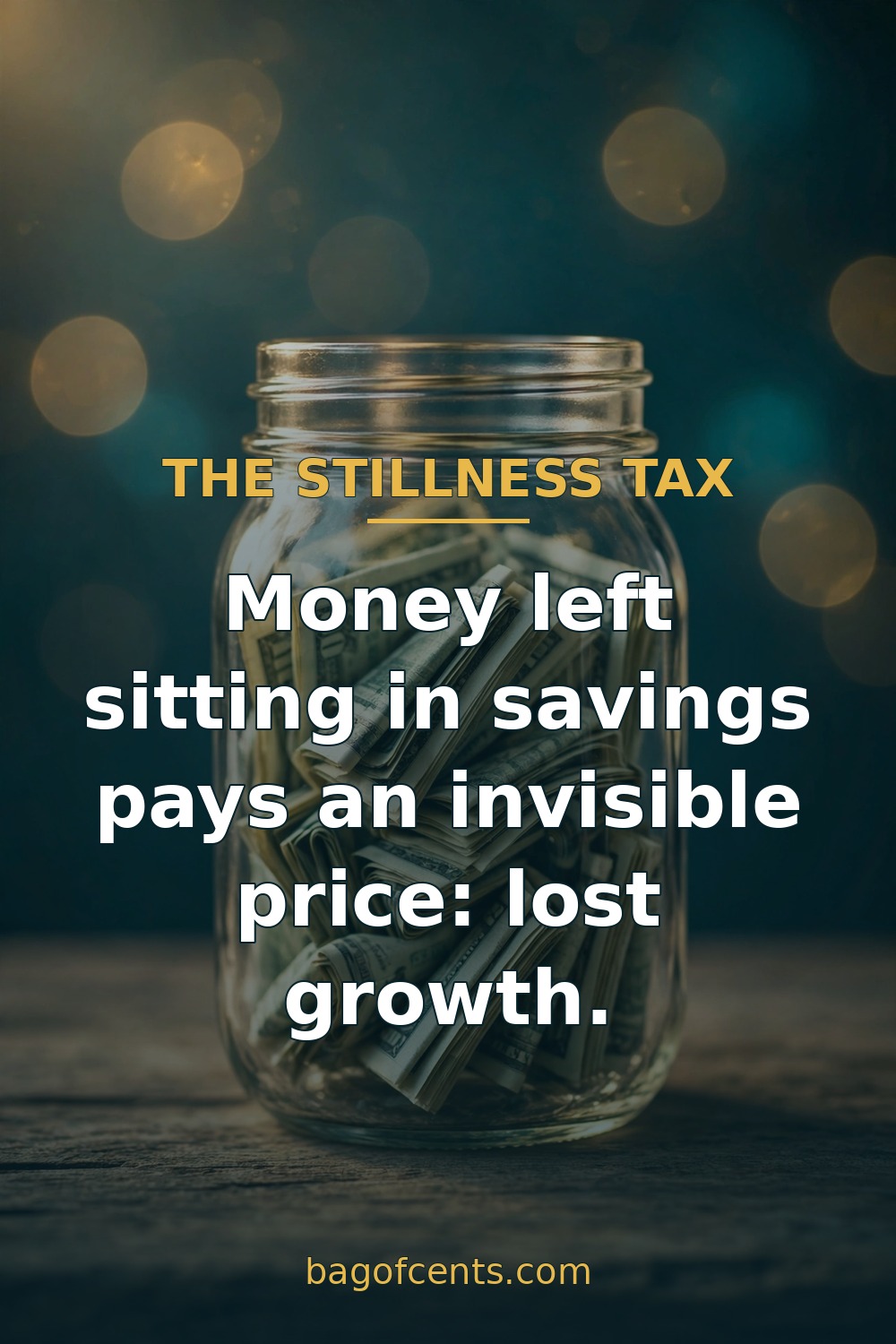
Let’s call it what it is: the stillness tax — the difference between what your money could have grown into if invested, and what it actually became sitting in cash. You never pay it in a lump sum. You pay it in growth that simply never happened.
Below: the real math, honestly computed with every assumption on the table — then the fix, which is smaller and more boring than you’d expect. (Nothing here is personalized financial advice; this is general education so you can make your own informed decisions.)
What the “Stillness Tax” Actually Is
The stillness tax is the gap between two futures for the same dollars. Future A: your money sits in a savings account earning a modest interest rate, safe and barely moving. Future B: the same money is invested in a diversified portfolio earning a hypothetical market-like return. The tax is the difference between those two outcomes — money you didn’t lose in a crash, didn’t spend on anything, and never got to keep.
It’s not a real tax — no government collects it. But the name fits: unlike market losses, which come with drama and headlines, the stillness tax is collected in silence, one uneventful year at a time.
Here’s the headline figure, stated honestly: take $50,000. Leave it in a savings account earning about 0.5% for 24 years — a realistic window for someone saving through their 30s and 40s — and compare it against the same $50,000 earning a hypothetical 7% annualized. The gap between the two outcomes lands at roughly $197,000. That’s the stillness tax on one $50,000 decision, and nobody ever sent an invoice for it.
Why the Math Is So Brutal: Compound Interest Runs Both Ways
Compound interest is usually sold as the hero of personal finance. But compounding is neutral — it multiplies whatever you feed it, at whatever rate you feed it. The difference between a 7% curve and a 0.5% curve is the stillness tax, and it grows faster than intuition suggests.
Our brains think in straight lines. If savings pay 0.5% and investing hypothetically earns 7%, the difference feels like 6.5 percentage points — noticeable, not life-changing. Over one year, it isn’t: on $50,000, that’s $250 versus $3,500. But compounding works in curves, and the curves diverge — each year, invested money earns returns on all prior years’ growth too. Time doesn’t just add to the stillness tax; it multiplies it.
The Real Numbers: $50,000 Over 20 Years
Let’s lay the core example out cleanly, with every assumption visible so you can check the math yourself:
- Starting amount: $50,000 (a lump sum — an inheritance, a home-down-payment fund that never got used, years of diligent saving)
- Scenario A (savings): 0.5% annual interest, compounded yearly, for 20 years → roughly $55,000
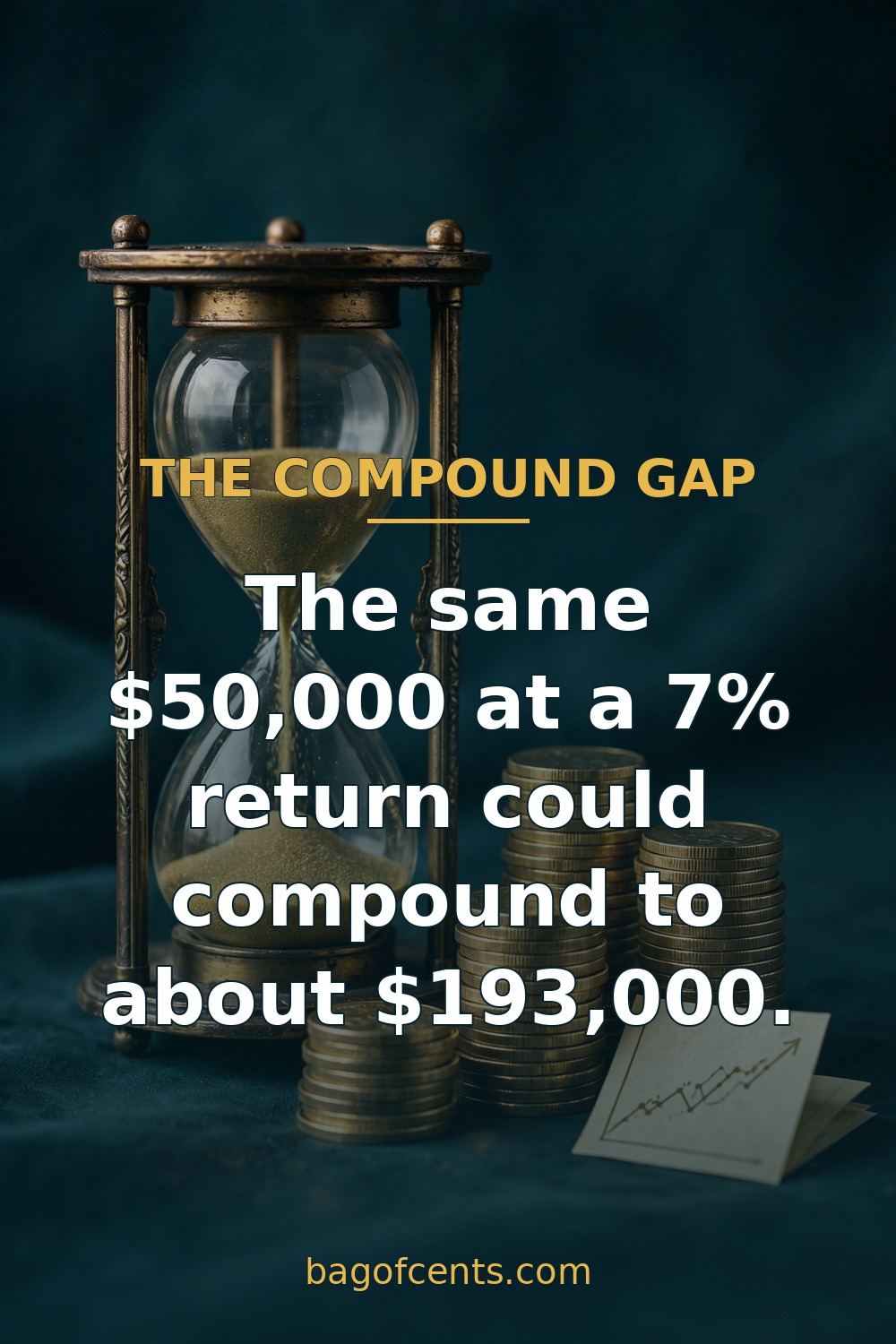
- Scenario B (invested): a hypothetical 7% annualized return, compounded yearly, for 20 years → roughly $193,000
- The stillness tax: about $138,000 in foregone growth
A few honest caveats. The 7% figure is a hypothetical illustration — it resembles long-run historical averages for diversified stock markets before inflation, but no investment guarantees anything close to it, and real portfolios carry fees and taxes that reduce the outcome. The 0.5% savings figure is illustrative too. These figures also ignore inflation — we’ll fix that in a second.
But the structure of the result is robust: it doesn’t depend on 7% being exactly right. At a hypothetical 6%, the invested $50,000 still reaches roughly $160,000 — a gap of about $105,000 over savings. At 5%, it’s roughly $133,000 — a gap near $78,000. The exact number moves; the lesson doesn’t.
Don’t Forget the Second Thief: Inflation
So far we’ve compared nominal dollars — the numbers on the statement. But a dollar in 20 years won’t buy what a dollar buys today, and this is where the savings-account story gets even worse.
At 2% annual inflation — roughly the Bank of Canada’s long-run target — prices rise about 49% over 20 years. So the roughly $55,000 in the savings account has the purchasing power of only about $37,000 in today’s dollars. The saver didn’t just miss growth; the money they “kept safe” quietly lost nearly a third of its buying power.
This is what people miss when they say investing “feels risky” and cash “feels safe.” Cash in a low-rate account isn’t standing still — it’s drifting backward in real terms. Investing carries visible risk: statements that fall, scary headlines. Cash carries invisible risk: the slow erosion of what your money can buy. One makes the news; the other just makes you poorer, politely.
None of this means cash is useless — an emergency fund in a savings account is one of the smartest things you can own, because its job isn’t growth, it’s availability. The stillness tax applies to money that’s sitting in cash with no job: long-term savings that could have been working harder but never got the assignment.
How to Start Paying Less of It: The Boring, Practical Fix
The fix for the stillness tax is not a hot stock tip, a crypto gamble, or perfect market timing. It’s a system: move long-term money out of idle cash and into diversified investments, automatically, inside the right account. Here’s what that looks like for a Canadian beginner, in plain language. (Again: general education, not personalized advice. Your situation may call for something different.)
Step 1: Use a TFSA first. If you’re a Canadian with available TFSA contribution room, it’s the natural home for long-term investments — growth inside generally isn’t taxed on withdrawal. But the account type doesn’t fix anything by itself; what you hold inside it does. A TFSA full of cash at 0.5% is the stillness tax in disguise.
Step 2: Open a brokerage account if you don’t have one. You can’t buy investments from a savings account. In Canada, beginner-friendly options include platforms like Wealthsimple and Questrade — both let you open a TFSA and buy low-cost investments with no intimidating minimum. This is the step where most people stall for months; it takes about 20 minutes.
Step 3: Buy boring, diversified index exposure. You don’t need to pick stocks. Broad, low-cost index ETFs — funds that hold hundreds or thousands of companies at once — are the default building block of a sensible long-term portfolio. In Canada, all-in-one ETFs with names like XEQT or VEQT are popular examples: a single purchase gives you global stock diversification with a management fee well under 0.30% a year. They’re examples of the category, not recommendations — the point is that diversification plus low fees is the engine, not any particular ticker.
Step 4: Automate it. Set up an automatic contribution — every payday, a fixed amount moves into the investment account and gets invested. Automation matters more than the amount, because it removes the monthly temptation to skip. Pay yourself first, then live on the rest.
Step 5: Leave it alone. The system works on a timescale of decades. Checking daily and panic-selling during dips are how people convert a good plan into a bad outcome. Invest, automate, and get on with your life.
Why Even $50 a Month Matters
“This is all fine for people with $50,000,” you might be thinking, “but I don’t have a lump sum.” Good news: the stillness tax applies to monthly contributions too, and small amounts genuinely move the needle over time.
Run the numbers on $50 a month for 20 years — that’s $12,000 of your own money contributed, one modest dinner out per month:
- In a 0.5% savings account: roughly $12,600 — your contributions plus about $600 of interest
- Invested at a hypothetical 7% annualized: roughly $26,000 — your contributions plus about $14,000 of growth
- The stillness tax on $50/month: about $13,400
Thirteen thousand dollars, from $50 a month, for doing nothing fancier than choosing a different account. Bump it to $100 a month and the invested figure roughly doubles to about $52,000. These are hypothetical illustrations, not promises — but they show why “I can’t afford to invest” is usually backwards.
The deeper point: starting small beats starting “someday.” A $50 monthly habit you actually maintain will outperform a $500 monthly plan you never start. You can raise the amount later — but the clock on compounding only starts when you do.
Common Mistakes That Keep People Paying the Tax
Mistake #1: Waiting for “the right time” to invest. The most expensive sentence in personal finance: “I’ll start investing when the market settles down.” The market never settles down — there’s always a reason to wait, which means waiting becomes permanent. Time in the market has historically mattered far more than timing it.
Mistake #2: Cash drag — holding too much “just in case.” An emergency fund of 3–6 months of expenses is smart. Keeping $40,000 in chequing “just in case” while your TFSA sits empty is cash drag: money with no assignment, earning nothing, taxed by stillness. Audit your cash once a year.
Mistake #3: Trying to time the market. Buying only after crashes and selling before dips sounds clever and works terribly in practice, because nobody rings a bell at the top or the bottom. The antidote is the boring system from above: automatic contributions that buy whether the market is up, down, or sideways.
Mistake #4: Letting fees quietly compound against you. The stillness tax has a cousin: the fee tax. A mutual fund charging 2% a year versus an index ETF charging 0.25% doesn’t sound like a big difference — until you compound it over 20 years, at which point it can devour tens of thousands of dollars. Low fees are one of the few reliable predictors of better long-term outcomes. Boring and cheap beats exciting and expensive, nearly every time.
Quick Answers to Common Questions
Isn’t investing risky? What if I lose money? Investing does involve real risk — markets fall, sometimes hard, and no return is guaranteed. That’s the honest truth. But “risky” needs a timeframe: over short periods, markets are volatile; over multi-decade periods, diversified stock markets have historically trended upward. The risk of investing is visible and bumpy. The risk of not investing — the stillness tax plus inflation — is invisible and steady. You’re choosing between two risks, not between risk and safety.
What if I need the money soon? Then don’t invest it. Money you’ll need within about three years — a home down payment, next year’s tuition — belongs in a savings account or GIC, where the stillness tax is the price of certainty you genuinely need. Investing is for money with a long runway.
Do I need a lot of money to start? No — that’s the $50-a-month section above. Most brokerages let you start with whatever you have. The barrier was never really the amount; it was the 20-minute account setup and the decision to begin.
Final Thought
The stillness tax is the only major financial cost that charges you for doing nothing, bills you in silence, and never sends a statement. Roughly $138,000 on $50,000 over 20 years. Roughly $197,000 if the window stretches a few years longer. About $13,400 on just $50 a month. None of those numbers are guaranteed — markets don’t do guarantees — but the direction is as close to certain as finance gets: idle cash compounds at almost nothing, and time multiplies the difference.
The encouraging flip side: the fix is small. Not a windfall, not a genius stock pick, not perfect timing — just a TFSA, a boring diversified fund, an automatic contribution, and patience. Your money is going to spend the next 20 years somewhere. The only question is whether it spends them working — or waiting.
Start your system this week.
Grab our free 52-Week Savings Challenge Tracker and build the saving habit first — up to $1,378 in a year, one small weekly deposit at a time, with a printable tracker to keep you on course.
Join the Bagofcents weekly money tips email. Unsubscribe anytime.
Happy Budgeting!
Stanley
Leave a Reply