
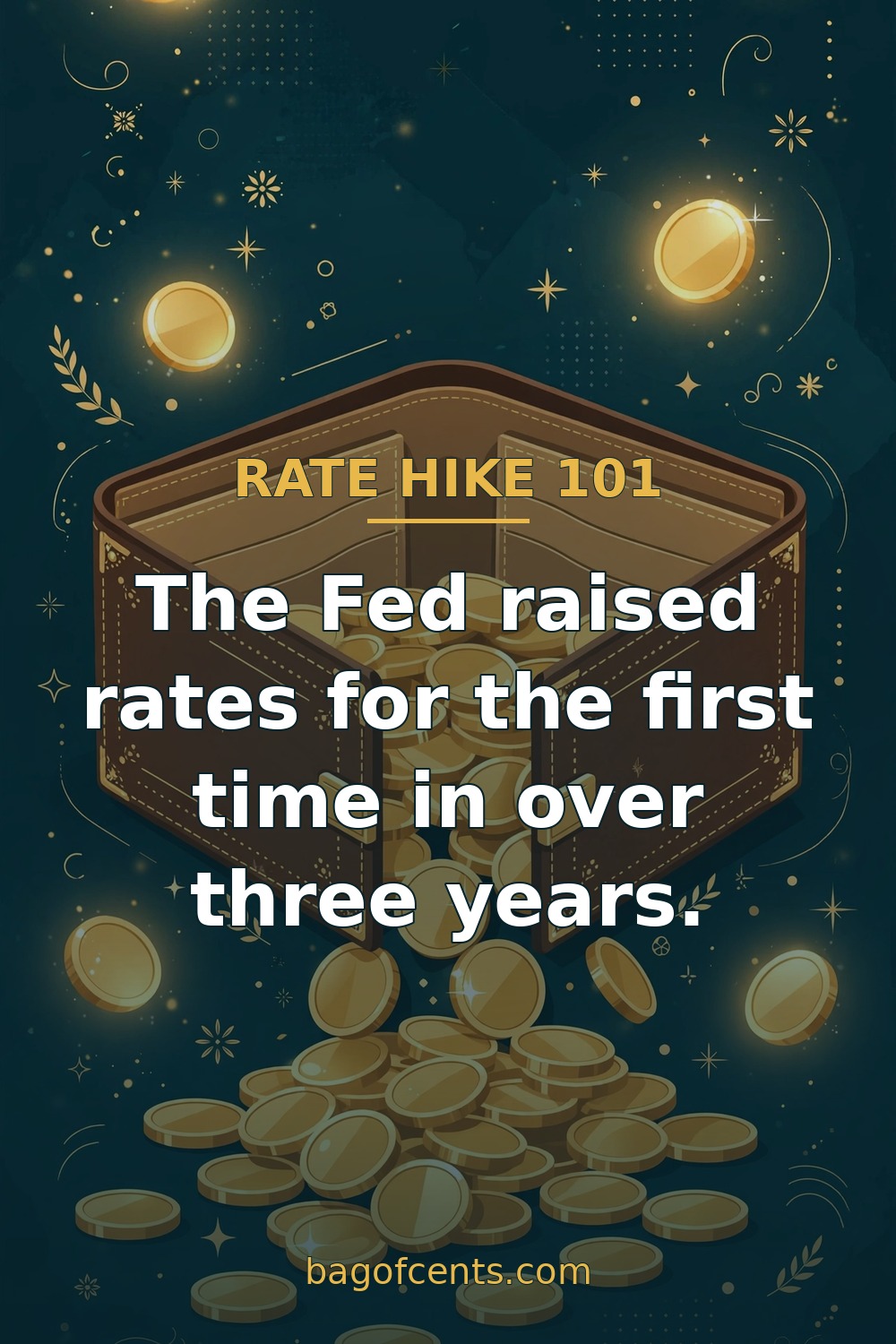
The Fed just raised rates for the first time in over three years. So what does that actually do to your money?
On September 16, 2026, the U.S. Federal Reserve did something it hadn’t done since July 2023: it raised interest rates. The vote was unanimous — 12 to 0 — and the fed funds rate now sits in a 3.75% to 4.00% range. Most Fed officials signaled at least one more hike could come before year-end.
If you read that headline and thought “okay, but what does that have to do with my rent, my car loan, or my grocery budget?” — this article is for you. The Fed’s decisions reach your wallet through the actual interest rates on your mortgage, your credit cards, your savings account, and the price of just about everything you buy.
This is a general explainer, not personal financial advice — I won’t tell you what to do with your mortgage or your money. But I’ll show you the mechanics, the real numbers, and the mistakes people make when rates move. (Canadian readers: this matters to you too — details below.)
First: what is the fed funds rate, really?
The federal funds rate is the interest rate at which banks lend money to each other overnight. It sounds remote, but it’s the single most important interest rate in the U.S. economy — the anchor that every other rate is measured against. When the Fed “raises rates,” it sets the cost of money at the foundation of the financial system, and banks reprice their own products on top of it: credit cards, auto loans, HELOCs, savings accounts, CDs.
The Fed raises rates for one main reason: to fight inflation. Higher borrowing costs slow down spending and investment, which cools off an overheated economy and takes pressure off prices. The trade-off is real, though — the same medicine that fights inflation can also slow hiring, squeeze businesses, and make debt more expensive for regular people. That’s why every Fed decision is a balancing act, and why the September minutes show officials weighing inflation risk against softer job numbers.
How rate hikes ripple through your money
Here’s where it gets personal. A rate hike doesn’t arrive in your inbox with a subject line — it shows up in specific places, at different speeds.
1. Mortgages and HELOCs get more expensive
Mortgage rates don’t move in lockstep with the Fed, but they respond to where markets think the Fed is going. After the September hike, U.S. 30-year mortgage rates climbed to a three-year high above 7% — the bond market priced in a whole hiking cycle, not just one move.
HELOCs (home equity lines of credit) and variable-rate mortgages react faster and more directly, because they’re usually tied to the prime rate, which moves within days of a Fed decision. If you’re carrying variable-rate debt, a rate-hiking cycle hits you first and hardest.
Canadian readers, take note: your variable-rate mortgages and HELOCs are tied to the Bank of Canada’s rate and Canadian prime, not the Fed’s. But the two central banks often move in the same direction, and Canadian fixed mortgage rates follow bond markets that track U.S. bonds closely. When the Fed hikes, Canadian borrowing costs almost always feel the pressure too.
2. Credit card APRs jump almost immediately
This is the fastest, most reliable transmission channel of all. Most credit cards have variable APRs tied to the prime rate, and when the Fed raises the fed funds rate, the prime rate typically moves within days. Your card issuer then applies the change to your existing balance at the next billing cycle.
Think about that: you don’t have to borrow new money to feel a rate hike. The debt you already carry gets more expensive automatically.
3. Auto loans get pricier
Auto loan rates follow the general direction of interest rates, though with some lag. New car loans reprice over weeks and months, not days. A couple of rate hikes might add a percentage point or more to a new auto loan — which, over a five- or six-year term, can add thousands to the total cost of a car.
4. Savings accounts and GICs finally pay you something
Here’s the good news side of the ledger. Higher rates mean banks pay more for your deposits. Online savings accounts, high-interest savings accounts, and GICs / CDs all tend to rise after hikes — though banks are famously quick to raise borrowing rates and slow to raise savings rates. Your credit card APR moves in days; your savings rate might take months, and it might not move the full amount.
Still, a hiking cycle is historically the best time to be a saver. Parking your emergency fund or short-term savings in a high-yield account during rising rates is one of the few ways rising rates actually help everyday people.
5. Bond prices fall
This one confuses a lot of people. When interest rates rise, existing bond prices fall. Why? Because if a new bond pays 5% and your old bond pays 3%, nobody wants your old bond unless you sell it at a discount. This matters if you own bond funds in your RRSP, 401(k), or TFSA — you’ll see the statement value drop when rates climb, even though the bonds themselves keep paying.
6. The U.S. dollar usually strengthens
Higher U.S. rates make dollar-denominated investments more attractive globally, which tends to push the dollar up. For Canadians, a stronger U.S. dollar typically means a weaker loonie — which makes everything priced in U.S. dollars more expensive in Canadian dollars. Rate hikes have cross-border consequences.
7. Recession risk goes up
This is the shadow behind every hiking cycle. Raising borrowing costs slows everything: businesses postpone expansions, consumers pull back on big purchases, hiring cools. The Fed aims for a “soft landing,” but the line between cooling and contracting is thin — one more reason to keep an emergency fund healthy while hikes are in play.
Let’s talk real numbers
Abstract percentages don’t change behavior — dollar amounts do. So let’s translate rate hikes into the language of your monthly budget.
A $400,000 mortgage: 5.50% vs 7.25%
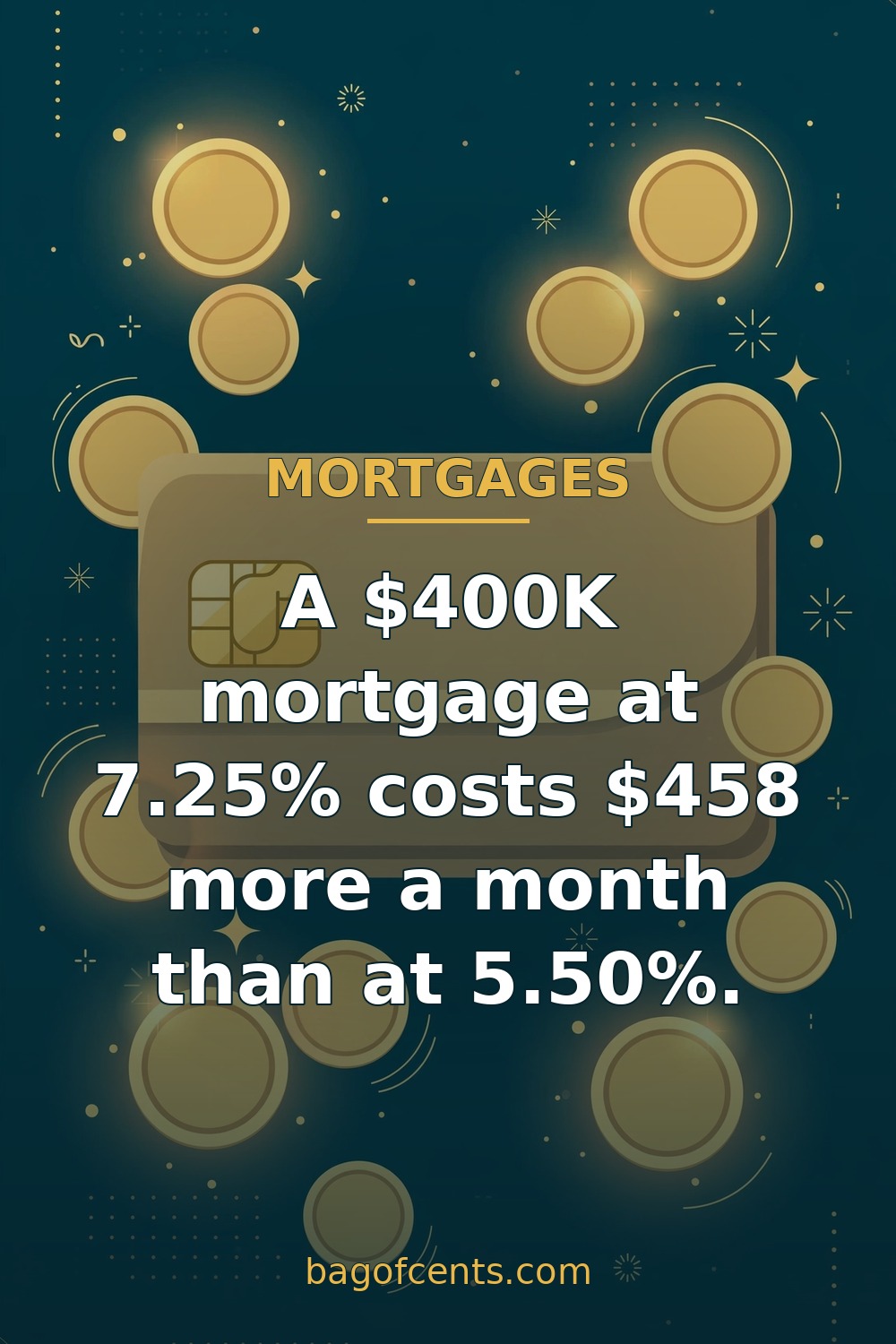
Imagine a 30-year fixed mortgage of $400,000. At a 5.50% rate, the monthly payment is about $2,271. At 7.25% — roughly the environment we’re in after the September hike pushed mortgage rates to three-year highs — the same mortgage costs about $2,729 a month.
That’s a difference of $458 per month, or about $5,491 per year, for the exact same house and loan amount. Over a 30-year term, that rate difference adds up to roughly $165,000 in extra interest. This is why “waiting for rates to drop” before buying is such a common strategy — and, as we’ll see, such a risky one.
Carrying a $5,000 credit card balance at 24% APR
At a 24% APR — a typical rate for a rewards card — carrying a $5,000 balance costs you roughly $1,200 a year in interest alone, even if you never charge another dollar. Each quarter-point Fed hike can nudge your APR higher, and because it applies to your existing balance, the cost climbs with no new spending on your part. A balance that felt manageable can quietly become a treadmill.
Savings: $10,000 at 4% vs 1.5%
On the flip side, parking $10,000 in a high-yield savings account earning 4% gives you $400 a year in interest, versus $150 at 1.5%. That’s $250 a year for the effort of moving money to a better account — the kind of easy win a rising-rate environment hands you if you take it.
Common mistakes people make when rates rise
Mistake #1: Waiting to buy a home “until rates come back down.” This sounds prudent, but it’s a gamble in disguise. Nobody knows when — or whether — rates will fall; the Fed just started hiking, and most officials expect at least one more increase this year. Buy based on whether you can afford the payment today and whether the home fits your life — not on a rate forecast.
Mistake #2: Ignoring variable-rate debt. Fixed-rate borrowers can mostly tune out the news. Variable-rate borrowers can’t. If you have a variable-rate mortgage, a HELOC balance, or a credit card balance, every hike lands directly on you — recalculate your payments and make a plan, whether that’s accelerating payoff, locking in a fixed rate, or at minimum re-budgeting.
Mistake #3: Leaving savings in a 0.5% account during a hiking cycle. Banks count on your inertia. If your savings account still pays next to nothing while the Fed is hiking, you’re donating the difference to your bank’s profit margin. Shopping for a high-yield account takes an afternoon.
Mistake #4: Panicking over bond fund statements. Seeing your bond fund drop when rates rise feels like losing money. But if you’re holding long-term, those funds are now buying new bonds at higher yields — your future income from them is actually improving. Selling in a panic locks in the paper loss and forfeits the higher future yield.
Quick answers to common questions
Does the Fed set MY mortgage rate? No — not directly. The Fed sets the federal funds rate. Your mortgage rate is set by lenders based on bond markets, their costs, your credit, and competition. But Fed policy heavily influences the bond markets, so hikes push mortgage rates up in practice, just with a lag and some independence.
How fast do savings rates respond to a hike? Slowly and incompletely. Online banks and credit unions tend to move fastest; big traditional banks are often the slowest, sometimes raising savings rates only a fraction of the Fed’s move — if at all. This lag is exactly why shopping around matters.
Should I rush to lock in a rate or pay down debt before the next hike? There’s no universal answer, but the direction is clear: the Fed has started hiking and most officials expect more. If you’re carrying high-interest variable-rate debt, paying it down is one of the highest-return moves available to you right now — a guaranteed, risk-free return equal to your interest rate.
I’m Canadian. Does any of this apply to me? Yes. The Bank of Canada sets Canadian rates independently, but it watches the Fed closely, and Canadian fixed mortgage rates are driven by bond markets that move with U.S. bonds. A Fed hiking cycle almost always puts upward pressure on Canadian borrowing costs too — and a stronger U.S. dollar can raise the price of imported goods in Canada.
Do rate hikes cause recessions? Not automatically, but they raise the odds — the Fed is trying to cool inflation without freezing the economy, and the line between “cooling” and “contracting” is thin. It’s a good reason to keep an emergency fund healthy during hiking cycles, which is the one piece of advice that applies in every rate environment.
Final Thought
The Fed’s September hike is a reminder of something easy to forget when rates have been quiet: the cost of money is never fixed. When it moves, it moves your mortgage payment, your credit card bill, your savings yield, and the price of your groceries — adding up to thousands of dollars a year for many households.
You can’t control the Fed. But you can control your exposure to its decisions: the type of debt you carry, the rate on your savings, and whether you have a cash cushion when the economy cools. The people who come through hiking cycles best aren’t the ones who predicted the Fed’s next move — they’re the ones whose finances work in any rate environment.
This article is for general educational purposes only and is not personal financial advice. Everyone’s situation is different — consider speaking with a qualified professional about your own decisions.
Liked this? Take it further.
Grab our free 52-Week Savings Challenge Tracker and save up to $1,378 in a year — one small weekly deposit at a time, with a printable tracker to keep you on course.
Join the Bagofcents weekly money tips email. Unsubscribe anytime.
Happy Budgeting!
Stanley
Leave a Reply