
Most budgets fail for one boring reason: they ask you to save whatever is left over at the end of the month. And there is never anything left over. The “pay yourself first” budget flips that order. Saving happens before the spending starts — automatically, on payday, before your willpower even wakes up. That one change is the difference between savers and everyone else.
What “Pay Yourself First” Actually Means
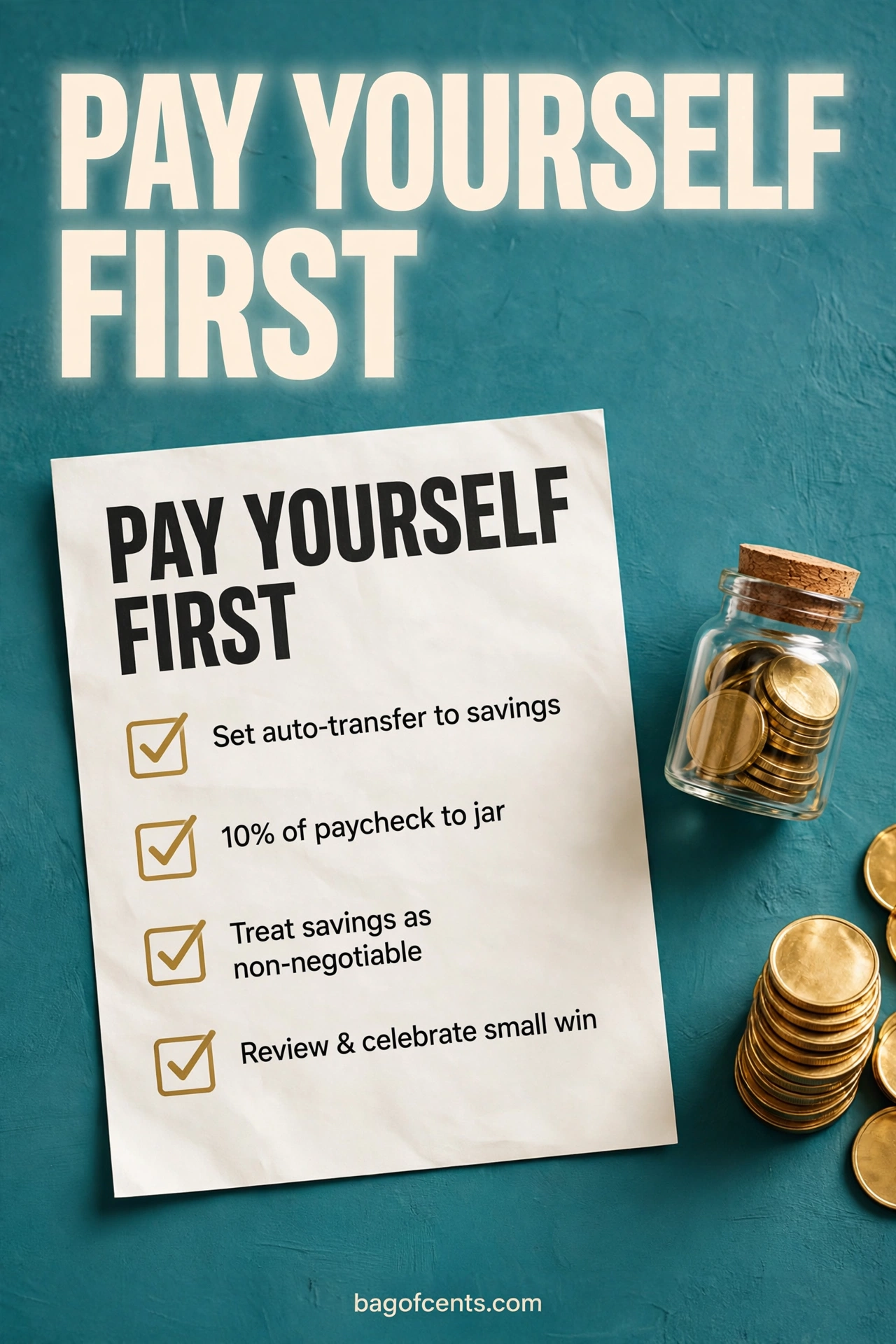
Pay yourself first is a simple rule: every time money comes in, a fixed amount (or percentage) moves straight to savings before you pay a single bill. You — your future self — get paid first, like a non-negotiable bill. Everything else in the month gets built from what remains.
It is not a spreadsheet trick or a budgeting app feature. It is a reordering of priorities. Traditional budgeting says: Income − Expenses = Savings. Pay-yourself-first says: Income − Savings = What You Can Spend. The math looks almost identical. The results are not.
Why does it work? Because it removes the decision. Research on habit formation shows that willpower is a weak planning tool but automation is nearly unbeatable. You do not need discipline to avoid spending money you never see. The money leaves your chequing account on payday morning, and your brain budgets around the smaller number without a fight.
This system quietly beats every budget category you have tried before, because it has exactly one rule to break instead of forty. You can still use the 50/30/20 split or a zero-based budget on the spending that remains — pay yourself first is the engine, those frameworks are the steering wheel.
How to Set It Up (4 Steps, About 30 Minutes)
Step 1: Pick your number — 10% is the starting line
Choose a fixed percentage or dollar amount per paycheque. Ten percent of take-home pay is the classic starting point, but the right number is one you can sustain without raiding savings by week three. If 10% feels tight, start at 5% and raise it by 1% every two months. A smaller amount you actually keep beats a heroic amount you cancel.
For someone taking home $3,200 a month, 10% is $320. That is the headline number. Everything else is logistics.
Step 2: Open a separate savings account (not at the same bank, ideally)
The money needs to land somewhere you do not see every time you check your balance. A separate online savings account — ideally at a different institution from your daily bank — adds just enough friction that dipping in requires a deliberate transfer. If it sits in the same chequing account you spend from, it is not savings. It is a wish.
Canadian readers: most online banks pay noticeably more interest than the big-bank savings account you already have. The account choice is secondary to the automation, but there is no reason to earn 0.05% when better options exist.
Step 3: Automate the transfer for payday morning
Set up an automatic transfer that fires the day your pay lands — not three days later, not “when I remember.” Morning of payday. If you are paid bi-weekly, the transfer fires 26 times a year; if you are paid twice a month, 24 times. The timing matters because the money is gone before your spending habits get a vote.
Most employers also let you split your direct deposit — some straight to savings, the rest to chequing. That is the cleanest version of pay yourself first there is: the savings never touch your spending account at all. If your payroll department offers it, take it.
Step 4: Give every saved dollar a job
A pile of “savings” with no purpose is a pile that gets spent. Split your automatic transfer across goals: the emergency fund until it is full, then a vacation fund, a down-payment fund, or an investment contribution. Even two buckets — “safety” and “goals” — is enough. Named buckets survive temptations that a generic savings balance does not.
Real Numbers: What It Looks Like on $3,200 a Month
Here is the pay-yourself-first math for a take-home pay of $3,200 per month:
- Paycheck lands: $3,200
- Automatic transfer to savings (10%): $320 moves immediately
- Left to spend: $2,880
- Bills, groceries, rent from the $2,880: $2,550
- Left over (buffer): $330
Compare that with the leftover method on the same income:
- Paycheck lands: $3,200
- Spend through the month: $3,050
- Left to save: $150 (on a good month — $0 on most)
Over one year, pay-yourself-first at 10% saves $3,840. The leftover method, being generous, saves maybe $1,200. Same income. Same person. Different order of operations.
And the compounding version: that $320 a month, invested at a 7% average annual return, is roughly $55,000 after 10 years and over $165,000 after 20 years. Starting at 5% and stepping up 1% a year lands you at 20% by year fifteen — the people who “can’t save” often find they never noticed the ramp.
5 Mistakes That Sink Pay-Yourself-First Budgets
1. Saving a round number instead of a percentage. A flat $200 a month feels fine until your income changes. Percentages scale with raises, overtime, and lean months automatically. Tie it to a percent.
2. Keeping the savings at the same bank in the same login. One tap transfers kill more budgets than any emergency. Separate institution, separate login, out of sight.
3. Starting at 20% to “catch up.” An aggressive target that collapses in month two teaches you that the system does not work — when really the target was the problem. Start boring. Ramp later.
4. Raiding savings for predictable expenses. Christmas is not an emergency. Car insurance is not an emergency. If a “surprise” happens every year, it is a line item — build a sinking fund for it instead of touching your pay-yourself-first transfer.
5. Automating but never reviewing. Set a calendar reminder every six months: can the percentage go up 1%? Did a raise arrive that should flow to savings before lifestyle? Automation runs the system; reviews grow it.
Pay Yourself First: FAQ
Is pay yourself first the same as the 50/30/20 rule?
Not quite. The 50/30/20 rule is a spending framework — 20% of income goes to savings and debt. Pay yourself first is the mechanism that makes that 20% actually happen: automate it on payday instead of hoping it survives the month. They work beautifully together.
What if my income is irregular?
Use a percentage, not a dollar amount, and set a floor. Freelancers can route 10% of every invoice payment the day it lands, plus a “good month” rule: anything above your baseline month gets split 50/50 between savings and spending. The principle survives irregular income — the transfer just follows the money in.
Should I pay off debt first instead of saving?
Do both, in order: first, automate a small emergency buffer ($1,000 is the classic starter) so surprise expenses stop landing on credit cards. Then split the automatic transfer — most to debt, some to savings. Killing high-interest debt at 19% while earning 2% in savings is bad math, but zero savings means every emergency becomes new debt.
Where should the automatic transfer go?
A separate high-interest savings account at a different institution from your daily bank. Once your emergency fund is full, redirect the automation toward investments or specific goals. The destination can evolve; the habit should not.
Final Thought
Nobody has ever regretted the money they saved automatically. They regret the months they meant to save and did not. Pay yourself first is not about deprivation — it is about deciding once, on a calm Saturday, instead of deciding thirty times a month when you are tired and the sale is on. Set the transfer, give it a job, and let your future self collect the paycheck.
Liked this? Take it further.
Grab the free 52-Week Savings Challenge Tracker — the printable that turns $1 a week into $1,378 a year, with a box for every deposit so you never lose momentum.
Join the Bagofcents weekly money tips email. Unsubscribe anytime.
Happy Budgeting!
Stanley
Keep Reading
- The 50/30/20 Budget Rule, Explained — https://bagofcents.com/50-30-20-budget-rule/
- Zero-Based Budgeting: Give Every Dollar a Job — https://bagofcents.com/zero-based-budgeting/
- The Bi-Weekly Budget: Plan Around Every Paycheque — https://bagofcents.com/bi-weekly-budget-paycheque-plan/
- Build a Budget Tracker Spreadsheet in 15 Minutes — https://bagofcents.com/build-budget-tracker-spreadsheet/
Leave a Reply