
Pull out your last credit card statement and find the little box the law requires your card issuer to print. In Canada, that box shows what happens if you only ever make the minimum payment. On a few thousand dollars of balance, it reads like a horror story: decades of payments, and thousands of dollars in interest — often more than the original debt itself.
That box exists because minimum payments are a trap by design. A typical Canadian credit card charges 20.99% or 22.99% interest, and the minimum payment is only about 3% of the balance (or $10, whichever is more). At that pace, almost everything you pay goes to interest, and the balance barely moves. Canadians who carry balances know the feeling: you pay month after month, and the number on the statement refuses to die.
But here is the part the statement box does not tell you: a focused plan can kill that same debt in under two years, for a fraction of the cost. This article lays out a simple 4-step kill plan — what it is, how to run it, what it does to a real $9,300 debt with concrete CAD math, the mistakes that stall it, and answers to the questions everyone asks. This is general information, not personal advice — but the mechanics work the same for every Canadian cardholder.
What Is the Credit Card Debt Kill Plan?
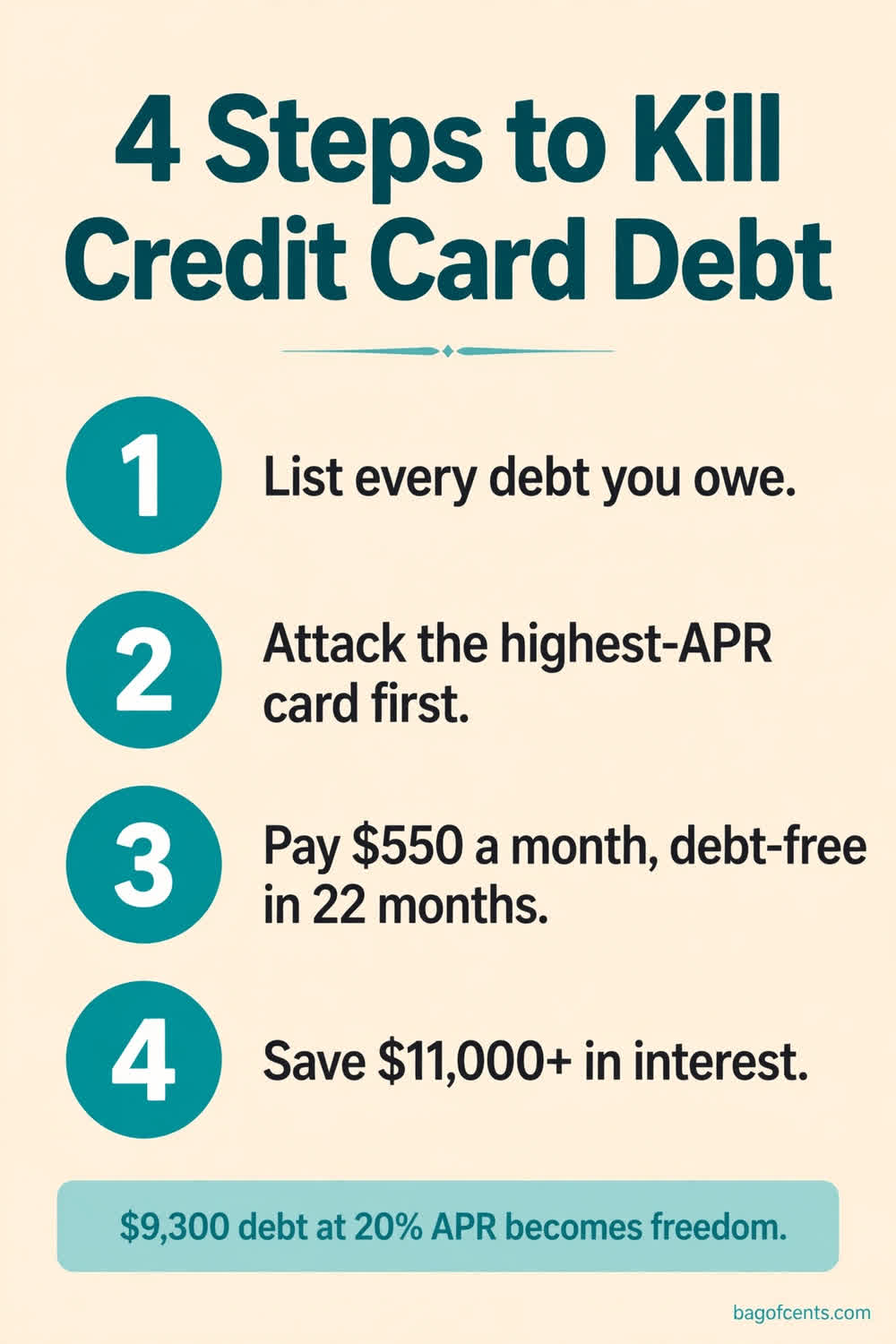
The kill plan is a focused payoff system built for one specific enemy: high-interest revolving credit card debt. It has four steps: stop the bleeding (no new charges), list and order your debts, set a fixed attack budget bigger than your minimums, and automate and roll payments forward until every balance hits zero.
It is not a new invention — it combines the best-tested ideas in debt payoff. The snowball method (smallest balance first) gives you fast early wins that keep you going; the avalanche method (highest rate first) minimizes total interest. The kill plan lets you pick the order that fits your personality, because the research is clear on one point: the plan you finish beats the plan with the best math every time.
Why does credit card debt need its own plan, separate from other debts? Three reasons. First, the interest rate: at 20%+, a credit card balance is usually the most expensive debt a Canadian household carries. Every dollar of extra payment aimed at a 22.99% balance earns you a guaranteed, risk-free 22.99% return — no investment offers that. Second, the minimum payment structure is designed to keep you in debt as long as possible. Third, unlike a loan with a fixed end date, a credit card balance has no finish line unless you create one. The kill plan creates the finish line.
One honest note before we start: this plan is for people who can cover their minimums and find at least some extra money each month, even $50. If you cannot make minimum payments at all, skip to the FAQ — there is guidance there for that situation, and talking to a nonprofit credit counsellor sooner is better than later.
The 4-Step Kill Plan
Step 1: Stop the bleeding
You cannot pay off a card you are still charging to. This is the step people resist and the step that matters most. Take the cards with balances out of your wallet — physically remove them. Delete saved card numbers from online stores and shopping apps. If you need a card for daily spending, use a debit card or a single card that you pay in full every month (and if that is not realistic right now, debit is fine).
This is not forever — just until the balances are zero. Every new charge during payoff is a small betrayal of the plan, and interest on new purchases often starts accruing immediately when you carry a balance, because you lose your grace period.
Step 2: List every balance and choose your attack order
Write down every credit card and store card balance: the amount owing, the interest rate, and the minimum payment. All of them. The card you “forgot” about is the one charging you 28.8% in the background.
Now order the list. You have two good options:
- Smallest balance first (the snowball order). Kill the smallest balance first for a fast early win, then roll that payment into the next one. Best if you have quit debt plans before or need proof this works.
- Highest rate first (the avalanche order). Attack the most expensive balance first to pay the least total interest. Best if you are disciplined and motivated by efficiency.
There is no wrong answer here. In the real-numbers example below, the two orders differ by about $165 in interest on a $9,300 debt — real money, but tiny compared with the $11,000+ either plan saves versus minimums. Pick the one you will actually finish.
Step 3: Set your attack budget
Add up all your minimum payments. That total is your floor — the amount that keeps every account current. Now find your extra: go through your spending and redirect every dollar you can toward the payoff. A subscription audit, two no-spend days a week, pausing dining out for a few months — the usual levers. Even $100 extra a month changes the timeline dramatically; $300 changes it beyond recognition.
Your attack budget is minimums + extra, and it stays fixed every month until the debt is gone. This is the commitment that makes the plan work: the same total payment, every month, no matter what. When one card hits zero, you do not shrink the payment — you roll that card’s entire payment into the next target. That is how the timeline collapses.
Step 4: Automate everything and roll payments forward
Set every minimum payment to autopay for at least the minimum amount due. One late fee — typically $25 to $40 in Canada — plus a potential penalty interest rate can undo months of progress. Automation removes willpower from the equation.
Then, each month, send your extra amount to the first card on your ordered list. When that card hits zero, take its minimum payment plus your extra and aim the whole combined amount at the next card. Watch the payment grow as cards fall: $550 becomes effectively larger against the remaining balances with every kill, because fewer minimums are splitting it up. That snowballing payment is the engine of the whole plan.
Two optional accelerators: a balance transfer and a rate call. Some Canadian cards offer promotional balance transfer rates (sometimes under 2% for 6–12 months) with a transfer fee of around 1–3%. Moving a high-rate balance to a promo rate means almost every dollar of your payment hits principal — but only if you pay it off before the promo expires and do not rack up the old card again. And it never hurts to call your issuer and ask for a lower rate; the worst they can say is no, and loyal customers sometimes get a yes.
The Real Numbers: $9,300 at Canadian Card Rates
Enough theory. Meet a realistic Canadian scenario: two credit cards, $9,300 total, at the rates Canadians actually pay.
- Card A: $6,200 balance at 22.99% APR, minimum about $186/month
- Card B: $3,100 balance at 19.99% APR, minimum about $93/month
Minimums total roughly $279 a month. Here is what three different approaches do to this debt, run through an amortization calculation:
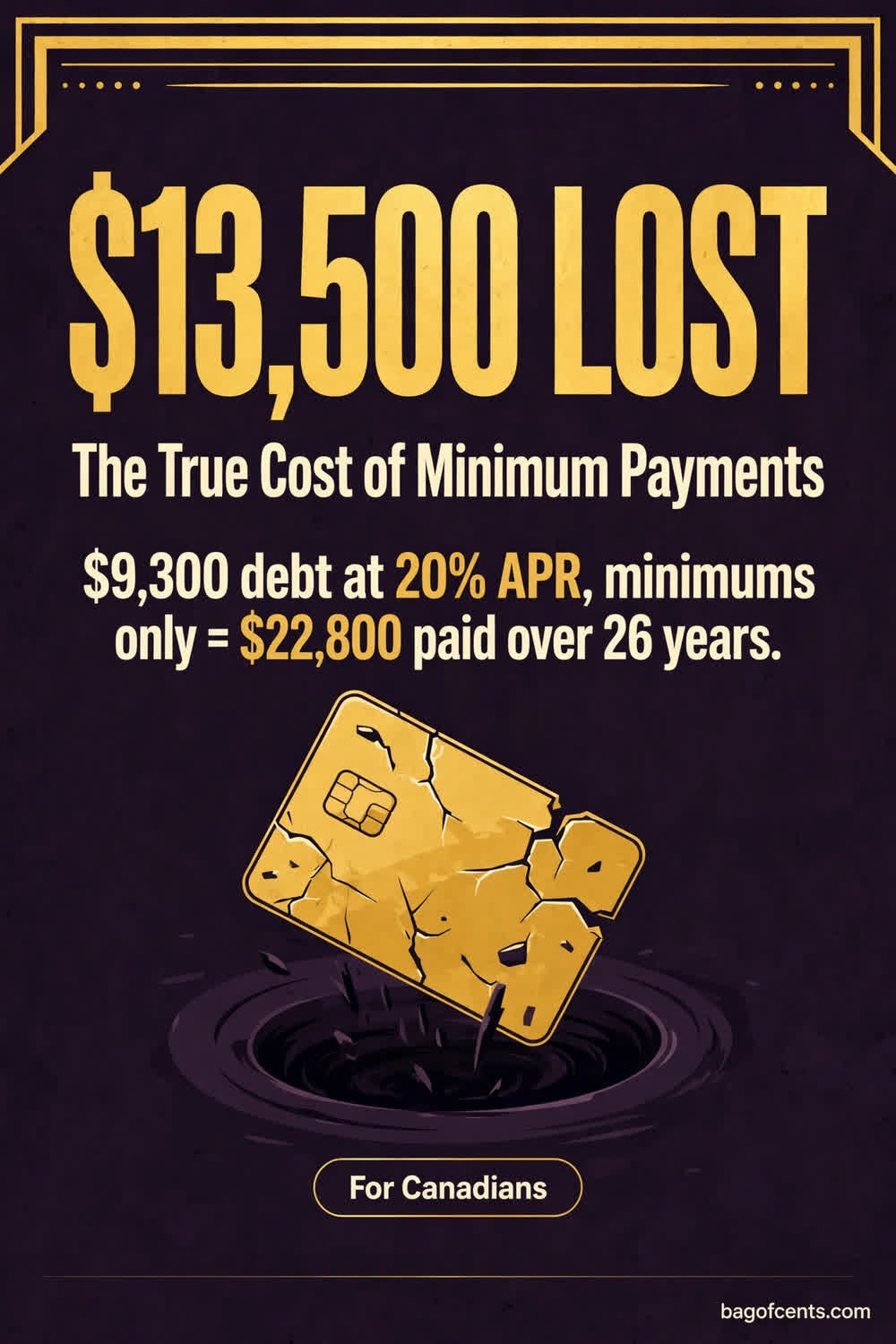
Minimums only. Paying just the minimums (about 3% of the balance each month) takes roughly 26 years and costs about $13,500 in interest — for a total paid of nearly $22,800 on $9,300 of actual purchases. That is the statement box horror story, and it is real.
The kill plan at $550/month (minimums plus about $271 extra), smallest balance first: the $3,100 card dies in month 10 — a real win less than a year in. The full debt is gone in 22 months, with about $2,070 in total interest.
The kill plan at $550/month, highest rate first: debt-free in 21 months, about $1,905 in interest. The avalanche saves roughly $165 versus the snowball here, but its first full payoff does not arrive until month 16.
Read that comparison slowly:
- Either version of the kill plan saves more than $11,000 in interest compared with minimums and finishes about 24 years sooner.
- The difference between the two orders is about $165 — meaningful, but tiny next to the $11,000+ the plan itself saves. The order matters far less than the decision to pay extra at all.
- Even a smaller attack budget works: at $400/month (just $121 over minimums), the snowball order still clears the debt in about 31 months for roughly $3,030 in interest — still saving over $10,000 versus minimums.
The math carries one blunt message: the villain was never the interest rate alone. It was the minimum payment. The moment your payment becomes a fixed, larger number aimed at one target at a time, the debt starts dying on a schedule you can see.
6 Mistakes That Stall the Kill Plan
Mistake 1: Keeping the cards in play. Paying down a card while still charging to it is bailing out a boat with a hole in the bottom. The new charges accrue interest immediately while you carry a balance (no grace period), so you are filling the boat as fast as you bail. Cards out of the wallet until zero.
Mistake 2: Skipping the mini emergency buffer. Without even $500–$1,000 parked in a separate savings account, the first car repair or vet bill goes right back on a card, and you rebuild debt as fast as you kill it. Build a small buffer before or alongside the attack — it is the plan’s insurance policy.
Mistake 3: Shortchanging the minimums to feed the target card. It is tempting to throw everything at card #1 and let the others slide. Do not. A late payment means fees, a potential penalty rate, and damage to your credit history — which matters if a mortgage renewal or car loan is in your future. Automate every minimum, then aim the extra.
Mistake 4: Shrinking the payment when a card dies. Killing a card feels like a raise. It is not. The month a balance hits zero, that card’s entire payment joins the attack on the next card. Every dollar of “freed” payment that drifts back into spending quietly doubles your timeline.
Mistake 5: Closing paid-off cards immediately. It feels satisfying, but closing your oldest card can hurt your credit score by shortening your credit history and raising your utilization ratio. Keep the oldest card open and unused, especially if a mortgage or loan application is on your horizon.
Mistake 6: Going it alone in silence. Tell someone — a partner, a friend, anyone who will ask how it is going. Debt thrives in secrecy; payoff plans thrive in daylight. Accountability is the cheapest performance enhancer in personal finance.
Credit Card Debt Kill Plan FAQs
Should I use savings to pay off the cards faster? Generally, keep your small emergency buffer intact and aim extra cash flow at the debt rather than draining long-term savings. Raiding an RRSP to pay a credit card triggers withholding tax and permanently destroys contribution room — an expensive trade. Never go to zero cash to do it.
What about a balance transfer — is it worth the fee? Often, yes, if you do the math first. A 2% fee on a $6,200 transfer is $124. If the promo rate saves you $800 in interest and you pay it off before the promo expires, you come out far ahead. The traps: missing the promo deadline (the rate snaps back to 20%+) and treating the freed-up old card as new spending room.
What if I can only afford the minimums right now? Then your first job is not choosing an attack order — it is finding extra money or reducing the interest rate. Audit subscriptions, sell unused items, pause non-essential spending for 90 days, or look into a balance transfer to slow the interest bleed. And if the minimums themselves do not fit your budget, talk to a nonprofit credit counselling agency before things spiral — in Canada, reputable nonprofit counsellors offer free consultations and can explain options like debt management programs without the sales pitch.
Will paying off my cards hurt my credit score? The opposite. Payment history and amounts owed are the two biggest factors in your score, and both improve as balances fall and payments arrive on time. Your score may dip slightly when you stop using cards (less activity), but steadily shrinking balances overwhelmingly move it up over the months of the plan.
Should I stop investing while I kill the debt? If your debt costs 20%+ and your investments might earn 7%, every extra dollar earns more killing the debt — a guaranteed 20%+ return versus a hoped-for 7%. Keep any employer retirement match (that is free money), but direct extra cash at the cards until they are gone. Then redirect the whole attack budget into savings and watch it compound in the other direction.
Final Thought
Here is the uncomfortable truth: the minimum payment is not a plan. It is a subscription to your own debt, auto-renewing every month for 26 years.
The kill plan is what happens when you do your own math instead. Four steps, one fixed payment, one target at a time. On a $9,300 debt, it is the difference between $22,800 paid over 26 years and $11,400 paid over 22 months. Same income. Same cards. Just a plan.
So tonight: pull the statements, list every balance with its rate and minimum, and take the cards out of your wallet. Pick your attack order — smallest first for momentum, highest rate first for math — and set the fixed payment. Month ten could be your first dead card. Month twenty-two could be the last payment you ever make on revolving debt. That is a trade worth making.
Liked this? Take it further.
Grab our free 52-Week Savings Challenge Tracker and save $1,378 in a year — one small deposit a week, a printable tracker that keeps you honest, and weekly money tips to keep the momentum going.
Join the Bagofcents weekly money tips email. Unsubscribe anytime.
Happy Budgeting!
Stanley
Keep Reading
- Debt Snowball vs Avalanche: Which Wins? — the full head-to-head on payoff order, with real numbers.
- The Debt Hybrid Method: One Quick Win, Then Avalanche — start with a fast victory, finish with the cheapest math.
- What the Fed’s Rate Hikes Do to YOUR Wallet — why your card’s APR keeps climbing and what to do about it.
- 10 Saving Money Hacks That Actually Work — find the extra dollars your attack budget needs.
Leave a Reply