
Open any credit card statement and look for the little box the law requires — the one that tells you what happens if you only pay the minimum. On a $21,400 balance, that box reads like a horror story: 87 monthly payments, $20,772 in interest, and $42,172 paid in total. More than seven years of payments, and nearly half of everything you hand over goes to interest, not to the debt itself.
That fine print is why payoff order matters. Two famous strategies argue about which debt to attack first: the debt snowball (smallest balance first, for fast psychological wins) and the debt avalanche (highest rate first, for the lowest total cost). A third option borrows the best of each — and for many households, it is the plan they actually finish.
It is called the debt hybrid method. Here is what it is, how it runs in four steps, and what it does to a real $21,400 debt — with the numbers to back it up.
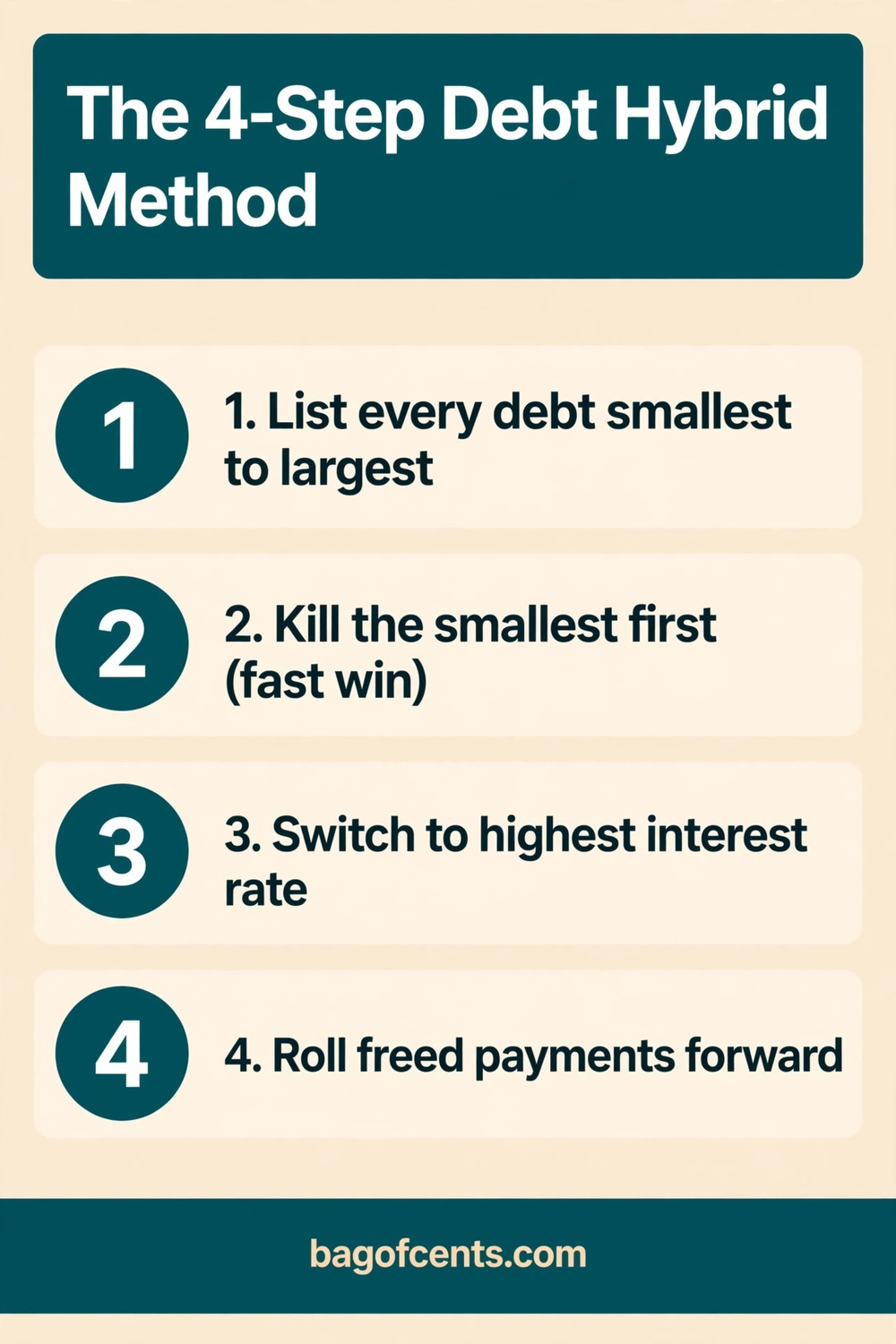
What the Debt Hybrid Method Is
The debt hybrid method is exactly what it sounds like: you start with the snowball and finish with the avalanche. You attack your smallest debt first — not because the math says so, but because killing one entire account quickly gives you proof the plan works. Then, with momentum on your side, you switch to avalanche order and aim every extra dollar at the highest interest rate until everything is gone.
Think of it as a two-phase campaign. Phase one is about behavior: one fast win, usually within six to nine months, that turns “I’m trying” into “I’m doing this.” Phase two is about math: once you believe the plan works, you stop paying for motivation and start paying the least interest possible.
The hybrid helps you decide between the two classic methods instead of agonizing over them — often a good fit if a pure plan stalled on you before, or if your smallest and highest-rate debts are different accounts.
One honest note up front: if you are purely math-driven and confident you will never quit, the pure avalanche usually costs a little less. The hybrid trades a small amount of interest for a big early win. Whether that trade is worth it depends on which person you are — and we will put exact numbers on it below.
The Debt Hybrid Method in 4 Steps
Step 1: List every debt, smallest balance to largest. Write down each balance, interest rate, and minimum payment. Credit cards, lines of credit, store cards, personal loans — all of it. This list is your map, and you cannot plan a route without one. Keep the interest rates visible too, because you will need them in step 3.
Step 2: Kill the smallest debt first — the quick win. Pay minimums on everything else, and aim every extra dollar at the smallest balance. Do not look at the rates yet. The goal of this phase is speed: one account closed as fast as possible. In the example below, the smallest card is gone in about seven months — a concrete victory you can point to when motivation dips.
Step 3: Switch to the highest interest rate — the avalanche phase. Once the smallest debt is dead, reorder the remaining debts by interest rate, highest first. Take the payment you were making on the finished debt — its minimum plus all your extra money — and roll it into the highest-rate balance. From here on, you are running a pure avalanche: the most expensive debt always gets the biggest payment.
Step 4: Roll every freed dollar forward. Each time a debt hits zero, its entire payment joins the attack on the next target. Your monthly debt payment grows like a snowball rolling downhill — the same total effort from your budget, but an ever-larger share of it landing on one target. Do not shrink the payment when a debt disappears; that is how timelines quietly double.
Two setup moves make the whole thing work better: automate every minimum payment so a forgotten bill never triggers a late fee, and park a small emergency buffer (even $500–$1,000) in a separate account so the first surprise expense does not go right back on a card.
The Real-Numbers Example
Time to see what the hybrid actually does. Picture a household with $21,400 across three credit cards, paying $535 a month in minimums — and able to find an extra $400 a month for debt, for a total attack budget of $935:
- Card A: $3,200 balance at 22.99% APR, $80 minimum
- Card B: $6,800 balance at 19.99% APR, $170 minimum
- Card C: $11,400 balance at 24.99% APR, $285 minimum
Here is how the four approaches compare, run through an amortization script:
| Payoff approach | Attack order | Time to zero | Interest paid | Total paid |
|---|---|---|---|---|
| Minimums only | — | 87 months (7.25 years) | $20,772 | $42,172 |
| Pure snowball | A → B → C | 38 months | $8,341 | $29,741 |
| Pure avalanche | C → A → B | 36 months | $7,169 | $28,569 |
| Hybrid | A → C → B | 37 months | $7,552 | $28,952 |
Read the table slowly, because the honest story lives in the gaps between the rows:
- Any plan demolishes minimums. The hybrid saves $13,220 compared with paying only minimums ($42,172 down to $28,952) and finishes more than four years sooner. The method you pick matters far less than the decision to pay extra at all.
- The hybrid costs $383 more in interest than the pure avalanche ($7,552 vs. $7,169) and takes one month longer. That $383 is the price of the quick win — and for many people it is money well spent, because it buys the momentum that keeps the plan alive.
- The smallest card dies in about seven months. With $480 a month aimed at Card A’s $3,200 balance ($80 minimum + $400 extra), the first account closes before the year is out. The pure avalanche, by contrast, asks you to grind on the $11,400 card for well over a year before a single account disappears.
- The hybrid beats the pure snowball on both time and interest — 37 months vs. 38, and $789 less interest — because switching to rate order for the big balances captures most of the avalanche’s math advantage.
So the hybrid lands almost exactly where it promises: nearly the avalanche’s efficiency, with the snowball’s early victory built in.
Why the Quick Win Matters
Personal finance is often described as 20% math and 80% behavior — and the hybrid is designed for the 80%. Behavioral research has repeatedly found that people who experience early, visible progress toward a goal are more likely to stick with it. Closing an entire account — watching a balance go from $3,200 to $0 — is a different psychological event from watching a big balance shrink by 12%. One feels like winning; the other feels like working.
This is where debt plans usually die: not in month one, when enthusiasm is high, but around month eight or ten, when the novelty is gone and the remaining balances still look enormous. The hybrid front-loads a genuine victory into those fragile early months. By the time the grind phase arrives, you have proof — your own proof, not a guru’s promise — that the system works when you work it.
Now the honest counterpoint, because it matters: if you are the type who runs on spreadsheets and has never quit a plan, the pure avalanche saves you $383 and a month. Motivation is not your bottleneck, so do not pay for motivation you do not need. The hybrid is for everyone else — the people who have started debt plans before and watched them fade, the people who need to see it working to believe it will keep working.
A useful test: look at your smallest debt. If you could kill it in under nine months with focused payments, the hybrid’s quick-win phase will likely pay for itself in persistence. If your smallest debt would still take two years, the “quick win” is not quick — consider the avalanche instead, or a balance transfer to manufacture a faster first victory.
5 Mistakes That Kill Debt Plans
Mistake 1: Never writing the full list. The plan cannot start until every debt is on paper — balance, rate, minimum. The debt you leave off the list is the one that ambushes you in month five. Spend the uncomfortable hour. Future you will thank present you.
Mistake 2: Keeping the cards in play. Paying down a card while still charging to it is bailing out a boat with a hole in the bottom. Take paid-off cards out of your wallet, delete saved card numbers from shopping sites, and do not close your oldest account (it helps your credit history) — just stop feeding it new charges.
Mistake 3: Skipping the emergency buffer. Without even $500–$1,000 parked separately, the first car repair or vet bill goes straight back onto a card, and you rebuild debt as fast as you kill it. Build the mini buffer alongside step 2, before you go all-in on the attack.
Mistake 4: Shortchanging the minimums while you focus. It is tempting to throw everything at the target debt and let the other minimums slide. Do not. One late fee or penalty interest rate can wipe out months of ordering advantage. Automate every minimum, then aim the extra.
Mistake 5: Celebrating the first win by spending. Killing the smallest debt feels amazing — and the worst response is “rewarding” yourself with new debt. Celebrate cheaply: a nice dinner, a day off, telling someone who will cheer. Then roll the full payment into the next target the very next month, without a gap.
Debt Hybrid Method FAQs
Is the hybrid method better than the avalanche? Mathematically, no — the avalanche usually costs a little less in interest ($383 less in our example). The hybrid is a behavioral compromise: it trades a small amount of interest for an early win that helps many people stay consistent. The best method is the one you finish.
When exactly do I switch from snowball to avalanche order? After the first debt is fully paid off — or after two small debts, if you have several tiny ones you can clear quickly. Do not switch early “because the math says so”; the whole point of phase one is finishing something fast. One clean kill, then switch.
What if my smallest debt is also my highest-rate debt? Then your hybrid and your avalanche are the same plan for phase one. Attack it, enjoy the double benefit (fastest payoff and cheapest interest at once), and continue in rate order afterward.
What if I can only find $100 extra a month instead of $400? The hybrid still works; everything just moves slower. The ordering logic is identical — quick win first, then highest rate — and at lower payments the minimums-only trap gets even uglier, so any extra amount matters. Even $50 a month changes the math.
Can I switch methods halfway through if I change my mind? Absolutely. These are frameworks, not contracts. Many people start as pure snowballers, gain confidence, and drift into hybrid or avalanche order naturally. The only real rule: keep the total monthly debt payment the same (or growing) until every balance is zero.
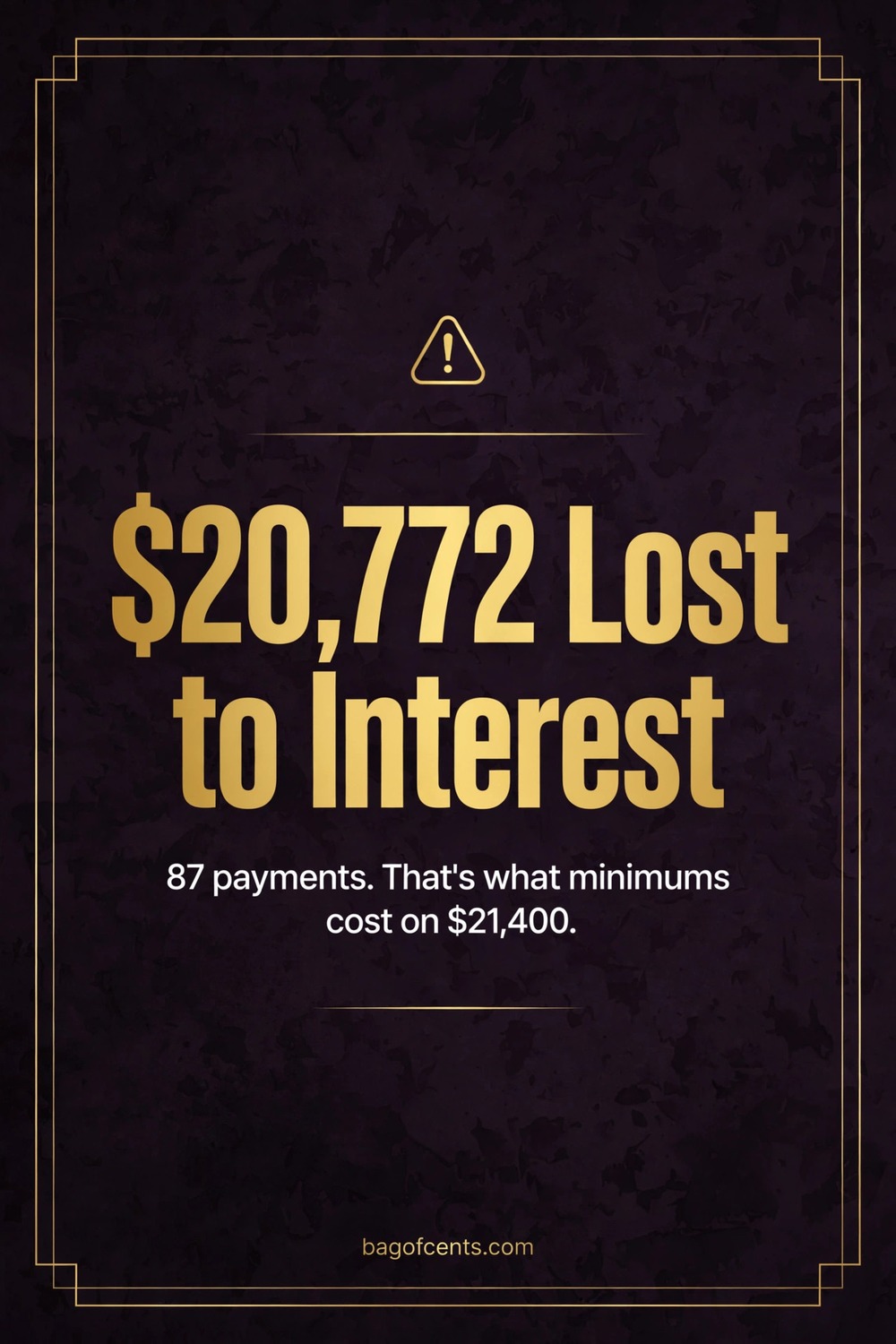
$7,552 interest versus 87 months and $20,772 paying only minimums” width=”500″ />
Final Thought
The snowball-versus-avalanche debate treats debt payoff as a math problem, when for most people it is a stamina problem. The hybrid respects both halves: a win early enough to matter, and math sharp enough to save $13,220 over minimums.
List your debts tonight — all of them, with rates and minimums. Circle the smallest one. That is your first target, your first win, and the first domino. The avalanche phase will handle the rest. Thirty-seven months from now, you could be looking at three zero balances instead of seven more years of minimums. That is a trade worth making.
Liked this? Take it further.
Grab our free 52-Week Savings Challenge Tracker and save up to $1,378 in a year — one small weekly deposit at a time, with a printable tracker to keep you on course.
Join the Bagofcents weekly money tips email. Unsubscribe anytime.
Happy Budgeting!
Stanley
Leave a Reply