
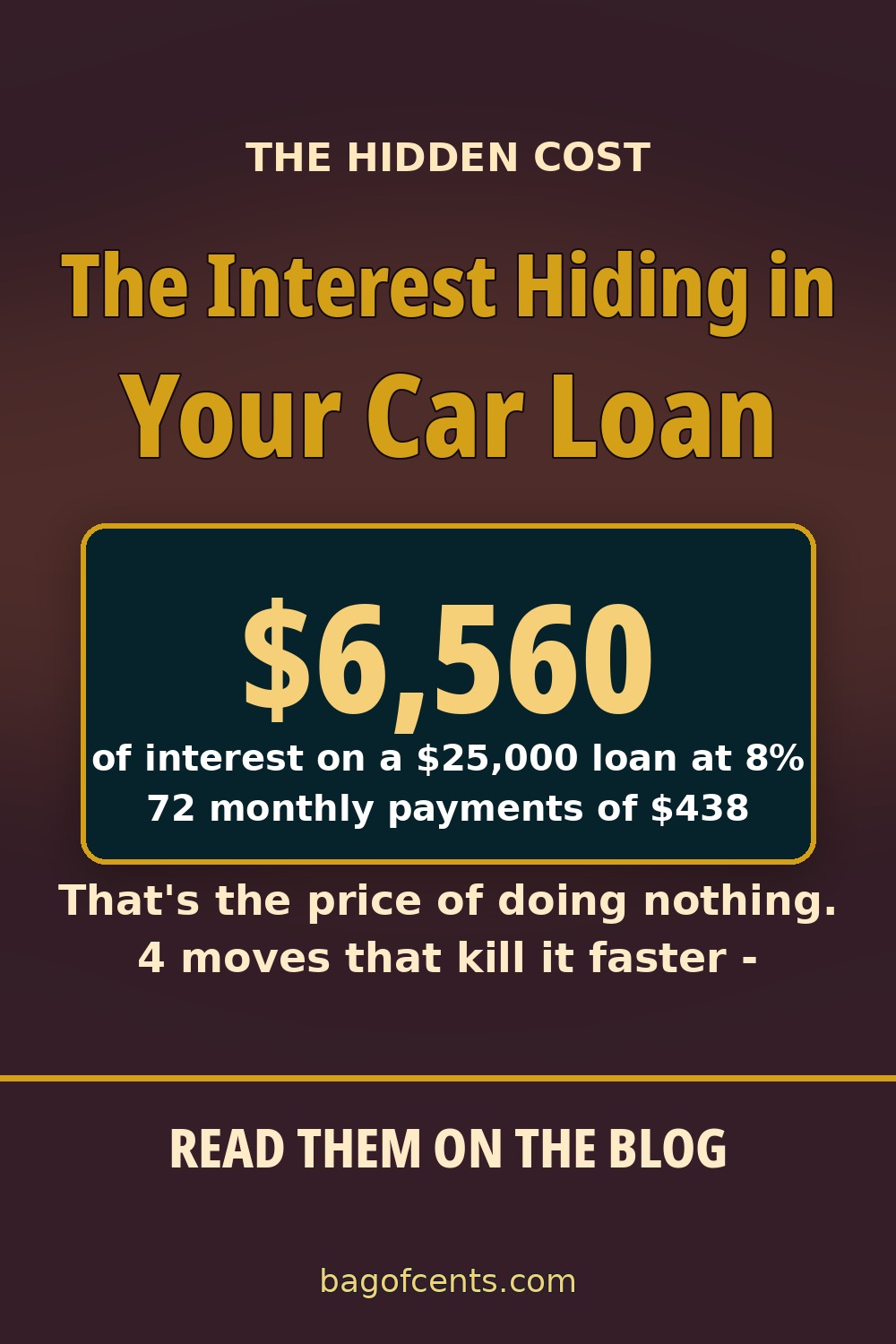
Here’s a number most car owners never sit down and calculate: on a $25,000 car loan at 7.99% interest stretched over 72 months, you’ll hand your lender $6,551.04 in interest alone. That’s on top of the $25,000 you borrowed. Total damage: $31,551.04 for a $25,000 car — and cars only lose value while you pay for them.
The payment feels manageable — $438.21 a month sliding quietly out of your account. But those 72 months are the problem: every extra month is another month of interest on a depreciating asset.
The good news is that paying off a car loan early doesn’t require a windfall or a second job. It comes down to small, repeatable moves that attack the principal — the amount you actually borrowed — faster than the minimum-payment schedule intends. Small changes compound: adding just $75 a month to that same loan shaves a full year off the term and saves over $1,200 in interest.
Below: why paying early saves so much, the four moves, a real-numbers example, the mistakes that trip people up, and answers to common questions. This is general educational information, not personalized financial advice.
Why Paying a Car Loan Early Saves Real Money
Let’s clear up a common myth first: the idea that car loan interest is “front-loaded” — that lenders charge most of the interest early on, so paying early barely helps. That describes old-style loans (the Rule of 78s), which are rare today. Most modern car loans are simple-interest amortizing loans, and the mechanics are straightforward:
Each month, your lender charges interest on your current outstanding balance, your payment covers that interest first, and the rest reduces the principal. Next month the balance is smaller, the interest charge is a little smaller, and a little more goes to principal.
Here’s why that matters: every extra dollar you pay toward principal today doesn’t just save you today’s interest — it saves you interest on that dollar in every single remaining month of the loan. Kill $1,000 of principal in month 12 of a 72-month loan and you skip paying interest on that $1,000 for 60 more months. At 7.99%, that’s roughly $400 of interest you simply never pay. Pay the same extra $1,000 in month 60 and you skip interest for just 12 months — about $80 saved. Same dollar, five times the impact.
That’s the entire logic of early payoff: extra payments are most powerful early in the loan, when the balance — and therefore the interest charge — is highest.
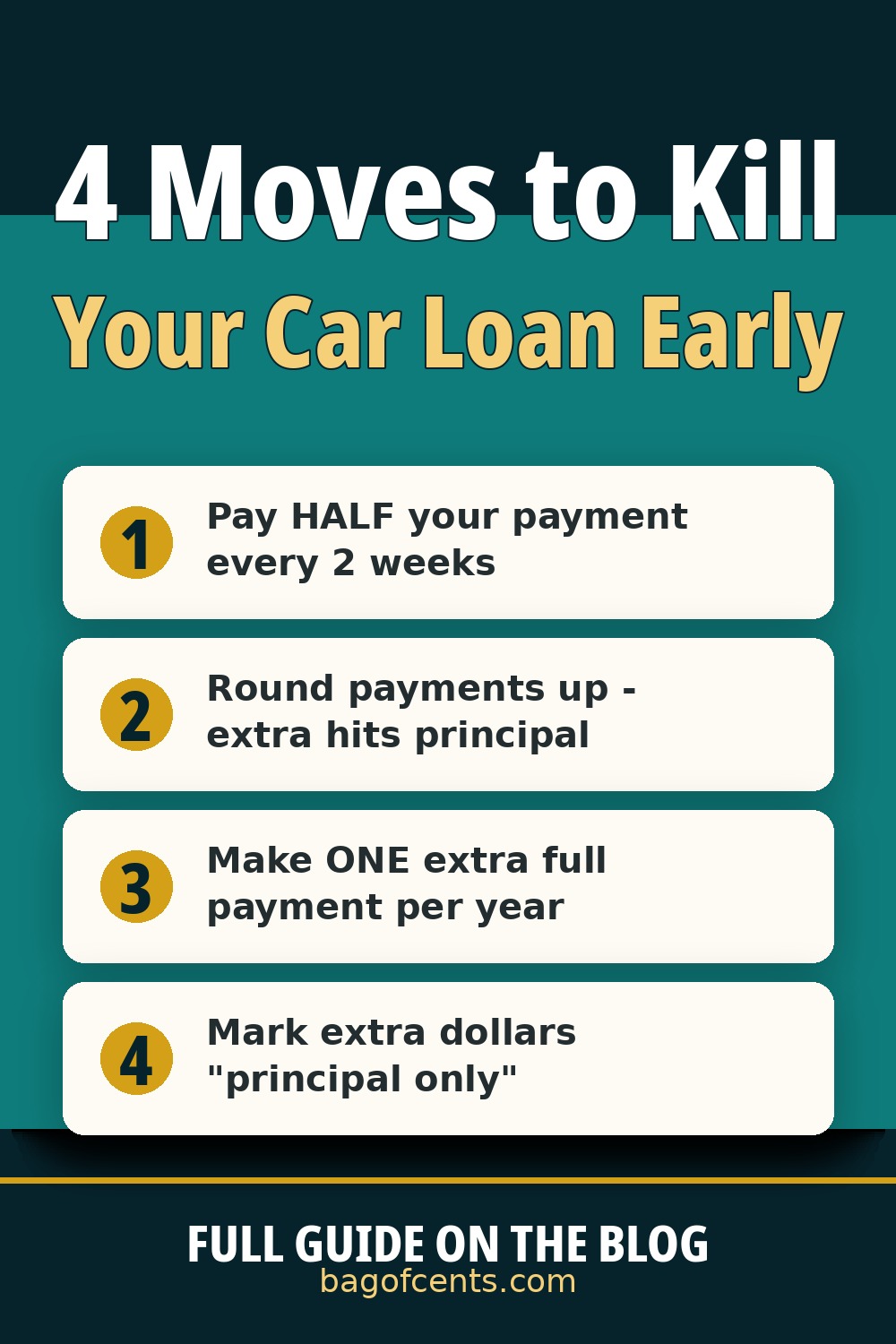
Move 1: Switch to Bi-Weekly Half-Payments
This is the oldest trick in the book because it’s nearly painless. Take your regular monthly payment, cut it in half, and pay that half every two weeks instead of paying the full amount once a month.
A year has 12 months but 26 bi-weekly periods, so paying half 26 times a year equals 13 full payments per year instead of 12. That extra payment goes against your principal, and it repeats every year without you thinking about it.
On our $25,000 / 7.99% / 72-month example: the $438.21 monthly payment becomes $219.11 every two weeks. That change alone pays the loan off in roughly 65 months instead of 72, saving about $719 in interest — no budget change required, just a different rhythm. And bi-weekly often lines up with a bi-weekly paycheque, so the money leaves when it arrives.
One important note: make the payments yourself on the right schedule if your lender won’t set it up, and make sure the extra money goes to the loan balance — more on that in the mistakes section below.
Move 2: Round Up Each Payment
Move 2 changes how much — barely. Round your required payment up to a clean number: $438.21 becomes an even $500, sending an extra $61.79 a month straight to principal.
It doesn’t feel like much. Sixty bucks a month is a couple of takeout orders. But rounding $438.21 up to $500 pays the loan off in 62 months instead of 72 and saves roughly $1,049 in interest. Ten fewer payments. Over a thousand dollars saved. From rounding up.
The psychology is what makes this move stick: a flat $500 is easier to budget than $438.21, so most people keep it going indefinitely.
Move 3: Make One Extra Lump Payment a Year (the “13th Payment” Trick)
If bi-weekly payments feel fiddly and rounding up feels slow, this move is the structured version: once a year, make one full extra payment designated entirely to principal. Tax refund season is the natural home for it.
On our example loan, making one extra $438.21 payment each year (designated to principal) finishes the loan in 66 months instead of 72 and saves about $560 in interest. On its own it’s modest — but combined with rounding up to $500, the payoff drops to 57 months with about $1,434 in interest saved: fifteen payments erased, nearly $1,500 back in your pocket.
Here’s the real-numbers summary for the $25,000 / 7.99% / 72-month loan:
| Strategy | Extra per month (avg) | Loan term | Total interest | Interest saved | Months saved |
|---|---|---|---|---|---|
| Minimum payments only | $0 | 72 months | $6,551 | $0 | 0 |
| Bi-weekly half-payments | ~$36.52 | ~65 months | $5,832 | $719 | 7 |
| Round up to $500 | $61.79 | 62 months | $5,502 | $1,049 | 10 |
| One extra payment/year | ~$36.52 | 66 months | $5,991 | $560 | 6 |
| Round up + extra payment | ~$98.31 | 57 months | $5,117 | $1,434 | 15 |
Figures are approximate, based on a $25,000 loan at 7.99% APR over 72 months with a $438.21 monthly payment. Your numbers will differ based on your rate, balance, and term.
The takeaway: combining two moves doesn’t just add their savings — it accelerates everything, because each extra dollar compounds on the previous ones.
Move 4: Do a Refinance Check — and Watch for Prepayment Penalties
The first three moves work inside your current loan. This one asks whether your current loan is still the right one — but it comes with two traps you must check first:
Trap 1: prepayment penalties. Some car loans charge a fee for paying off early or making extra payments beyond a limit. Read your loan agreement or call your lender and ask directly: “Is there any penalty for making extra principal payments or paying off the loan early?” If the penalty wipes out your savings, the math doesn’t work.
Trap 2: the term stretch. When refinancing, the monthly payment almost always drops — and that can mislead. A lender might offer a lower rate and restart the clock at 72 months, so you pay interest longer and the total cost can be higher. When you refinance, compare total interest over the remaining term, not the monthly payment. The only refinance that saves money is one that lowers your total cost, ideally at the same or a shorter term.
4 Mistakes That Undo All of This
Mistake 1: Not checking for prepayment penalties. Before you send a single extra dollar, confirm with your lender — in writing if possible — that extra principal payments are allowed without fees. Some loans cap the amount of extra payments per year. Know your rules.
Mistake 2: Extra payments that don’t go to principal. Many lenders, if you just send extra money, treat it as an advance on future payments — pre-paying next month’s bill — instead of reducing your principal today. That doesn’t cut interest the way a principal payment does, because the balance never drops. You must explicitly instruct your lender: “Apply this extra amount to the principal balance.” Then check your statements to confirm the principal actually dropped.
Mistake 3: Refinancing to a longer term to “save” money. A lower monthly payment is not the same as a lower total cost. If your refinance restarts a 72-month clock on a loan you were two years into, you’ve added years of interest. Always compare the total interest under the new loan versus the current one.
Mistake 4: Draining your emergency fund to kill the loan. Paying down a 7.99% loan feels productive — until a dead transmission with no savings sends the repair onto a 20% credit card. That’s trading cheap debt for expensive debt. Keep a reasonable emergency buffer before you accelerate loan payments.
Quick Questions, Straight Answers
Does paying off my car loan early hurt my credit score?
It can cause a small, temporary dip — and that’s normal. Closing an installment loan reduces your “credit mix” and ends that account’s payment history growth. But the effect is usually minor and short-lived if your other accounts stay in good standing. Don’t let a small fluctuation stop you from saving hundreds or thousands in interest. Your score recovers; interest paid is gone forever.
What if I’m upside down — I owe more than the car is worth?
Being “upside down” (owing more than the car’s market value) is common in the first couple of years, since cars depreciate fastest early on. Extra principal payments are one of the best fixes: they close the gap faster than the minimum schedule. Just know that a standard insurance policy pays market value, not your loan balance, if the car is written off — gap insurance exists for this. Check whether you have it.
Should I invest the extra money instead of paying down the loan?
It depends on the math and your risk tolerance. Paying down a 7.99% loan is a risk-free return of 7.99% on every extra dollar — no investment offers that combination of certainty and rate. If your loan rate is low (say 2–3%) and you’d rather invest the difference for the long term, that’s reasonable — but it carries market risk, and the loan interest is certain. The higher your loan rate, the stronger the case for paying it down first. This is general information, not advice for your situation.
What should I pay first: the car loan or credit card debt?
Almost always the credit card debt. Credit cards typically charge 19–25% interest — roughly triple a car loan rate. Every dollar aimed at the highest-rate debt first saves the most interest. Once the high-interest debt is gone, redirect that payment amount at the car loan.
How do I make sure extra payments actually reduce my principal?
Say the words to your lender: “apply to principal.” Ask what their process is for principal-only payments — some need a separate payment marked “principal only,” others let you add a note online. Then verify on your next statement that the balance dropped by the expected amount. If it didn’t, call back immediately.
Final Thought
A car loan is one of the most expensive kinds of “invisible” spending in a household budget — not because the payment is huge, but because it runs silently for years, charging you thousands for the privilege of borrowing. The four moves in this article don’t require earning more or living on less. They just redirect money you’re already spending: less to interest, more to ownership, months or years sooner.
Pull up your loan statement tonight. Find your balance, your rate, and your remaining term. Run the numbers with even the smallest move applied. Once you see how many payments disappear and how much interest evaporates, minimum payments start to feel like a choice rather than a requirement.
Liked this? Take it further.
If this article got you thinking about where your money goes, the free 52-Week Savings Challenge Tracker is a great next step — a simple week-by-week plan that builds your savings to $1,378 by year end, one small deposit at a time.
Join the Bagofcents weekly money tips email. Unsubscribe anytime.
Happy Budgeting!
Stanley
Leave a Reply