
You check your bank account on a random Tuesday. The paycheque landed, the bills went out, nothing dramatic happened — and yet the balance is lower than it should be. Not by a lot. Just… a little. Ten dollars here. Five dollars there. Sixteen ninety-five, gone, for what exactly?
That’s the thing about bank fees: they never announce themselves. Nobody holds a press conference when your account plan quietly costs you $203.40 a year. The charges are small, regular, and buried in the fine print of statements you stopped reading years ago. And because each one is tiny, your brain files them under “not worth the hassle” — which is exactly how banks want you to file them. This is general information about banking costs in Canada, not financial advice; fees vary by institution and plan, and your numbers will differ. But the mechanics are the same everywhere, and the fix takes about thirty minutes.
Here’s the uncomfortable truth: a typical Canadian on a standard Big 5 chequing plan hands over roughly $240 to $360 a year in fees they could mostly eliminate — the monthly account fee, e-transfer charges, ATM fees, the occasional NSF hit. You don’t need a raise to get that money back. You need a 30-minute audit.
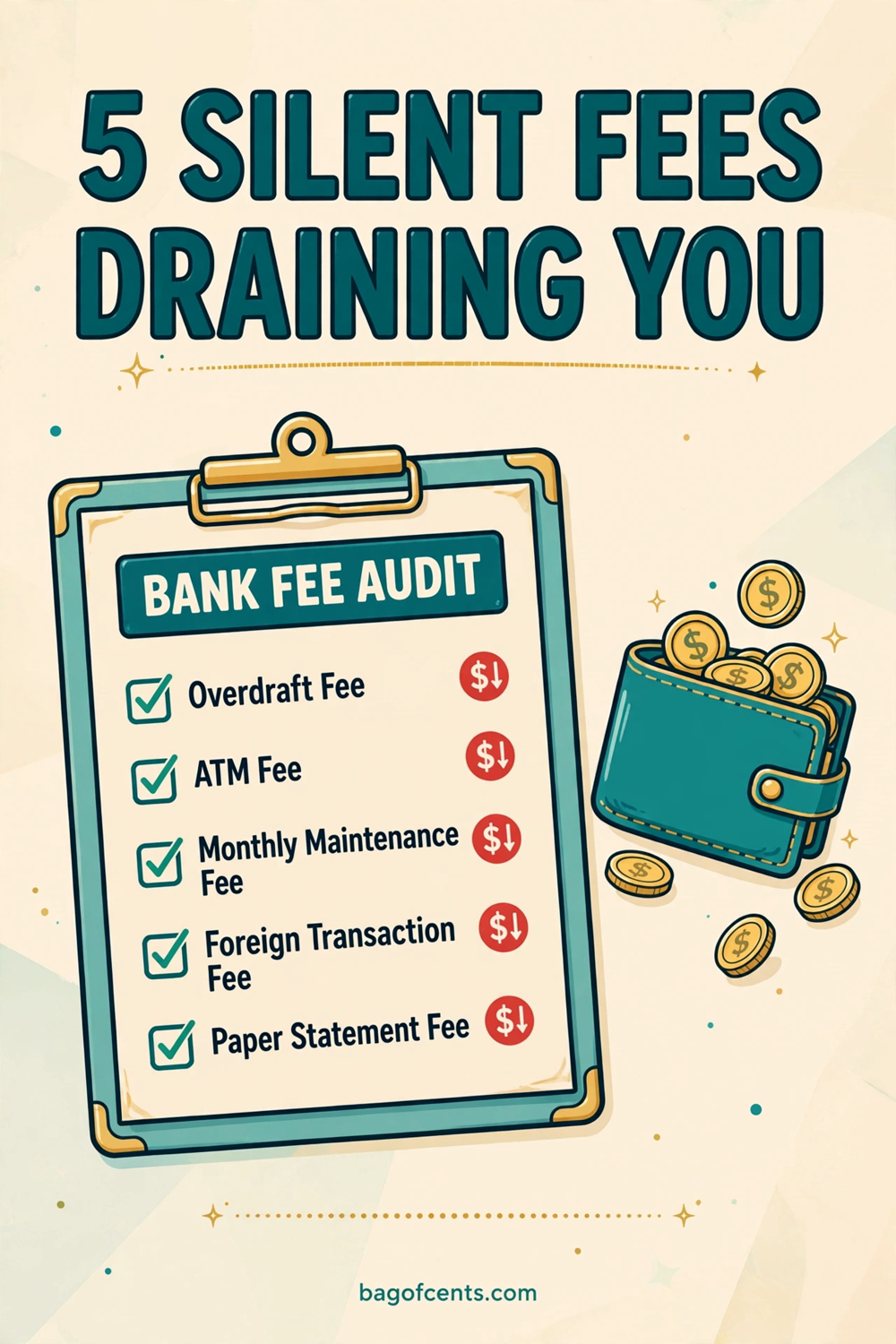
What These 5 Silent Fees Actually Are
Before you can kill a fee, you have to see it. Most Canadians can name one — the monthly account fee — and are completely blind to the other four. Let’s bring them all into the light.
1. The Monthly Account Fee (the big one)
This is the heavyweight. Unlimited chequing plans at Canada’s Big 5 banks typically run about $16.95 a month, with premium packages climbing to around $30.95. That’s $203.40 to $371.40 a year, billed every single month, for the privilege of holding your own money.
Banks will tell you the fee is waivable — and it is, if you keep a minimum balance parked in the account, often $4,000 to $5,000. Read that deal carefully: you’re locking thousands of dollars in a chequing account earning essentially nothing, just to avoid a fee. No-fee digital accounts charge nothing at all, with no minimum balance.
2. Interac e-Transfer Fees (the convenience tax)
Many modern plans include unlimited e-transfers, but plenty of Canadians are still on plans that charge about $1.00 to $1.50 per transfer. Splitting rent, paying the dog walker, sending birthday money — three transfers a month at $1.25 each is $45 a year for moving your own money around.
3. Out-of-Network ATM Fees (the double dip)
Use an ATM that isn’t your bank’s, and you can get charged twice on one withdrawal: a fee from the machine’s owner (often around $2) plus a fee from your own bank (often around $3). One $100 withdrawal can quietly cost you $5. A couple of these a month is $60 to $120 a year, paid for nothing but habit.
4. NSF and Overdraft Fees (the punishment fees)
This is the ugliest category. A bounced payment — a cheque or pre-authorized debit that hits when the money isn’t there — typically triggers an NSF fee of about $45 per item at the big banks. One mistimed car payment, one forgotten subscription renewal, and you’re out $45 plus the embarrassment. Overdraft protection is the “nicer” alternative, but it comes with about a $5 fee per occurrence plus interest around 22% on the negative balance. These fees punish the exact moment you’re most stretched — which is why they’re the most important to guard against.
5. Foreign Transaction Fees (the travel tax)
Most Canadian credit cards add 2.5% to every purchase made in a foreign currency — and that includes online shopping in US dollars, not just travel. A $2,000 trip’s worth of spending costs you an extra $50 in pure markup, silently folded into your statement. Cards without this fee exist, and if you travel or shop cross-border at all, this one fee can dwarf all the others.
Every one of these fees is small enough to ignore individually and large enough to matter collectively — and fee revenue is a business model built on exactly that.
The 30-Minute Fee-Bill Audit (4 Steps)
Here’s the audit. Thirty minutes, once, and you’ll know exactly what your bank is taking from you — and what to do about it.
Step 1: Pull Three Months of Statements (10 minutes)
Log into online banking and open your chequing statements for the last three months. Highlight any line item that isn’t your own spending: monthly plan fees, e-transfer charges, ATM fees, NSF or overdraft fees, paper statement fees — anything labelled “service charge,” “transaction fee,” or “handling fee.” Don’t skip the small ones; the $1.25 charges are the whole point.
Step 2: Categorize and Total Them (10 minutes)
List each fee category and multiply to an annual figure: the monthly fee × 12, e-transfers per month × fee × 12, ATM fees the same way. Write the annual total in big numbers — and record it in the free budget tracker, where fee savings show up as real breathing room in your monthly split. Most people discover they’re paying far more than the “$16.95, whatever” they assumed.
Step 3: Kill or Negotiate Each Fee (10 minutes)
Now work the list from biggest to smallest:
The monthly fee: This is the one worth switching banks over. No-fee chequing accounts from Canadian digital banks charge $0 a month with no minimum balance — unlimited transactions, unlimited e-transfers. If switching feels like too much, call your bank and ask what it would take to reduce the fee; banks do negotiate, especially if you mention you’re considering leaving. But run the honest math on the “keep a minimum balance” waiver: $5,000 parked to avoid a $203 fee is money earning nothing that could be working elsewhere.
E-transfer fees: If your plan charges per transfer, batch them: one $300 transfer instead of three $100 ones cuts the fee by two-thirds. Or move to a no-fee account where they’re unlimited.
ATM fees: Two fixes, both free: use only your own bank’s ATMs (the app shows locations), or get cash back at the grocery checkout — most stores offer it free with a debit purchase, and it replaces an ATM trip entirely.
NSF and overdraft: The fix here is a buffer, not a product. Keep a small cushion — even $200 to $300 — in your chequing account that you treat as zero, and turn on low-balance alerts so you get warned before a payment bounces. And if you do get hit with an NSF fee, call and ask for a reversal: first-time reversals are granted far more often than people expect.
Foreign transaction fees: If you travel or shop in USD at all, get a no-foreign-transaction-fee card for those purchases. One card swap, fee gone forever.
Step 4: Set the Guardrails (ongoing, zero effort)
Turn on balance alerts, keep the buffer, and put a calendar reminder for one year from now to repeat the audit. Banks change fee schedules; the annual re-check takes ten minutes.
A Real-Numbers Example: $354 a Year Down to $0
Meet a hypothetical Canadian we’ll call Marcus — Big 5 bank, standard unlimited chequing plan, pays his bills on time, never once thought about his fee schedule. Here’s what his 30-minute audit found:
| Fee | Marcus’s Annual Cost | After the Fix |
|---|---|---|
| Monthly account fee ($16.95) | $203.40 | $0 — no-fee chequing account |
| Interac e-Transfers (3/mo × $1.25) | $45.00 | $0 — unlimited included |
| Out-of-network ATM (1/mo, ~$5 total fees) | $60.00 | $0 — own-bank ATMs + cash back at checkout |
| NSF fee (1 bounced payment/year) | $45.00 | $0 — $300 buffer + low-balance alert |
| Total | $353.40/year | $0 |
$353.40 a year — about $29 a month — back in Marcus’s pocket, from one afternoon of admin. That’s squarely in the typical $240–$360 range, and Marcus isn’t even an unusual case: no travel, no foreign shopping, no overdraft habit.
Now run it forward. $353 a year, redirected into savings instead of fees, is $3,534 over ten years — before any interest. Nobody gets rich killing bank fees, but this is money you were already earning and simply handing over: $353 saved for 30 minutes of work is an hourly rate of over $700.
5 Mistakes That Keep the Fees Flowing
Mistake 1: “It’s only $16.95.” It’s never only $16.95 — it’s $16.95 times twelve, plus the e-transfers, plus the ATMs, plus the one NSF a year. Always multiply fees to the annual number before deciding they’re too small to care about.
Mistake 2: Parking $5,000 to dodge a $203 fee. The minimum-balance waiver sounds like a deal until you do the math: $5,000 sitting idle to avoid $203 is money earning nothing that could be growing elsewhere. You’re not avoiding the fee; you’re paying it in lost growth.
Mistake 3: Switching banks but keeping the old habits. A no-fee account doesn’t protect you from yourself. If you switch and keep using random ATMs and running a zero buffer, the punishment fees follow you. The switch kills the scheduled fees; the buffer and alerts kill the surprise ones.
Mistake 4: Ignoring the foreign transaction fee because “I don’t travel much.” Online shopping counts. Every USD purchase on a standard Canadian card costs an extra 2.5% — the streaming service billed in dollars, the US retailer, the app subscription. Check last year’s statements for USD charges; the fee hides in the exchange rate.
Mistake 5: Never reading the fee schedule. Banks update their fees, and “grandfathered” free plans quietly develop charges. The annual audit exists because fee schedules are living documents. Ten minutes a year to re-check beats discovering a new $4 monthly charge three years after it started.
Where It Fits With the Rest of Your Budget
Killing bank fees isn’t a budgeting system — it’s found money that makes every budgeting system work better. The $29 a month Marcus reclaimed is a line item that now has a real job: the start of an emergency fund, an extra debt payment, or the seed of a savings challenge. Plug it into the free budget tracker and watch your monthly split shift — seeing the number move is what turns a one-time audit into a permanent habit of questioning every recurring charge.
Questions People Ask
Are no-fee accounts actually safe? The established Canadian digital banks are real banks — deposits are eligible for the same CDIC protection (up to $100,000 per depositor per institution) as the Big 5, and they’re owned by or partnered with major financial institutions. Do your own check on any specific institution’s CDIC membership before moving money, but “no monthly fee” doesn’t mean “not a real bank.”
Can I just call and ask for fees to be waived? Yes — especially NSF fees and one-off charges, which banks reverse routinely for customers in good standing. But don’t negotiate yourself into staying for a partial win: a “we’ll waive it for six months” deal just reschedules the problem. Use negotiation for surprise fees; use switching for scheduled ones.
Will switching mess up my direct deposits and bill payments? Make a list of every automatic deposit and withdrawal (your statements show them all), set them up at the new account, run both accounts in parallel for one pay cycle to confirm everything lands, then close the old one. One careful hour, and it’s done.
Final Thought
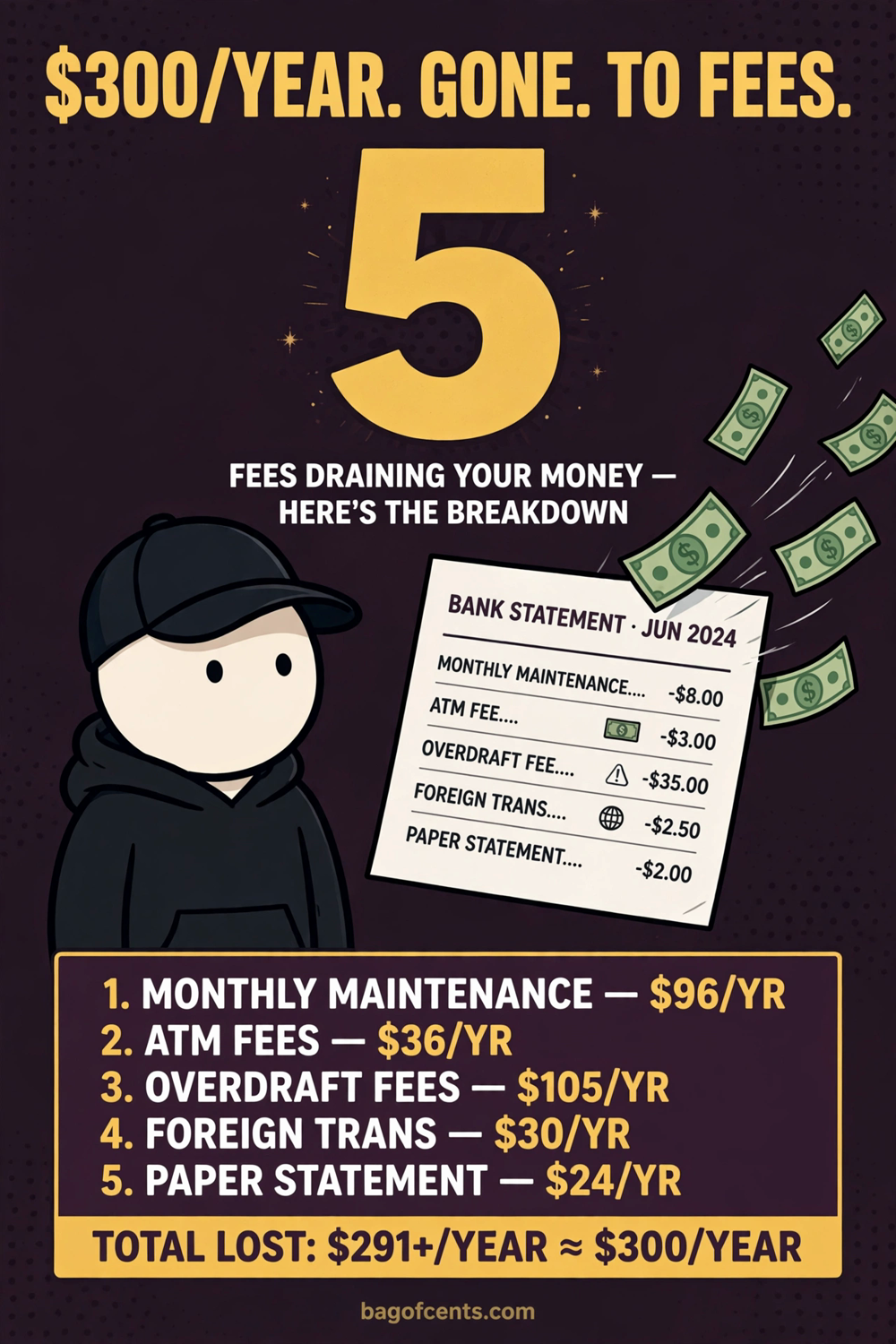
Bank fees are the only expense in your life that charges you for the privilege of being charged. Do the audit this weekend: pull the statements, total the fees, and look at the annual number with fresh eyes. Then kill them — switch the account, set the buffer, turn on the alerts — and give that $300 a year a real job. Your bank won’t miss it. You will feel it.
Liked this? Take it further. That ~$29 a month in killed fees needs a destination — otherwise it just evaporates into spending. The free 52-Week Savings Challenge Tracker gives you a week-by-week plan for the whole year: follow it all the way through and you’ll have $1,378 saved by year end. Grab it below and put your fee savings to work.
Join the Bagofcents weekly money tips email. Unsubscribe anytime.
Happy Budgeting!
Stanley
Leave a Reply