
You walk out of the grocery store with four bags and a receipt for $187. You didn’t buy anything fancy. No steak, no imported cheese — just the week’s basics, and somehow it’s nearly two hundred dollars. Again.
If that feels familiar, you’re not imagining it. A typical Canadian family of four now spends well over $1,000 a month on food, and grocery prices have been climbing faster than paycheques for years. The usual advice — clip coupons, drive across town for a sale — feels like bringing a teaspoon to a flood.
So here’s a different approach: a 30-day grocery budget reset that cuts roughly $200 a month off a $900 food budget, with zero coupons. No extreme frugality, no eating rice for a month, no three-hour Sunday meal-prep marathons. Just four weekly shifts in how you shop — each one simple, each one compounding. This is general information, not a promise: your savings will depend on your household, your stores, and how closely you follow the plan. But the math below is real, and it’s worked out for plenty of families.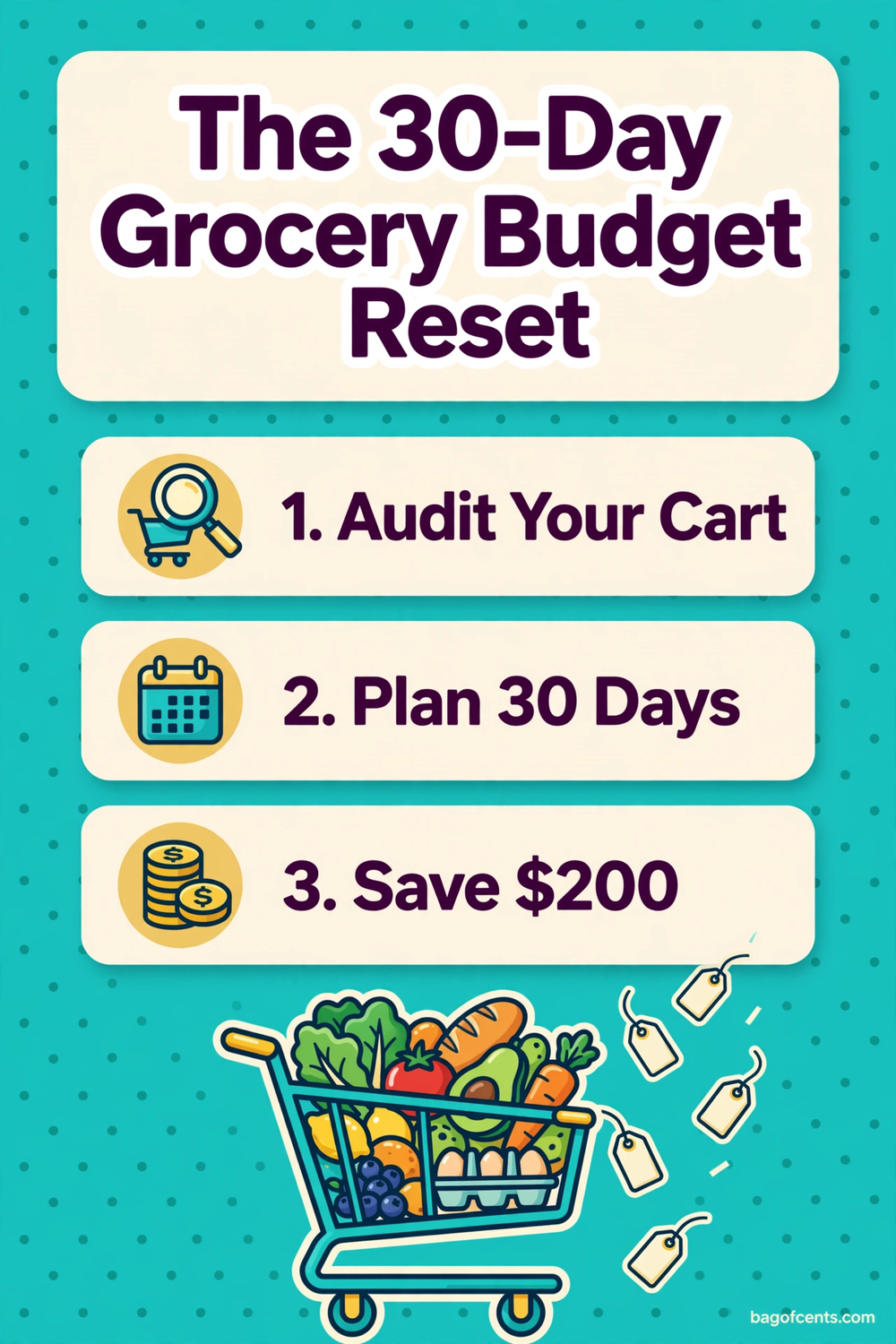
What the Grocery Budget Reset Actually Is
The reset is not a diet and not a coupon system. It’s a four-week overhaul of your grocery habits, one change per week, designed so each week’s win funds your motivation for the next. Most grocery overspending doesn’t come from what you buy — it comes from how you buy: too many trips, no plan, brand autopilot, and a pantry full of food you forgot you owned.
Think of your current grocery spending as a leaky bucket. Coupons try to add more water. The reset plugs the leaks: the forgotten pantry items you rebuy, the impulse grabs on trip number four of the week, the brand-name markup on staples that taste identical, the fresh food that quietly dies in the crisper. Fix the leaks and the bucket fills on its own.
The four weeks build on each other on purpose. Week 1 creates immediate, visible savings (nothing motivates like an extra $100 in week one). Week 2 installs the planning habit. Week 3 locks in the swaps. Week 4 turns it all into a rhythm you can run on autopilot. By day 30, you’re not “on a grocery budget” — you just shop differently now.
The 30-Day Reset: 4 Weeks to $200/Month
Week 1: The Pantry-First Week (Target: ~$120 saved)
Open your pantry, your freezer, and your fridge, and take honest inventory. Most Canadian households are sitting on one to two weeks of food they already own — the pasta bought on sale, the frozen chicken from the bulk pack, the cans pushed to the back. Week 1’s rule is simple: build every meal around what you already have, and buy only fresh essentials (milk, eggs, produce, bread).
This does two things at once. First, it slashes this week’s shop roughly in half — many families spend $60–$80 instead of $200+. Second, it forces you to actually see your inventory, which kills the most expensive grocery habit of all: buying duplicates of things you already own. Write the inventory on a notepad stuck to the fridge. Cross items off as you use them. By Sunday, you’ll know exactly what your household actually eats — data you’ll use in Week 2.
Week 2: Flyer-First Meal Planning (Target: ~$40 saved)
Here’s where the Flipp app earns its place on your phone. Every Wednesday evening (when most Canadian flyers flip over), spend 20 minutes scrolling the week’s flyers for your regular stores. Plan 5–6 dinners around what’s actually on sale — not around cravings, not around a Pinterest recipe requiring eleven ingredients you don’t own.
The method that works: pick your proteins from the flyer (chicken thighs at $1.97/lb? That’s three dinners), fill in with pantry staples you inventoried in Week 1, and add the fresh produce that’s in season and on special. Then write one list, organized by store section — produce, meat, dairy, pantry — and shop from it like it’s a contract. The list is the plan; the plan is the budget. Shoppers who plan from the flyer typically cut 15–20% off their weekly shop, because sale-priced proteins are the single biggest lever in a grocery budget.
Week 3: The Store-Brand Swap (Target: ~$50 saved)
Walk your usual shop and identify 15 staples where you buy the brand name on autopilot: canned tomatoes, pasta, rice, frozen vegetables, oats, peanut butter, cheese, yogurt, cleaning basics. Then swap every one of them to the store brand for one week — President’s Choice, No Name, Compliments, Irresistibles, whatever your store carries.
Here’s the thing the brands don’t want you to test: on staples, the store brand is often made in the same facility as the brand name, and the price gap is usually 20–40%. A family swapping 15 staples typically saves $10–$15 per weekly shop — that’s $40–$60 a month from a change you’ll stop noticing by the second week. Keep a simple rule going forward: store brand by default, brand name only when you’ve taste-tested and genuinely prefer it. Most households end up keeping 12 of the 15 swaps permanently.
Week 4: The One-Big-Shop Rhythm (Target: ~$40 saved, compounding)
Count your grocery trips last month. If the answer is more than eight, you’ve found a leak: every extra trip is an impulse-buy opportunity, and the average unplanned grab adds $10–$20 to the bill. Week 4 installs the rhythm that prevents it: one big weekly shop plus exactly one mid-week top-up for fresh items (milk, bread, produce that won’t last).
The big shop follows your flyer plan and your list. The top-up has its own mini-list — written before you leave the house — and a hard rule: in and out, no browsing the aisles. Two trips a week instead of four or five typically saves $30–$50 a month in pure impulse spending, and it saves something just as valuable: your time. This is the week the reset stops being a project and becomes just how you shop.
A Real-Numbers Example: $900/Month Down to $700
Let’s make it concrete. Meet a hypothetical Ontario family of four spending $900 a month on groceries — about $210 a week, squarely in the normal range for Canada. Here’s what the reset does to their numbers:
| Week | The Shift | Typical Saving That Week |
|---|---|---|
| Week 1 | Pantry-first: buy only fresh essentials | ~$120 |
| Week 2 | Flyer-first meal plan (Flipp) + strict list | ~$40 |
| Week 3 | Store-brand swaps on 15 staples | ~$50 |
| Week 4 | One big shop + one top-up rhythm | ~$40 |
Week 1 is deliberately the biggest win — that early $120 is what keeps a family going through weeks 2 and 3. Now here’s the monthly picture once all four habits are running together:
| Before the Reset | After the Reset | |
|---|---|---|
| Weekly grocery spend | ~$210 | ~$160 |
| Monthly total | ~$900 | ~$700 |
| Yearly total | ~$10,800 | ~$8,400 |
| Yearly savings | — | ~$2,400 |
$200 a month. $2,400 a year. Not from coupons, not from eating worse — from plugging leaks. And note what happens to that $200: sent to savings every month, it’s a vacation fund, an emergency fund top-up, or extra debt payments. The reset doesn’t just cut spending; it redirects it. One caution: these are typical figures, not a guarantee — a household that already shops carefully will save less, and one with heavy impulse habits may save more. Your Week 1 inventory will tell you which one you are.
5 Mistakes That Wreck a Grocery Budget
1. Chasing coupons instead of building a system. Coupons save cents on items you might not have bought anyway. The reset’s four habits save dollars on food you were definitely buying. Do the system first; add coupons later only if you enjoy it.
2. Shopping without a list — or worse, shopping hungry. The list is the budget in physical form. And the old advice is true: a hungry shopper’s cart costs measurably more. Eat before you go, list in hand, every time.
3. The daily top-up trap. “Just popping in for milk” five times a week means five walks past the bakery, the sale end-caps, and the new snacks. Consolidate into the one-big-shop rhythm and watch the impulse line on your receipt shrink.
4. Brand loyalty on staples. Nobody’s childhood memories are attached to canned black beans. Save the brand loyalty for the two or three items where you genuinely taste the difference, and go store brand on everything else.
5. Letting fresh food die in the fridge. Canadians throw away a staggering amount of edible food, and every wilted head of lettuce is money you already spent. The fix from Week 2’s planning: schedule the most perishable meals early in the week, and keep a “use first” shelf in the fridge for anything near its end.
Your Questions, Answered
Q: My kids are picky eaters / we have dietary restrictions. Does this still work?
Yes — the reset changes how you shop, not what your family eats. Flyer-first planning works with any cuisine or restriction; you’re just choosing this week’s proteins and produce from the sale items instead of from habit. Picky eaters actually benefit from the pantry inventory — you’ll spot the five meals they reliably eat and can plan around those.
Q: I live in a small town with basically one grocery store. What then?
You lose flyer-hopping, but the other three weeks work fully: pantry-first, store-brand swaps, and the one-big-shop rhythm don’t need competing stores. And Flipp still shows your store’s flyer — planning around its sales beats planning around nothing. Price-matching is a bonus where available, not a requirement.
Q: Doesn’t meal planning take hours every week?
The first week takes about 30 minutes because you’re learning the method. After that, it’s 15–20 minutes with the flyer app on Wednesday evening — less time than one unplanned grocery trip. The plan also kills the daily “what’s for dinner” decision fatigue, which most families find is worth it on its own.
Q: Is a Costco membership worth it for a family trying to save?
As a rule of thumb: yes if you buy only what your household will actually use before it expires, and you treat Costco as one of your planned shops — not a browsing trip. Bulk pantry staples, frozen proteins, and household basics are usually genuine wins. Bulk fresh produce for a small household is usually a loss. Track it for two months; the numbers will tell you.
Q: How do I keep this going after the 30 days?
You won’t need motivation — you’ll need the rhythm. Keep the Wednesday flyer check, the store-brand defaults, and the two-trips-a-week cap. Most families report the habits feel automatic by week six. And give yourself one planned “off” week per quarter (holidays, visits) without guilt; a system that survives real life beats a perfect streak that collapses.
 Final Thought
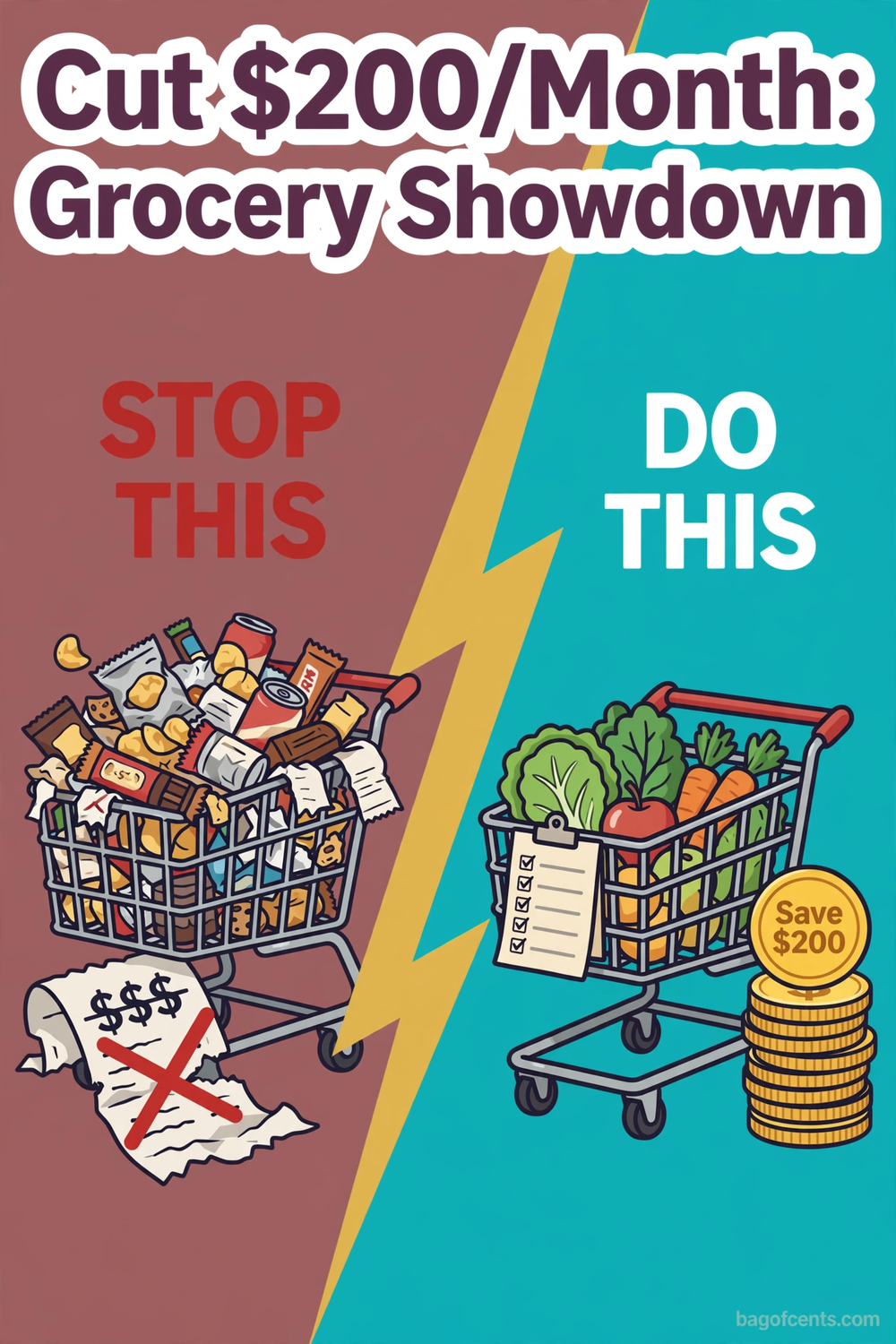
Groceries are the rare budget category where you can cut $200 a month without feeling deprived — because most of that $200 was never feeding your family in the first place. It was feeding duplicate pantry purchases, impulse end-caps, brand markups, and the crisper drawer. The 30-day reset just reroutes it: four weeks, four habits, one calmer receipt at a time. Start with Week 1 tonight — open the pantry, take the inventory, and watch how much dinner you already own.
Liked this? Take it further.
That $200 a month has to go somewhere — make it savings, automatically. The free 52-Week Savings Challenge Tracker gives you a week-by-week plan for the whole year: follow it all the way through and you’ll have $1,378 saved by year end. Grab it below and start this week.
Join the Bagofcents weekly money tips email. Unsubscribe anytime.
Happy Budgeting!
Stanley
Leave a Reply