
Your eight-year-old just asked why you cannot simply buy the thing. You tried to explain budgets, and their eyes glazed over before you finished. Most parents have lived some version of this moment, and most of us quietly worry we are getting it wrong.
Here is the reassuring truth: kids do not learn about money from lectures. They learn it from handling money, making small decisions with it, and watching what you do with yours. You need a few simple systems, repeated often, that let them practice.
Why Habits Beat Lectures
Think about how you learned about money. Probably not from a classroom lesson. More likely from watching a parent count cash at the grocery store, getting a first paycheque and being shocked by the deductions, or blowing money on something silly and regretting it for a week. Experience is the teacher, and you can give your kids that experience in small, safe doses while the stakes are still low.
A child who loses $5 on a toy they did not really want learns a lesson that costs $5. An adult who learns the same lesson with a credit card learns it at a much higher price. Let them make small mistakes now, while you are there to talk through them, so the big mistakes later are less likely.
Kids also copy what they see. If they hear you stress about money but never see you plan for it, they learn money is stressful and mysterious. If they see you check prices, wait for a sale, and talk calmly about trade-offs, they learn money is manageable. You are already teaching them every day. The systems below just make the lesson intentional.
Match the Habit to the Age
For younger kids, roughly ages 4 to 7, money is concrete: coins, bills, and a clear jar they can watch fill up. Let them pay for a small item with cash and count the change. The goal is simple: money is limited, and when it is spent, it is gone.
For middle kids, roughly ages 8 to 12, add decisions. This is the allowance and jar age, the saving-goal age, and the age where comparing prices starts to make sense. They can grasp that waiting gets them something better, and that choosing one thing means not choosing another. It is also the age they notice what other kids have, so it is the right age for honest talks about advertising.
For teens, roughly 13 and up, money gets real: part-time jobs, bank accounts, debit cards, and the costs of phones, transit, and outings. Teens can handle bigger conversations — how paycheques work, what deductions are, why credit cards are not free money. Start earlier, and the teen years become practice, not panic.
The Allowance Question
Should you pay an allowance, and should it be tied to chores? Two principles help. First, make it regular and predictable, because practice requires repetition: a random handout teaches nothing, while a steady weekly amount teaches planning. Second, keep everyday chores separate from pay — kids help around the house because they live there. Paying for extra jobs beyond the usual chores can work well, because it mirrors real life: regular responsibilities are expected, and extra work can earn extra pay.
How much? Whatever fits your budget; it does not need to be big. Many families use a guide like a dollar per year of age per week, but consistency matters more than the amount. Be clear about what the allowance must cover — snacks, small toys, apps — so the money has a job. An allowance that has to stretch to cover what they want is a lesson in itself.
The Three Jars: Spend, Save, Give
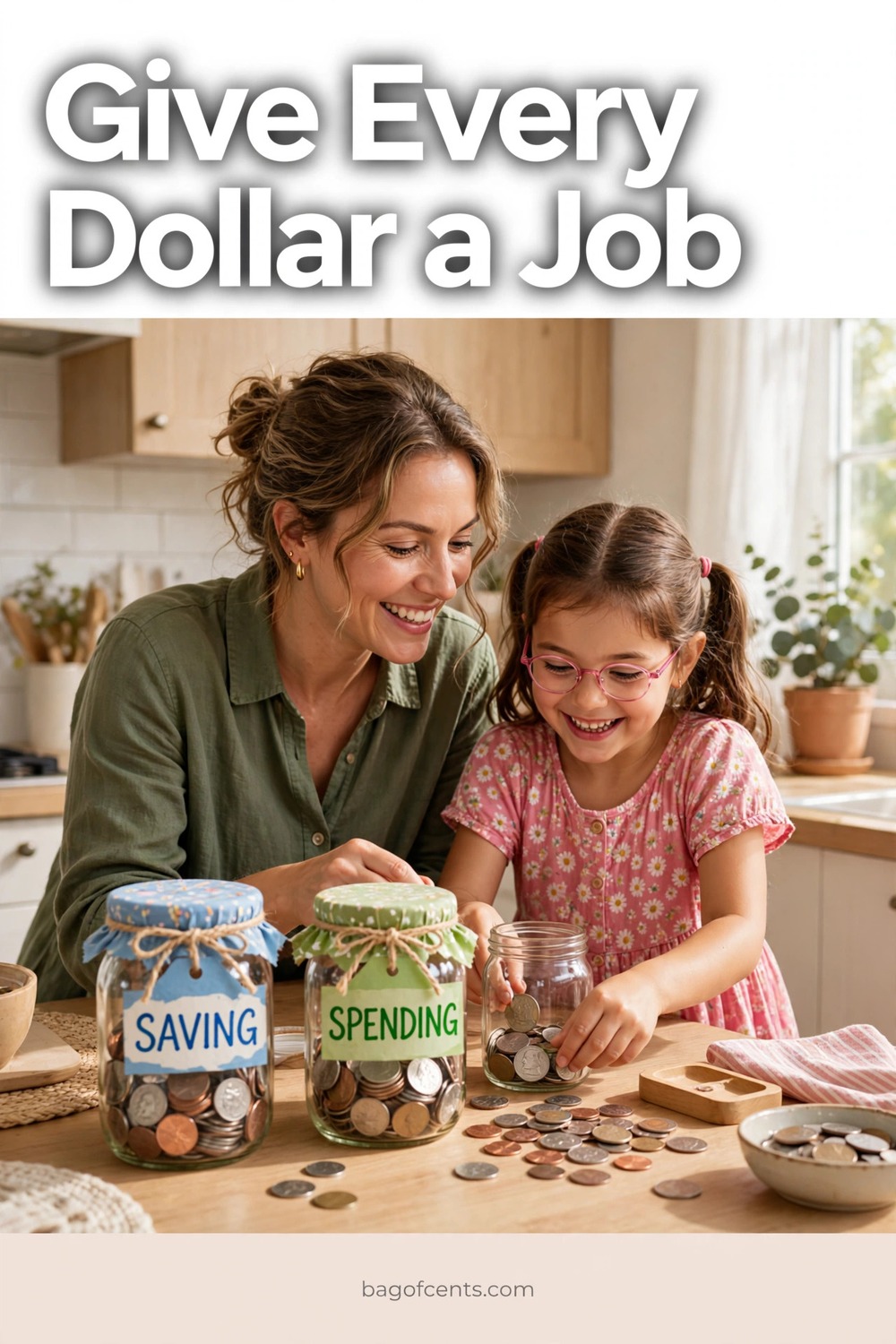
The simplest system that sticks is the three-jar system, and it works because a child can see it. Take three clear jars and label them Spend, Save, and Give. Every time money comes in — allowance, birthday cash, a small job — split it three ways. A common split is 60 percent spend, 30 percent save, and 10 percent give. The point is that saving and giving happen automatically, before spending, every single time.
The Spend jar is for fun now. Let them spend it freely, even on things you think are silly, because choosing badly with $4 is the lesson. The Save jar is for a goal they chose themselves, where the patience lesson lives. The Give jar is for someone beyond themselves — a charity, a food bank donation, a gift for a friend. Giving teaches the most underrated money habit of all: money is not only about you. As kids get older, the jars can graduate into a youth bank account. Keep the split going either way.
The Saving Goal That Teaches Patience
A saving goal turns waiting into a result a child can hold. Help your child pick one goal that is meaningful but reachable within a few months — a bike, a game, a special outing. Too easy and there is no lesson; too far away and they will give up. Six to ten weeks of steady saving is about right for a younger child.
Make progress visible: a paper chart with boxes to colour in, or a line on the jar marking the target. Visibility is what keeps a child going when the novelty wears off. When they hit the goal, celebrate it properly. Let them buy the thing with their own saved money, in person if possible. That purchase feels different from an impulse buy, because they earned the wait. That feeling is the lesson.
The First-Job Years
When your teen starts earning, help them open a bank account in their name and read their first pay stub together. That first stub is a famous shock: gross pay and net pay are different numbers, and the gap is taxes and deductions. Explain, in general terms, that Canada’s tax system takes a share before the money reaches them, and that this is normal, not a mistake.
Agree on a split for earned money before the first paycheque arrives, while everyone is calm. A common teen split is 50 percent spending, 30 percent saving toward a bigger goal, and 20 percent future costs like school or a phone. The percentages matter less than having the conversation in advance. And introduce paying themselves first: move the saving share out on payday, before spending starts, so saving is not whatever happens to be left over.
Money Talks That Do Not Backfire
Be honest at an age-appropriate level. “We cannot afford that right now” is a complete sentence, and it beats a vague “maybe later” that teaches a child to keep asking.
Never use money as a guilt trip. “Do you know how hard I work for that?” teaches shame, not skill. “That costs $40, and you have $25 saved — what would you like to do?” teaches decision-making. Talk about advertising directly, too: naming the trick — that the ad is designed to make you want it right now — is a powerful inoculation.
Finally, let them see you make trade-offs out loud. “We could eat out tonight, or we could cook and put that $50 toward our trip” is a masterclass in opportunity cost, delivered in one sentence, with no lecture attached. Your everyday choices are the curriculum. Narrate a few of them.
A Real-Numbers Example: One Kid, One Bike, One System
Meet Emma, a nine-year-old whose example is new and original to this article. Emma gets $8 a week in allowance, split $4 to Spend, $3 to Save, and $1 to Give — 50 percent spend, 37.5 percent save, and 12.5 percent give, adjusted to round numbers a nine-year-old can work with.
Emma wants a bike that costs $120. Her Save jar receives $3 every week, so the calculation is straightforward: $120 divided by $3 per week equals 40 weeks to reach the goal. That is a long time for a nine-year-old, so her parents agree on a milestone: at the halfway mark, $60 saved, Emma can pick a small accessory for her current bike, like a bell.
Over a full year at a steady allowance, her Save jar receives $3 multiplied by 52 weeks, which equals $156. Her Give jar receives $1 multiplied by 52 weeks, which equals $52 given away. Her Spend jar receives $4 multiplied by 52 weeks, which equals $208 of her own choices, including one regret purchase: a $12 toy she stopped playing with in a day.
Here is the part that matters most. After buying the $120 bike, Emma still had $36 left in the Save jar — $156 minus $120 equals $36 — which became seed money for her next goal, a helmet and lock set. She did not just get a bike. She got the experience of a plan working, a leftover balance proving that saving ahead leaves something behind, and a story she tells herself about money: I can wait, I can reach it, and I can start the next one from ahead instead of from zero.
Common Mistakes to Avoid
Mistake 1: Lecturing instead of letting them practice. If your child has never handled money, no explanation substitutes for it. Start the jars and the allowance, and let the small mistakes happen while they are cheap.
Mistake 2: Rescuing every regret purchase. Topping up a spent jar teaches that consequences are optional. Empathy plus a restart teaches far more than a bailout.
Mistake 3: Tying all money to chores or grades. When every dollar is a reward for behaviour, money becomes a control tool instead of a life skill. Keep family contributions expected and unpaid.
Mistake 4: Keeping money a total secret. Kids who never hear a calm money conversation grow into adults who avoid money conversations. Narrate trade-offs and answer questions honestly.
Mistake 5: Starting too late. Waiting until a teen asks for a credit card means the first practice happens at full stakes. Start with coins and jars early, so the teen years are a graduation, not a first lesson.
Frequently Asked Questions
What age should I start teaching my kids about money?
As soon as they start asking for things, usually around age four or five. Start concrete — coins, a clear jar, paying at a store — and add complexity as they grow.
Should allowance be tied to chores?
Most families do best keeping everyday chores separate from pay, since contributing to the household is a shared responsibility. Paying for extra jobs beyond the usual chores can work well. Be consistent, because the learning comes from repetition.
How much allowance should I give?
Whatever fits your family budget, given regularly. A common guide is about a dollar per year of age per week, but consistency matters more than the amount. Be clear about what the allowance is expected to pay for.

Final Thought
You do not need to be perfect with money to teach your kids well. You need to be visible about it: the jars on the counter, the goal chart on the wall, the trade-off said out loud. Start with one habit this week — the three jars, a steady allowance, a single saving goal — and repeat it until it is boring. Boring is the point. The habits that stick are the small ones, done so often that your child carries them into adulthood without remembering when they learned them. That is the gift, and it starts with $3 in a jar.
Get the Free 52-Week Savings Challenge Tracker
The same habit that works for kids works for grown-ups: small, steady, automatic. The free 52-Week Savings Challenge Tracker is a simple week-by-week plan for the whole year — follow it all the way through and you will have $1,378 saved by year end. Grab it below and start this week.
No spam — just the tracker and occasional money tips. Unsubscribe anytime.
Happy Budgeting!
Stanley
Leave a Reply