
Intro
Your neighbour just got a new truck. Your cousin posted kitchen renovation photos. A coworker is taking the family to an all-inclusive in February, and someone from high school — someone you barely liked — just bought a house with a pool.
And suddenly your perfectly fine life feels… behind.
That feeling has a name: the comparison trap. It’s the quiet, constant pressure to match the spending of people whose finances you know nothing about. And it is one of the most expensive psychological forces in personal finance — not because it makes one big purchase, but because it nudges hundreds of small ones, month after month, year after year.
The cruel irony? The people you’re comparing yourself to are often comparing themselves to someone else. Nobody wins. The only guaranteed outcome is that everyone spends more.
This article breaks down how the comparison trap actually works, what it costs in real numbers, and the practical filter that stops it from running your budget.
What the Comparison Trap Really Is
Psychologists call it social comparison theory: humans constantly evaluate themselves against others. It’s wired in — it helped our ancestors figure out their place in the group. The problem is that the “group” used to be 50 neighbours. Now it’s 500 Instagram accounts, and every single one of them posts the highlight reel.
Here’s what makes the modern version so expensive:
You compare your behind-the-scenes to their highlight reel. You see the truck, not the 84-month loan. The renovation, not the line of credit. The vacation, not the credit card statement that arrives in March.
The reference group keeps moving. Finish one upgrade and the bar moves. New phone? Now everyone has the newer one. New car? The neighbour got the electric one. There is no finish line because the game isn’t about arriving — it’s about never feeling behind.
Spending becomes identity. “I’m the kind of person who…” is the most expensive sentence in personal finance. The kind of person who drives something respectable. Who hosts properly. Whose kids have the right gear. Each identity has a monthly price tag, and the trap makes you pay it without ever deciding to.
The comparison trap doesn’t feel like a money problem. It feels like a life problem — like you’re falling behind. That’s exactly why it’s so hard to budget against.
Where the Trap Takes Your Money
It rarely announces itself. It shows up in five quiet channels:
1. The car. The average new vehicle payment has crept toward $800 a month in Canada. But the trap isn’t the payment — it’s the upgrade cycle. Your 6-year-old car runs fine, but the parking lot at work is full of new SUVs, so “fine” starts feeling embarrassing. That embarrassment costs about $400 a month in extra payment, insurance, and depreciation.
2. The home. Renovations are the comparison trap’s masterpiece. Nobody renovates a kitchen because the old one stopped cooking food. They renovate because the kitchen on the screen looks better than theirs. A $30,000 renovation financed at 7% costs roughly $450 a month for seven years — for a room that worked fine.
3. The kids. Other families’ kids have the travel teams, the lessons, the brand-name everything. Saying no feels like shortchanging your children. But kids don’t rank their childhood by activity fees. They remember whether you were there.
4. The vacations. The all-inclusive in February isn’t about rest — it’s about the photos. A $6,000 trip financed on a credit card at 20% doesn’t cost $6,000. Carried for a year, it costs closer to $7,000. The memories are real. The interest is too.
5. The everyday flex. The $7 coffees, the lunch out because the team goes, the clothes that look right for the office. Small, frequent, and almost entirely driven by who’s watching.
None of these are evil. All of them are fine in a budget that chose them deliberately. The trap is when they happen by default — because everyone else is doing it.
Real Numbers: The Cost of Keeping Up
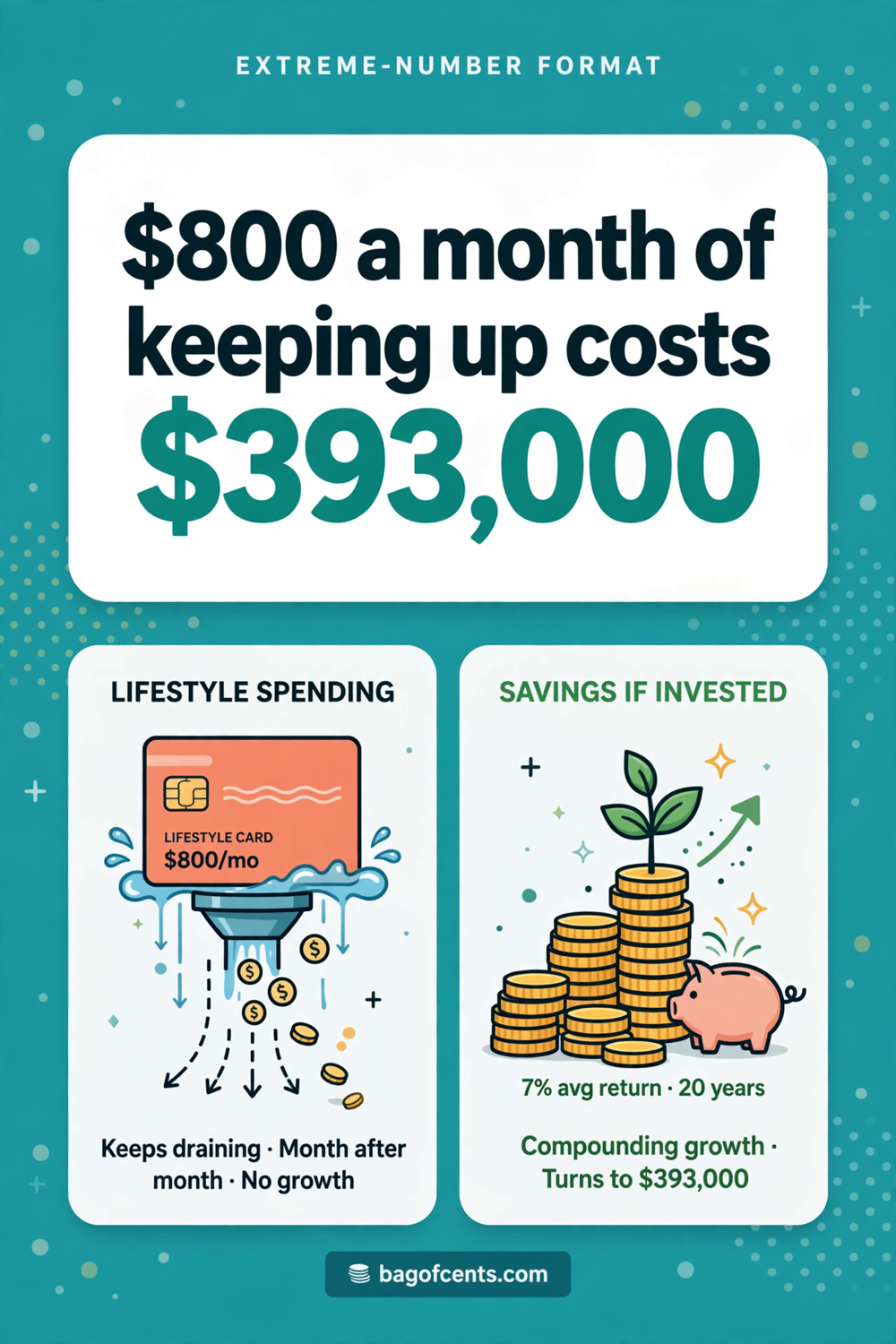
Let’s put a number on “just keeping up.” Imagine two households with identical $90,000 incomes:
- Household A spends an extra $800 a month on comparison-driven upgrades: the nicer car payment, the renovated kitchen financed, the bigger vacation, the everyday flex.
- Household B invests that $800 a month instead, earning a long-run average return.
After 10 years, Household A has… newer stuff, mostly depreciated. Household B has roughly $138,000.
After 20 years, the gap is roughly $393,000.
Those are illustrative numbers, not promises — markets move around. But the direction is the point: the comparison trap doesn’t just cost you money today. It costs you the compounding of that money for decades. Every $800 month of keeping up is a month your future self doesn’t get.
Here’s the question that reframes everything: in 20 years, will you remember the truck? Or will you feel the $393,000?
The 3-Question Filter
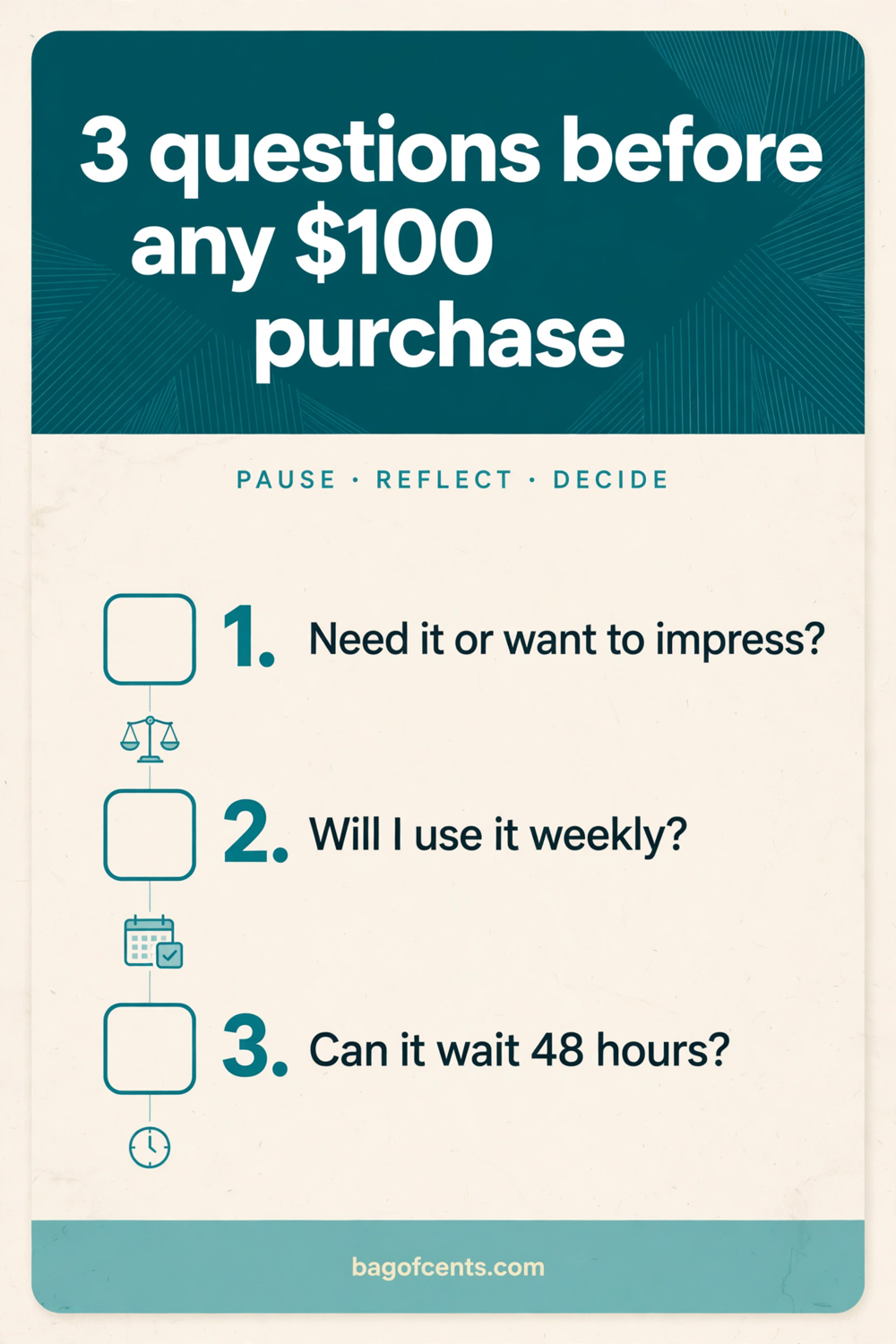
You can’t turn off social comparison. It’s wiring. But you can put a filter between the feeling and the spending. Before any non-essential purchase over $100, ask:
1. “Would I want this if nobody would ever see it?”
This is the killer question. The truck, the renovation, the vacation photos — strip away the audience. If the desire evaporates, it was never about the thing. It was about the signal. Don’t pay signal prices for things you don’t want.
2. “What am I actually feeling right now?”
Comparison spending is emotional spending wearing a disguise. Are you tired? Bored? Embarrassed? Anxious about your age, your status, your choices? Name the feeling. Half the time, naming it is enough — the urge to spend was just the feeling looking for an exit.
3. “What does this cost my ‘enough’ number?”
Pick your enough number — the monthly amount that funds the life you actually want. Every comparison purchase either fits inside it or steals from it. When you can see the trade — this kitchen reno is four months of my freedom fund — the decision gets honest fast.
Three questions. Thirty seconds. It won’t stop every impulse, but it stops the expensive ones — the ones that used to happen on autopilot.
Rewiring the Inputs
The filter handles individual purchases. These three habits shrink the trap itself:
Curate the feed. You don’t need willpower against 500 highlight reels a day — you need fewer highlight reels. Mute, unfollow, or limit the accounts that make your life feel small. This isn’t weakness. It’s environment design. Nobody tries to diet inside a bakery.
Find your reference group deliberately. Comparison is inevitable, so choose who you compare yourself to. Follow people who talk about net worth, not new cars. Join communities where the flex is a paid-off mortgage or a maxed TFSA. The trap runs on whatever group you give it.
Do the annual “enough” audit. Once a year, write down what your good life actually costs — housing, food, the things you genuinely enjoy, a margin for surprises. That’s your enough number. Everything the trap offers gets measured against it. Most years, you’ll find your enough number is smaller than your spending. That gap is the trap, quantified.
Common Mistakes
1. Comparing income instead of wealth. The neighbour with the truck might earn $140,000 and save nothing. Income is what you see. Wealth is what’s left. Never confuse the two.
2. Assuming it’s affordable for them. “They must be doing well” is a story you invented. You don’t know their debt, their down payment help, or their stress level at 2 AM. Affordability is invisible from the outside — in both directions.
3. Treating frugality as deprivation. The trap’s final trick is making a good financial life feel like missing out. Flip it: every dollar you don’t spend keeping up is a dollar buying your freedom. That’s not deprivation. That’s the trade of the century.
4. Trying to win. There is no winning the comparison game. Someone will always have more — a bigger house, a better vacation, a quieter kind of rich you can’t even see. The only move is not to play.
FAQ
Is all comparison bad?
No. Comparing yourself to people who are good with money — savers, investors, the debt-free — is genuinely motivating. The trap is specifically about comparing spending. Compare habits, not purchases.
What if my partner is the one feeling the pressure?
Don’t lecture — that just adds shame to the mix. Share the numbers instead. “Here’s what the kitchen reno costs us per month for seven years” is a conversation. “We can’t afford it” is an argument. Talk about the enough number together.
How do I handle the social pressure directly — friends who spend big?
You don’t need a speech. “Not our thing right now” covers almost everything. True friends don’t audit your spending. And the ones who do were never the audience worth paying for.
Does this mean never buying nice things?
Of course not. Buy the nice thing when you genuinely want the thing — not the signal. A deliberate luxury inside your enough number is one of life’s great pleasures. An accidental luxury bought for an audience is one of its great regrets.
What about kids and peer pressure at school?
Kids feel it hardest. The honest conversation — “other families make different choices with their money, and here’s what our family is choosing instead” — teaches more financial literacy than any lecture. And “instead” matters: show them what the family gains, not just what it skips.
Final Thought
Here’s the truth the comparison trap hides: the people you’re trying to keep up with are, in many cases, one emergency away from trouble. The truck has a payment. The renovation has a loan. The vacation has a balance. You’re comparing your insides to their outsides, and the outsides are often rented.
Your enough number is the way out. Not a smaller life — a chosen one. Every dollar you stop spending on the audience is a dollar that starts working for you, compounding quietly, building the kind of wealth nobody can see in a photo.
And that, in the end, is the real flex: a life you don’t need to photograph to enjoy.
Liked this? Take it further.
If comparison spending has been quietly raising your budget, the free 52-Week Savings Challenge Tracker gives you one small weekly target that rebuilds your savings to $1,378 by year end — one checked box at a time.
Join the Bagofcents weekly money tips email. Unsubscribe anytime.
Happy Budgeting!
Stanley
Leave a Reply