
It’s 9:47 PM on a Tuesday. One of you is staring at a bank notification: $86.40 at a store neither of you discussed. The other one is bracing, because they know what’s coming. Not a conversation — an ambush. Voices rise. Old purchases get excavated like evidence. Somebody says “you always” and somebody else says “you never.” And the $86.40 is long forgotten by the time it ends.
If that scene feels familiar, here’s the reframe that changes everything: couples almost never fight about money. They fight about money surprises. The spending itself is rarely the problem — it’s the discovering, the not-knowing, the feeling of being out of the loop in your own financial life. And the arguments that do the most damage share one feature: they happen at random, triggered by a bill, a balance, or a box on the doorstep.

The weekly money date fixes the randomness. It’s a 20-minute meeting, same time every week, with a simple agenda and a few ground rules — and it replaces a dozen ambush fights a year with one calm conversation a week. This is general relationship and money-organization information, not financial or therapy advice. The format is simple enough to start this weekend, and couples who run it usually report the same thing within a month: the fighting didn’t get resolved. It just… stopped happening.
Why Couples Really Fight About Money
Before the format, it helps to know what you’re actually solving. Most money fights are driven by three things, and none of them is the dollar amount.
First: surprises. A partner who discovers spending after the fact doesn’t feel like a teammate — they feel like a bystander in their own budget. The emotional charge isn’t “you spent $86,” it’s “you spent $86 and I didn’t know.” The money date eliminates surprises by design: everything gets said out loud, once a week, before it becomes a discovery.
Second: different money scripts. Almost every couple is secretly a saver married to a spender — scripts usually inherited from childhood. One of you watched money cause stress and learned to grip it tightly; the other learned money is for enjoying now. Neither script is wrong. But without a regular forum, they collide as character judgments instead of preferences.
Third: control disguised as concern. When one partner earns more or manages the accounts, money conversations can quietly become permission-seeking. “Can I buy this?” is a question no adult should have to ask their partner. The money date fixes the power imbalance with structure: equal airtime, one decision each, and a personal spending allowance that requires zero justification.
Notice what all three have in common: they’re information and process problems, not money problems. Which is exactly why a process — a short, regular, structured conversation — solves them.
The 20-Minute Money Date Format
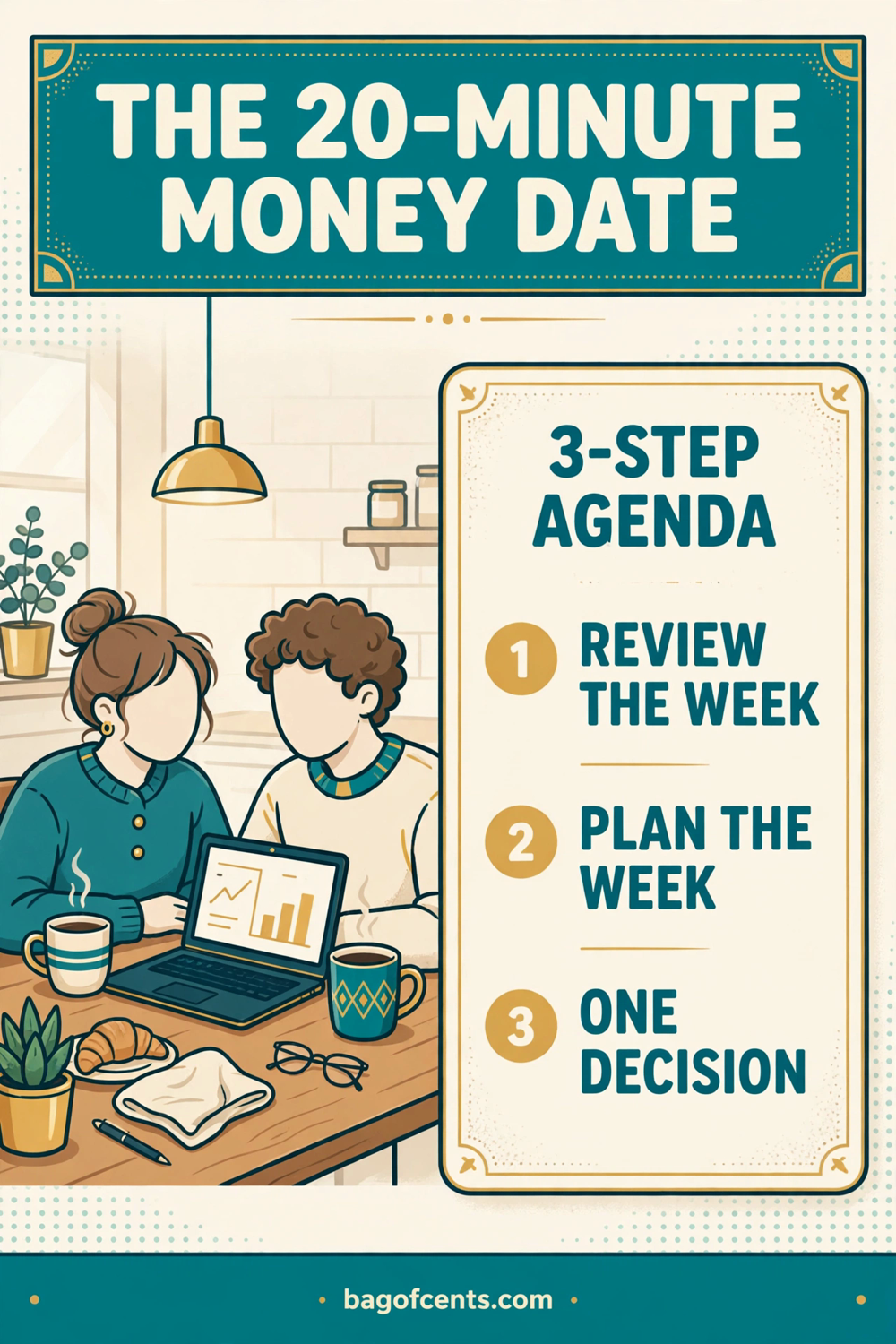
The format is deliberately small. Twenty minutes, once a week, same day and time. Phones face-down. A timer on the table, because the time limit is what keeps it from becoming a summit. Here’s the agenda, in three blocks.
Block 1: Wins and Review (5 minutes)
Start with what’s working: “We stayed under on groceries.” “The emergency fund hit $2,000.” This isn’t fluff; it’s the reason the meeting doesn’t feel like a performance review. Then a quick glance at the week’s spending together — shared awareness, not an audit. If something looks off, note it for Block 3.
Block 2: The Week Ahead (10 minutes)
This is the planning heart of the meeting. Walk through the next seven days: what bills are due, what irregular expenses are coming, what social plans cost money. The car insurance payment lands Thursday. Your sister’s birthday dinner is Saturday. Couples are routinely blindsided not by big expenses but by medium ones they both knew about and neither said out loud. Saying them out loud is the whole trick. This block is also where you catch the slow leaks together: the duplicate subscriptions, the delivery habit, the bank fee nobody owned.
Block 3: One Decision (5 minutes)
Exactly one money decision per meeting. Not three — one. “Do we put the tax refund toward the credit card or the emergency fund?” One decision keeps the meeting short and gives it the weight it deserves. Bigger questions carry to next week, which is a feature: most “urgent” money decisions improve with seven days of thought.
End on time, even mid-sentence. The timer is sacred. A meeting that reliably ends in twenty minutes gets kept; a meeting that bleeds into an hour gets dreaded, then skipped, then abandoned. Protect the container and the habit survives.
The Ground Rules (the No-Blame Zone)
The format only works inside rules that make it safe. Agree on these together before your first date — writing them down helps:
Rule 1: No blame language. “You always” and “you never” are banned. Talk about the numbers, not the person: “dining out was $420 this month” instead of “you eat out too much.” The moment it becomes a trial, the other person stops showing up.
Rule 2: Screens down, except the bank app. Twenty minutes of full attention. That’s the deal that makes it feel respectful instead of administrative.
Rule 3: One decision each. If you picked this week’s decision, your partner picks next week’s. Equal airtime, equal authority. This is the rule that quietly dismantles the permission dynamic.
Rule 4: A no-questions-asked allowance for each person. Agree on an amount — $50, $100, whatever fits — that each of you can spend monthly with zero justification and zero review. It doesn’t appear on the agenda. It doesn’t get discussed. This single rule eliminates the vast majority of small-spending friction, because most fights are about $30 purchases that never needed a committee.
Rule 5: No ambushes between dates. If something bothers you on Wednesday, it waits until the money date. This is the hardest rule and the most transformative one: it converts every potential fight into an agenda item — and agenda items, said calmly on Sunday, land completely differently than accusations said hotly on Wednesday.
Rule 6: End with one thing you’re grateful for. “I’m glad we’re doing this.” “Thanks for handling the insurance call.” Twenty minutes of money talk ends on warmth, and next week’s date starts from goodwill instead of dread.
Scripts for When Your Partner Resists
“A weekly money meeting” can sound, to a reluctant partner, like “a weekly audit of your failures.” The pitch matters. Don’t sell the meeting — sell what the meeting replaces.
For the partner who hears “you’re bad with money”: “This isn’t about catching anyone. It’s about us never being surprised again. Twenty minutes, and the small stuff doesn’t even get discussed.”
For the avoider who’d rather not know: “That’s why I want a container for it: right now money stress leaks into random Tuesday nights. One short meeting a week, timer on, then we don’t think about it for six days.”
For the “we’re fine, we don’t need this” partner: “We’re fine because we handle things well — this is maintenance, not repair. And there’s a selfish reason: couples who do this usually find money they didn’t know they were losing.”
For the partner who fears losing freedom: “That’s exactly why the no-questions-asked allowance is rule four. Your personal spending never goes on the agenda. The meeting is only about the shared stuff.”
If they still resist, propose a trial: four dates, one month, then decide together. Almost nobody quits after the first month — because the first month is when the surprises stop, and the quiet that replaces them is convincing.
A Real-Numbers Example: $310 a Month Found in 20 Minutes
Meet a hypothetical couple we’ll call Jade and Marcus — dual income, comfortable, vaguely aware that money feels tighter than their salaries suggest. Their third money date turned into an accidental audit. Here’s what twenty minutes of looking together uncovered:
| Overlap Found | Monthly Cost | The Fix |
|---|---|---|
| Two music streaming subscriptions (one each, neither knew) | $25.98 | One family plan: $16.99 |
| Two cloud storage plans (both paying for 2TB) | $23.98 | One shared plan: $11.99 |
| Food delivery 3×/week habit (neither tracked it) | ~$180 | 1×/week cap + one planned takeout night |
| Bank fees on an old joint chequing account | $16.95 | Switched to no-fee account |
| Forgotten subscriptions (meditation app, premium news) | $24.98 | Cancelled both |
| Total found | ~$310/month | ~$3,720/year redirected |
$310 a month — $3,720 a year — found not by budgeting harder but by looking together. Neither partner was overspending dramatically; they were running two parallel financial lives with duplicate subscriptions and untracked habits. And every cut was agreed in Block 3 as a single decision, on schedule, without blame — instead of discovered from a bank notification on a Tuesday night.
5 Mistakes That Turn Money Dates Into Fights
Mistake 1: Saving up grievances for the meeting. If you spend the week stockpiling ammunition for Sunday, the date becomes a courtroom. Note it, park it, say it calmly — or let the small ones go. Most don’t survive the wait, which tells you everything about their importance.
Mistake 2: Letting it bleed past twenty minutes. The timer isn’t a suggestion. A 20-minute meeting you both keep beats a 60-minute meeting one of you dreads. If a topic needs more time, schedule a separate conversation.
Mistake 3: Trying to fix everything in week one. The first date should have exactly one agenda: agree on the rules and pick a recurring time. Week two: review and one small decision. Small, weekly, compounding — the habit is the win.
Mistake 4: Putting small purchases on the agenda. If you’re discussing a $12 purchase, your allowance is too small. Raise the no-questions-asked amount until the small stuff genuinely doesn’t matter. The meeting is for shared money and real decisions.
Mistake 5: Skipping the date when money is tight. This is the most common and most backwards mistake. The month money is tight is the month you need the date most — that’s when surprises do the most damage. Protect the slot especially when you’d rather avoid it. Twenty minutes of looking beats a month of not looking, every time.
Questions Couples Ask
What if one of us earns a lot more? Then the structure matters even more, because the imbalance is where the permission dynamic breeds. The one-decision-each rule and equal allowances aren’t about the dollar amounts being equal — they’re about authority being equal. Many couples with income gaps split shared expenses proportionally by income but keep decision power 50/50.
Joint accounts, separate accounts, or both? The pattern that tends to work best is a hybrid: one joint account for shared bills and goals, plus individual accounts for personal spending funded by the no-questions-asked allowances. The joint account is what the money date reviews. The individual accounts are nobody’s business.
What if we disagree on the one decision? Then it carries to next week — no forcing it. A decision that can’t wait seven days is rare, and the cooling-off usually produces a better answer anyway. If you deadlock repeatedly on the same issue, that’s useful information: the disagreement is about values, not tactics, and naming that is progress.
Do we really need this if we’re not in debt and things are fine? “Fine” is exactly when the habit is cheapest to build. Couples who start money dates during calm periods have the process ready when life gets loud — the job loss, the new baby, the surprise repair. Maintenance beats repair in relationships exactly the way it does in houses.
What if my partner won’t even try the four-date trial? Start alone, with your own money, and let the results do the talking. Run a personal version — 20 minutes, same agenda, just you. When your partner notices you’re calmer about money, the pitch makes itself.
Final Thought
Every couple has two options for handling money tension: scheduled or spontaneous. Spontaneous means 9:47 PM on a Tuesday, a notification on a screen, and a fight about $86 that was never about $86. Scheduled means twenty minutes, a decision made together, and no surprises.
The money date doesn’t require you to agree about money. It requires you to agree about when you talk about money — and that single agreement defuses almost everything else. Pick your slot tonight. Set the timer. Start with the wins.
Liked this? Take it further. The money a weekly date uncovers — like the $310 a month in our example — needs somewhere to go, or it drifts back into spending. The free 52-Week Savings Challenge Tracker gives you both a week-by-week plan for the whole year: follow it together and you’ll have $1,378 saved by year end. Grab it below and make it your first shared decision.
Join the Bagofcents weekly money tips email. Unsubscribe anytime.
Happy Budgeting!
Stanley
Leave a Reply