
Digital Cash Stuffing: The Envelope System Without the Envelopes
Scroll TikTok for five minutes and you’ll meet the cash stuffers: creators sliding crisp bills into labelled plastic envelopes — Groceries, Gas, Fun Money — sealing binders shut with a satisfying zip. It’s hypnotic, it’s tactile, and it has racked up hundreds of millions of views. The idea underneath is decades old: the envelope system, where every dollar of your budget gets assigned to a category before the month begins. The catch? Most of us pay rent, groceries, and bills digitally — physical envelopes of cash don’t fit a tap-and-e-transfer life.
Digital cash stuffing keeps the psychology of the envelope system — the visual boundaries, the “when it’s empty, you stop” rule — and moves the envelopes into your banking app. No cash, no binder, no printer. Just separate digital “envelopes” (free savings accounts, sub-accounts, or a spreadsheet paired with one account) that hold your spending money in labelled buckets. When the Groceries envelope is empty, dinner comes from the pantry — exactly like the original system, minus the security risk of cash.
This article covers how digital cash stuffing works, the step-by-step setup using accounts you probably already have, a full month walked through with real Canadian numbers, the mistakes that break it, and answers to common questions. This is general educational information, not personalized financial advice.
What the Envelope System Is — and Why It Works
The envelope system is beautifully simple. At the start of the month (or each pay period), you divide your income into physical envelopes labelled with spending categories: rent, groceries, transport, fun money, and so on. Each envelope holds exactly the budgeted amount. You spend from each envelope until it’s empty, and when it’s empty, spending in that category stops until the next payday.
It works for one reason: it makes spending visible and finite. A debit card has no visible limit — it just keeps working until the account is drained. An envelope, physical or digital, has a hard edge. Money in separate labelled buckets feels different from one big pool, even when the total is identical. Separate buckets create little moments of friction (“do I really want to move money out of the Fun envelope for this?”), and that friction is the whole point.
Cash stuffing is the envelope system’s viral rebrand, popularized by creators who turned the monthly stuffing ritual into content. The digital version keeps the ritual — the payday sorting, the labelled buckets, the satisfying sense of order — and ditches the cash. People who track spending by category consistently overspend less than people who just watch their total balance. Digital envelopes give you that category tracking without carrying a binder.
Setting Up Your Digital Envelopes: Step by Step
You don’t need a special app. Three setups work — pick the one that matches your comfort level.
Option A — Multiple free savings accounts (recommended). Several Canadian banks let you open multiple free savings accounts under one login — Tangerine, Simplii, and EQ Bank are common choices. Each savings account becomes an envelope: Groceries, Transport, Fun Money. Transfers between your own accounts are instant and free. This is the closest digital twin of physical envelopes, because each bucket is genuinely separate.
Option B — One account plus a tracker spreadsheet. Keep one chequing account and run the envelopes in a free spreadsheet (Google Sheets works fine). Each row is an envelope with a budgeted amount and a running balance; you log spending against the right row. The money isn’t physically separated, so this demands more discipline — but the spreadsheet is free and takes ten minutes to build.
Option C — A budgeting app with virtual envelopes. Some apps are built around envelope budgeting. They work, but check subscription fees first — a budgeting method shouldn’t cost enough to need its own envelope.
### The setup steps
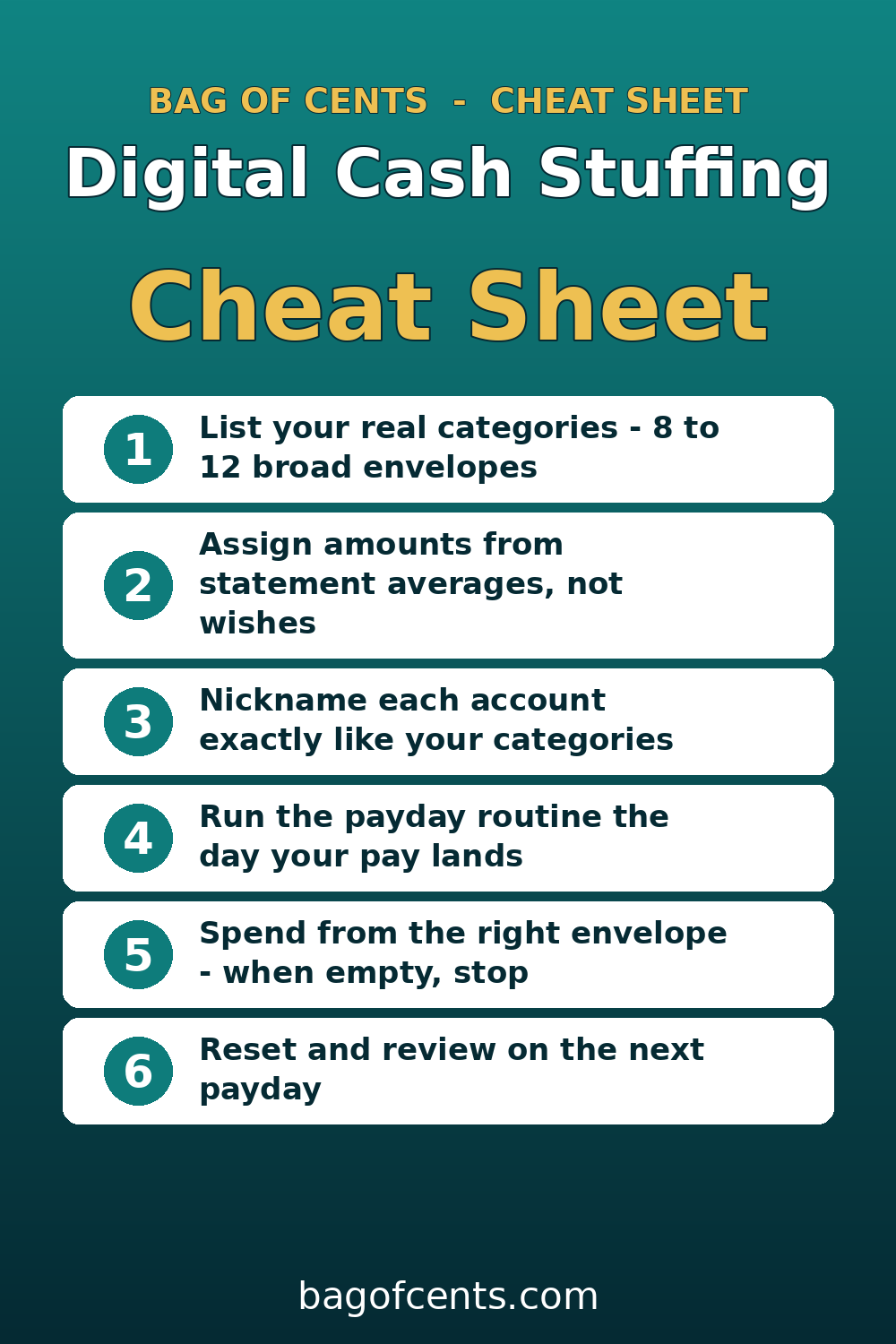
1. List your real categories. Don’t start with a template of 25 envelopes. Look at your last two months of bank statements and list where money actually went. Most households land on 8 to 12 categories: rent or mortgage, groceries, dining out, transport, utilities, subscriptions, personal care, fun money, clothing, and a buffer. Fixed bills on autopay (mortgage, insurance) can stay out of the envelopes — the buckets are for spending you actually control.
2. Assign an amount to each. Use your statement averages, rounded to something realistic — not aspirational. If you actually spent $640 a month on groceries, budgeting $400 guarantees failure in week two. If the totals exceed your income, that’s valuable information: it shows exactly which envelopes need trimming.
3. Create the envelopes. Open the savings accounts (Option A) or build the spreadsheet (Option B), and name each one exactly like your categories. Nickname the accounts in your banking app — a list that reads “Groceries,” “Transport,” “Fun Money” is psychologically different from “Savings 3,” “Savings 4,” “Savings 5.”
4. Run the payday routine. This is the ritual — the digital version of sliding cash into envelopes. On payday, move each envelope’s budgeted amount from chequing into its account (or log the allocations in your spreadsheet). Do it the same day your paycheque lands, before discretionary spending gets a chance. What stays in chequing afterward is your fixed bills plus whatever you deliberately left unassigned.
5. Spend from the right envelope. When you buy groceries, transfer the amount from the Groceries account back to chequing (or pay directly from it where your bank allows). Log it. When an envelope hits zero, the category is done for the period — you borrow from another envelope only by consciously deciding to, logging the transfer, and accepting the trade-off. No silent overspending.
6. Reset and review. On the next payday, review what happened: which envelopes ran dry early, which had money left over. Leftover money rolls into savings, into next month’s envelope, or gets spent guilt-free — you stayed inside the plan. Adjust the amounts that were unrealistic. After two or three cycles, the envelopes start fitting your actual life.
A Real Month, With Real Numbers
Meet the numbers for a typical single renter in, say, Hamilton or Calgary. Bi-weekly paycheque of $2,950 after tax — roughly $5,900 a month. Here’s how the envelopes could be stuffed:
- Rent: $1,550 (fixed, stays on autopay from chequing)
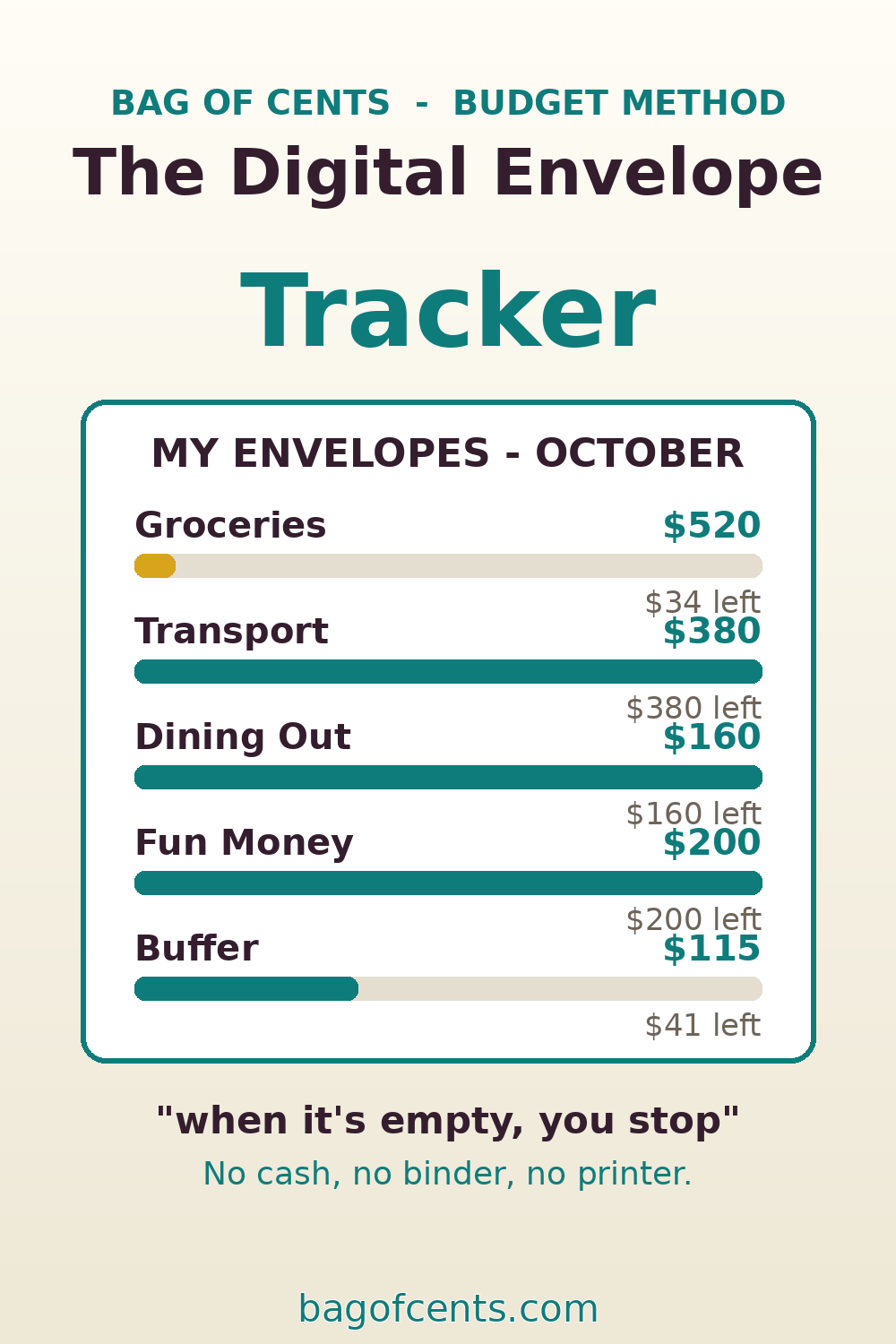
- Groceries: $520
- Transport (gas + insurance share): $380
- Utilities + phone: $210
- Dining out / takeout: $160
- Subscriptions: $65
- Personal care: $80
- Fun money: $200
- Clothing / household: $120
- Buffer (stuff I forgot): $115
Total allocated: $3,400 in envelopes plus $1,550 rent, leaving $950 unassigned each month. That unassigned remainder is the quiet hero of the system — it goes straight to savings or debt payoff before lifestyle creep can claim it.
Now watch the month play out. Groceries start at $520; by the 21st only $122 remains — the visible balance forces a decision. Instead of the usual autopilot grocery run, there’s a pantry-clearing week, and the envelope survives with $34 to spare. In week four, transport is nearly empty after an unexpected parking ticket, so the buffer envelope covers the last tank of gas — consciously, logged, no guilt, because that’s exactly what the buffer is for. Month end: groceries finished $34 under, fun money $8 under, buffer at $41. Total leftover swept into savings: $143. Nothing was tracked in exhausting detail — just category balances, glanced at before spending.
Compare that to the same month without envelopes: the $5,900 lands in one account, spending happens by feel, and the usual discovery arrives around the 25th — somehow only $400 left, no idea where it went. The envelopes didn’t change the income. They changed the visibility.
5 Mistakes That Break Digital Cash Stuffing
1. Creating too many envelopes. Twenty-three micro-categories (“Coffee,” “Coffee With Friends,” “Coffee Alone”) turn the system into a part-time job. Start with 8 to 12 broad envelopes. Split one later only if a category genuinely needs it.
2. Budgeting fantasy numbers. Setting groceries at $350 when you’ve never spent less than $600 doesn’t create discipline — it creates a week-two collapse and a reason to quit. Base every envelope on actual recent spending, then trim gradually. Honest buckets first, ambitious buckets later.
3. Skipping the tracker. The envelopes only work if the balances are current. With Option A, your banking app shows them for you. With a spreadsheet, log spending the same day — a five-minute nightly habit beats a miserable Sunday reconciliation. Stale envelopes are just decoration.
4. Raiding envelopes silently. Moving $80 from Groceries to Fun Money without writing it down is how the system quietly dies. Transfers between envelopes are allowed — life happens — but they must be deliberate and logged. You can move money, but you can’t pretend you didn’t.
5. Forgetting irregular expenses. The system breaks every December for people who never made a gifts envelope, and every April for people who forgot annual car insurance. Add envelopes for irregular-but-predictable costs (gifts, annual fees, car maintenance) and fund them a little each payday.
Frequently Asked Questions
Do I need a special app or paid subscription? No. Multiple no-fee savings accounts, or one account plus a spreadsheet, cover everything the system needs. Paid envelope-budgeting apps exist, but don’t let a subscription become the price of admission to budgeting. Start free; upgrade only if you outgrow it.
Which Canadian banks let me open multiple savings accounts easily? Digital-first banks make this painless: Tangerine and Simplii allow multiple savings accounts under one login, and EQ Bank offers savings “goals” that function like sub-accounts. The big five generally allow multiple savings accounts too, though fees may apply depending on your package. You need free transfers between your own accounts and the ability to nickname each one.
Does this work if my income is irregular? Yes, with one adjustment: fund envelopes as percentages instead of fixed dollars. If groceries get 9% of each paycheque instead of $520 flat, the system flexes with your income automatically. The category boundaries still do their job either way.
Can I use digital envelopes with a credit card? You can, but carefully. The cleanest approach: pay with the card, then immediately transfer the same amount out of the right envelope to cover it — or log the purchase against the envelope the same day. What you must avoid is letting the credit card become a shadow budget disconnected from the envelopes. If that’s too much overhead, run debit for envelope categories and keep the credit card for fixed bills you pay in full.
What do I do with leftover money at month end? Decide deliberately. The best default: sweep it into savings or toward debt — that’s the system’s whole purpose. Some people roll leftovers into next month’s envelopes as a cushion; others let one “fun” envelope absorb the surplus guilt-free.
Final Thought
Digital cash stuffing isn’t really about the envelopes — physical, digital, or otherwise. It’s about deciding where your money goes before it gets there, instead of reconstructing the crime scene on the 25th of the month. The payday routine takes maybe fifteen minutes: move the money, name the buckets, and spend the next two weeks inside boundaries you chose for yourself.
Start small. Pick your five biggest variable categories, set up five envelopes this week, and run one pay cycle. You’ll learn more from one month of real envelopes than from any article.
Liked this? Take it further.
If this article got you thinking about where your money goes, the free 52-Week Savings Challenge Tracker is a great next step — a simple week-by-week plan that builds your savings to $1,378 by year end, one small deposit at a time.
Join the Bagofcents weekly money tips email. Unsubscribe anytime.
Happy Budgeting!
Stanley
Leave a Reply