
Mortgage Prepayment: Shave Years Off Your Loan
Picture two identical Canadian households. Both buy homes in the same year, both borrow $400,000 on a 25-year amortization at roughly 5%. The only difference: one household uses its mortgage’s built-in prepayment privileges — a lump sum each year — while the other just makes the regular payments and gets on with life.
Fifteen years later, the first household is mortgage-free. The second still has the better part of a decade of payments ahead — and ends up paying roughly $126,000 more in interest over the life of the loan. Same income bracket, same house price, same starting rate. One habit apart.
That is the quiet power of mortgage prepayment: most Canadian mortgages include privileges that let you pay extra toward the principal without penalty, and most borrowers never use them. What follows is general information only — not personal financial advice — covering what those privileges are, the four moves that usually matter most, and the math on a modest annual lump sum, framed as an illustration.
With the Bank of Canada and the U.S. Federal Reserve both announcing rate decisions on October 28, mortgage talk is everywhere — but prepayment habits pay off regardless of which way rates move.
What Prepayment Privileges Actually Are
A mortgage prepayment privilege is a built-in feature of your mortgage contract that lets you make extra payments toward the principal — without the prepayment penalty that normally applies for breaking your term early. Think of it as a small penalty-free escape hatch the lender includes by design.
Exact privileges vary by lender and mortgage type, but most Canadian closed mortgages include two:
- Annual lump-sum privilege: usually 10% to 20% of the original mortgage amount, once per calendar or anniversary year.
- Payment-increase privilege: usually the right to increase your regular payment by 10% to 20% (some lenders allow up to double) once per year or per term.
The key point people miss: these privileges are part of the contract you already signed. Using them is not breaking your term — discharging the mortgage mid-term is what triggers penalties.
The Four Moves That Usually Matter Most
Move 1: The Annual Lump-Sum Privilege
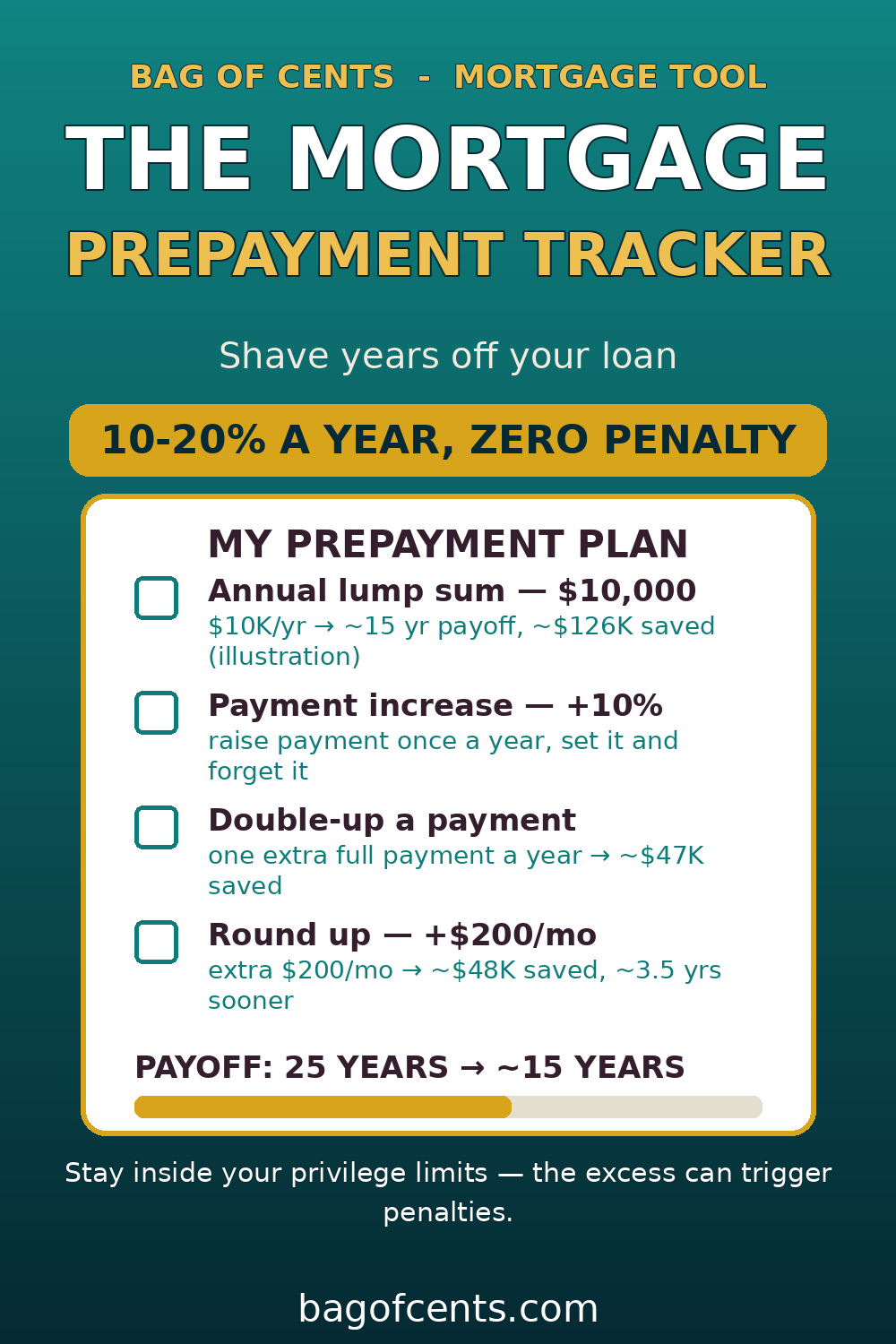
This is the single most powerful prepayment move for most borrowers, and the least used. Once a year, you can make a lump-sum payment — often 10% to 20% of the original mortgage amount — directly against the principal, with no penalty.
Why does it matter so much? Because a mortgage front-loads interest. Early in a 25-year amortization, a large share of every payment goes to interest, not principal. A $10,000 lump sum paid in year one kills off principal that would otherwise have been generating interest charges for two decades. The earlier the lump sum, the more interest it prevents — every dollar of principal eliminated today is a dollar that can never be charged interest again.
A rule of thumb: an annual lump sum in the low five figures, paid faithfully each year, is often the difference between a 25-year payoff and a 15-to-18-year payoff. It doesn’t have to be the full privilege: $5,000 or $10,000 a year still moves the needle dramatically, as the worked example below shows.
Move 2: Increase Your Regular Payment
Most Canadian mortgages let you raise your regular payment — commonly by 10% to 20% — at least once per year, penalty-free. Unlike a one-time lump sum, a payment increase is a habit that keeps working every month, automatically.
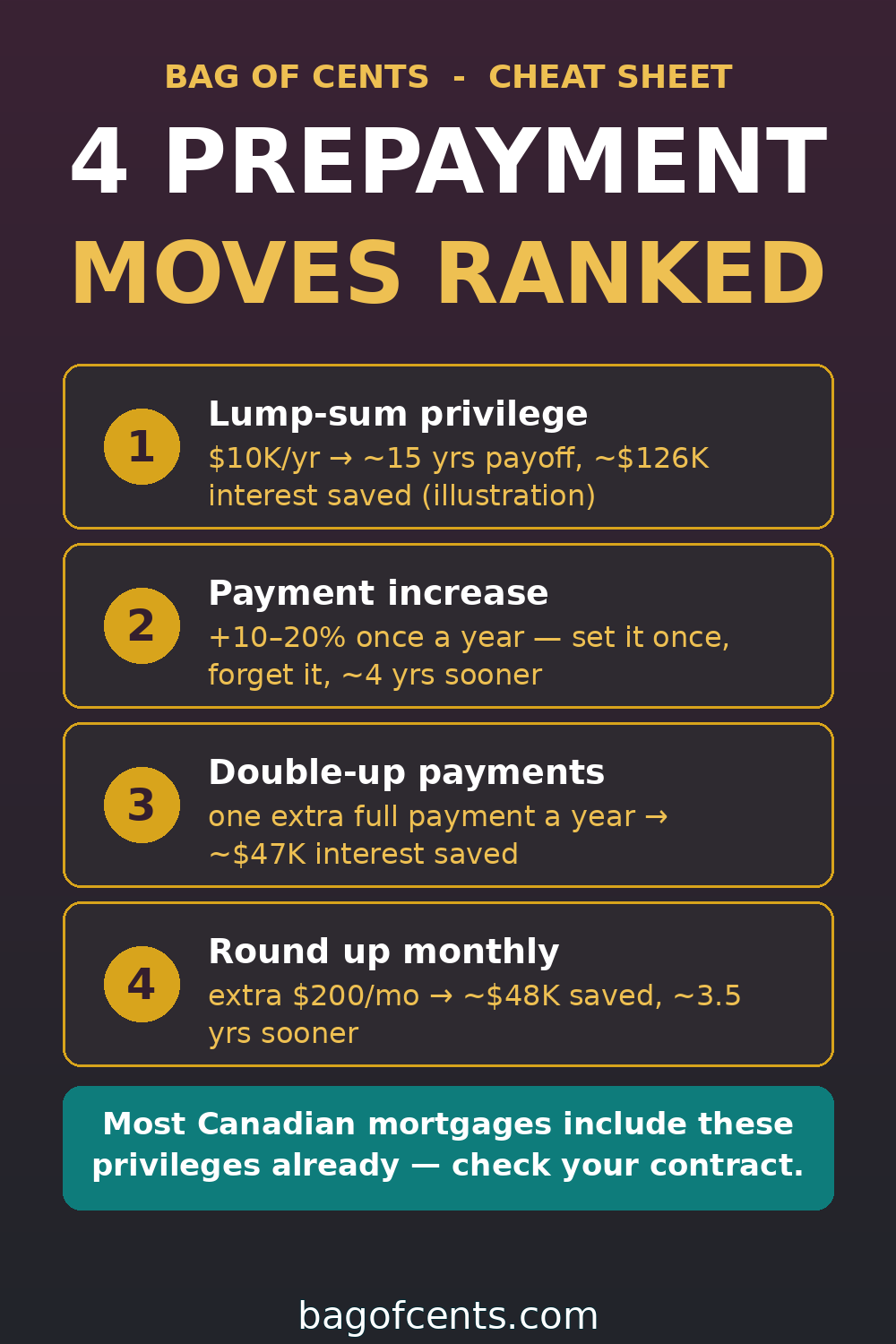
The math is quietly impressive. A 10% increase on a $2,326 monthly payment is about $233 a month — roughly $2,800 a year. Because the increase applies to every payment and compounds through the remaining balance, that modest bump can cut roughly four years off a 25-year amortization in the illustration below.
Because the increase runs inside your automatic payment, you make the decision once, not every month. One caveat: check whether your contract lets you raise and lower the payment, or only raise it, before changing anything.
Move 3: Double Up a Payment
“Double-up” is a privilege many Canadian lenders offer: the right to double up individual scheduled payments when you can afford it — pay twice the regular amount for a month, and the extra half goes straight to principal.
A common version: one extra full payment a year, timed to your bonus or tax refund. In the illustration below, one extra full payment a year shaves about three and a half years off the amortization and saves roughly $47,000 in interest — without committing to anything monthly. This suits variable incomes: use it in good years, skip it in tight ones, with no commitment.
Move 4: Round Up (or Add a Small Monthly Extra)
The smallest move is also the most accessible: round your payment up to a comfortable number, or add a fixed extra amount each month. An extra $200 a month on a $2,326 payment doesn’t feel dramatic. Over a 25-year amortization, it shortens the payoff by roughly three and a half years in the illustration below and saves on the order of $48,000 in interest.
Every extra dollar goes to principal, and early principal reductions have outsized effects. It also stacks naturally with other moves — a rounded-up monthly payment plus an annual lump sum is a completely normal, contract-allowed combination.
Fair warning: one-off extras made late in the amortization, when the balance is small and mostly principal, move the needle far less than the same dollars paid early.
The Real-Numbers Illustration
The example: a $400,000 mortgage, 25-year amortization, 5% rate (Canadian semi-annual compounding), monthly payment of about $2,326. Baseline: paid off in 25 years with roughly $298,000 in total interest. All figures are approximate illustrations, not predictions for any individual mortgage.
| Strategy | Payoff time | Interest paid (approx.) | Interest saved (approx.) |
|---|---|---|---|
| Baseline (no prepayments) | 25 years | $298,000 | — |
| 10% payment increase (~$233/mo) | ~21 years | $243,000 | ~$55,000 |
| Extra $200/month | ~21.5 years | $250,000 | ~$48,000 |
| One extra full payment/year | ~21.5 years | $251,000 | ~$47,000 |
| $10,000 lump sum each year | ~15 years | $172,000 | ~$126,000 |
The lump sum dominates — and note it uses only a fraction of a typical 10-20% annual privilege. Ten annual $10,000 payments remove $100,000 of principal that would otherwise have carried interest for most of the amortization.
Even the “small” moves — $200 a month — save roughly $48,000 and more than three years. There is no wasted prepayment inside your privileges; the only wasted one is the prepayment you never make while waiting to afford the big one.
4 Mistakes That Undo the Good
1. Breaking the term instead of using the privileges. To pay your mortgage off aggressively, use your privileges — don’t discharge the mortgage mid-term. Breaking a closed fixed mortgage early triggers a prepayment penalty: the greater of three months’ interest or the interest-rate differential (IRD). On a large balance in a falling-rate environment, IRD can run into the tens of thousands. Your privileges let you attack the principal without ever touching a penalty.
2. Prepaying while higher-interest debt is on fire. A dollar sent to a 5% mortgage saves you roughly 5 cents a year in interest. That same dollar sent to a 21.99% credit card balance saves you roughly 22 cents. If you’re carrying credit card debt or other high-rate balances, those usually come first — the math is not close. Prepaying the mortgage instead of clearing a 22% card balance is one of the most expensive “responsible” moves a household can make.
3. Skipping the emergency fund to prepay. Money sent to your mortgage is locked inside your home equity — getting it back requires refinancing or a HELOC, both of which cost money and take time. Before sending serious extra payments to the mortgage, hold a basic emergency fund — around $1,000 to start, growing toward a few months of expenses.
4. Ignoring the privilege limits. Go past your annual lump-sum or payment-increase limits and the excess can attract prepayment charges — the very penalties you were trying to avoid. The limits are generous (10-20% is a lot of room), but check your contract’s numbers and track what you’ve used each year. Confirm whether yours counts by calendar year or anniversary date.
Frequently Asked Questions
How much can I prepay each year without penalty? Most Canadian closed mortgages allow a 10-20% annual lump sum plus a 10-20% payment increase. Exact numbers are in your contract’s prepayment section — verify yours rather than relying on the ranges above.
Does a lump sum go to principal or interest? A lump sum made under your prepayment privilege goes directly to principal — none of it is skimmed off for interest. The principal drops immediately, and all future interest is calculated on the smaller balance.
What if I sell my house or want to pay it all off early? That’s discharging the mortgage before the term ends — different from using prepayment privileges — and it triggers prepayment penalties (three months’ interest or IRD on a fixed mortgage). If you’re selling, the penalty math is part of the move’s cost; portable mortgages and blended rates can sometimes reduce it. Talk to your lender or a mortgage professional before acting.
Should I prepay my mortgage or invest the money? This is the classic fork in the road, and there’s no universal answer — it depends on your mortgage rate, your expected investment returns, your risk tolerance, your time horizon, and your tax situation (RRSP/TFSA room changes the math). A common rule of thumb: prepaying earns you a fixed return equal to your mortgage rate, while investing offers uncertain returns with the chance of more. Many households split the difference. This is general information only — it’s worth running your own numbers or talking to a professional for your situation.
Can I prepay a variable-rate mortgage too? Usually yes — variable-rate closed mortgages usually include lump-sum and payment-increase privileges too, and variable open mortgages typically allow unlimited extra payments.
Is there ever a reason NOT to prepay? Yes. If you carry higher-rate debt, lack an emergency fund, haven’t used available employer retirement matching, or would pay a penalty to free the money, prepaying is often the wrong order of operations. Prepayment is a great use of surplus cash, not a great use of your safety net.
Final Thought
A mortgage is the biggest interest bill most Canadians will ever pay — roughly $298,000 of interest on a $400,000 loan at 5% over 25 years in the illustration above. The prepayment privileges in your contract are the one built-in lever you have against that bill, and they cost nothing to use.
You don’t need the heroic version. You need the repeatable one: a modest annual lump sum from the tax refund, a 10% payment bump you set once and forget, or an extra couple hundred dollars a month. Any one of them, sustained, takes years off the loan and tens of thousands off the interest. The households that finish early aren’t the ones with the biggest lump sums — they’re the ones that started the habit early and never stopped.
Pull out your mortgage contract tonight and find the prepayment section. Write down your two numbers — the annual lump-sum limit and the payment-increase limit. Then pick one move and calendar it: the month the tax refund arrives, or the next time your payment anniversary rolls around. That’s the whole plan. The math does the rest.
Liked this? Take it further.
If this article got you thinking about where your money goes, the free 52-Week Savings Challenge Tracker is a great next step — a simple week-by-week plan that builds your savings to $1,378 by year end, one small deposit at a time.
Join the Bagofcents weekly money tips email. Unsubscribe anytime.
Happy Budgeting!
Stanley
Leave a Reply