
Your credit card statement arrives and you do what feels like the responsible thing: you pay the minimum. Not the whole balance — you can’t, not this month — but the minimum, on time, every month. The balance barely moves. You tell yourself you’re managing it.
You’re not managing it. You’re feeding it.
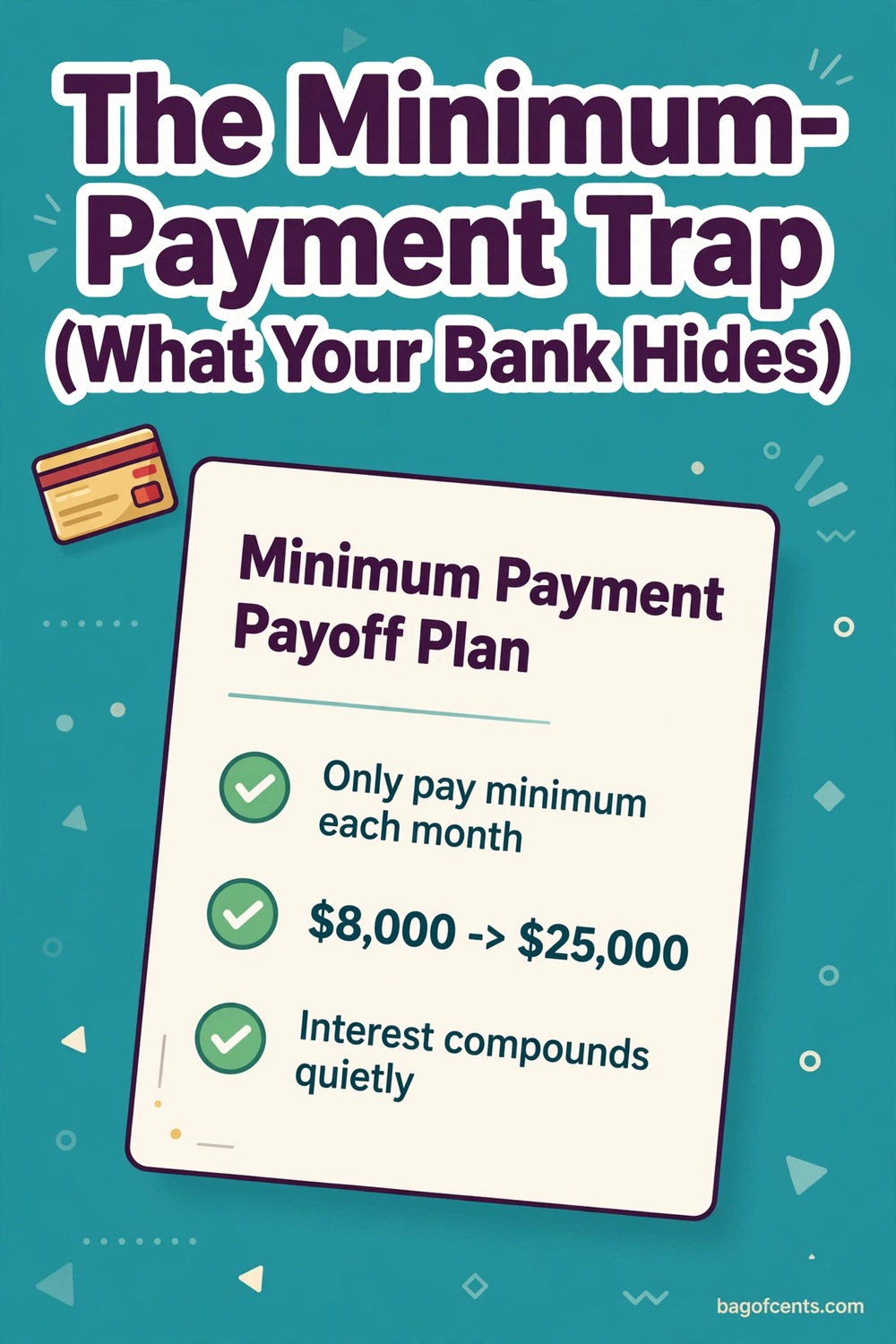
Here’s a number that should make your stomach drop: put $8,000 on a Canadian credit card at 20.99% and pay only the minimum each month, and you’ll be paying for 23 years. Your total bill won’t be $8,000 — it’ll be over $20,000, and on a typical store card at 24.99%, it pushes toward $25,000. That’s three Christmases of payments for every one Christmas of spending.
The minimum payment trap isn’t a scam. It’s math — math your card company understands perfectly and is in no hurry to explain. This article explains it, shows the real numbers, and gives you the fix. Nothing here is financial advice and there are no guaranteed outcomes — just the math, and a plan that usually beats doing nothing.
 What the Minimum Payment Trap Actually Is
The minimum payment is the smallest amount your card issuer will accept each month without marking you late. In Canada, it’s usually calculated as the greater of $25 or roughly 1% to 3% of your balance — and on many cards, the formula is closer to your monthly interest charges plus 1% of the balance. That last version sounds fair until you run the numbers.
Here’s the trap, in one sentence: the minimum payment is engineered to be just big enough to cover the interest and shave a sliver off the principal — which means the balance shrinks at a glacial pace while the interest meter keeps running.
Take that $8,000 balance at 20.99%. In month one, the interest charge is about $140. Your minimum works out to roughly $220 — the $140 in interest plus 1% of the balance ($80). So of your $220 payment, only $80 reduces what you owe. Next month the interest is slightly smaller, the minimum is slightly smaller, the sliver of principal is slightly smaller. The machine grinds on for 275 months.
And that’s the best case — the version where you never miss a payment and never add a single new charge. The moment you put groceries on that card again, the clock stretches further. The minimum payment trap isn’t a one-time mistake. It’s a system that keeps you paying interest for decades while your balance behaves like it’s nailed to the floor.
Why Minimum Payments Feel Responsible (But Aren’t a Plan)
Nobody wakes up and decides to pay $12,000 in interest over 23 years. People fall into the trap for reasons that are completely understandable:
- Paying the minimum keeps you “current.” No late fees, no scary calls, no hit to your credit score. It feels like handling your debt.
- The minimum looks small and manageable. $220 on an $8,000 balance feels doable in a way the full balance doesn’t — and the card company is happy to keep it feeling that way.
- You intend to “pay more next month.” Next month the car needs tires. The month after, it’s back-to-school. “Next month” never arrives — and the trap counts on that.
- The statement hides the timeline. The number that jumps out is the minimum due, not the decades-long calendar of what paying it actually costs you.
How to Escape the Trap: 5 Steps
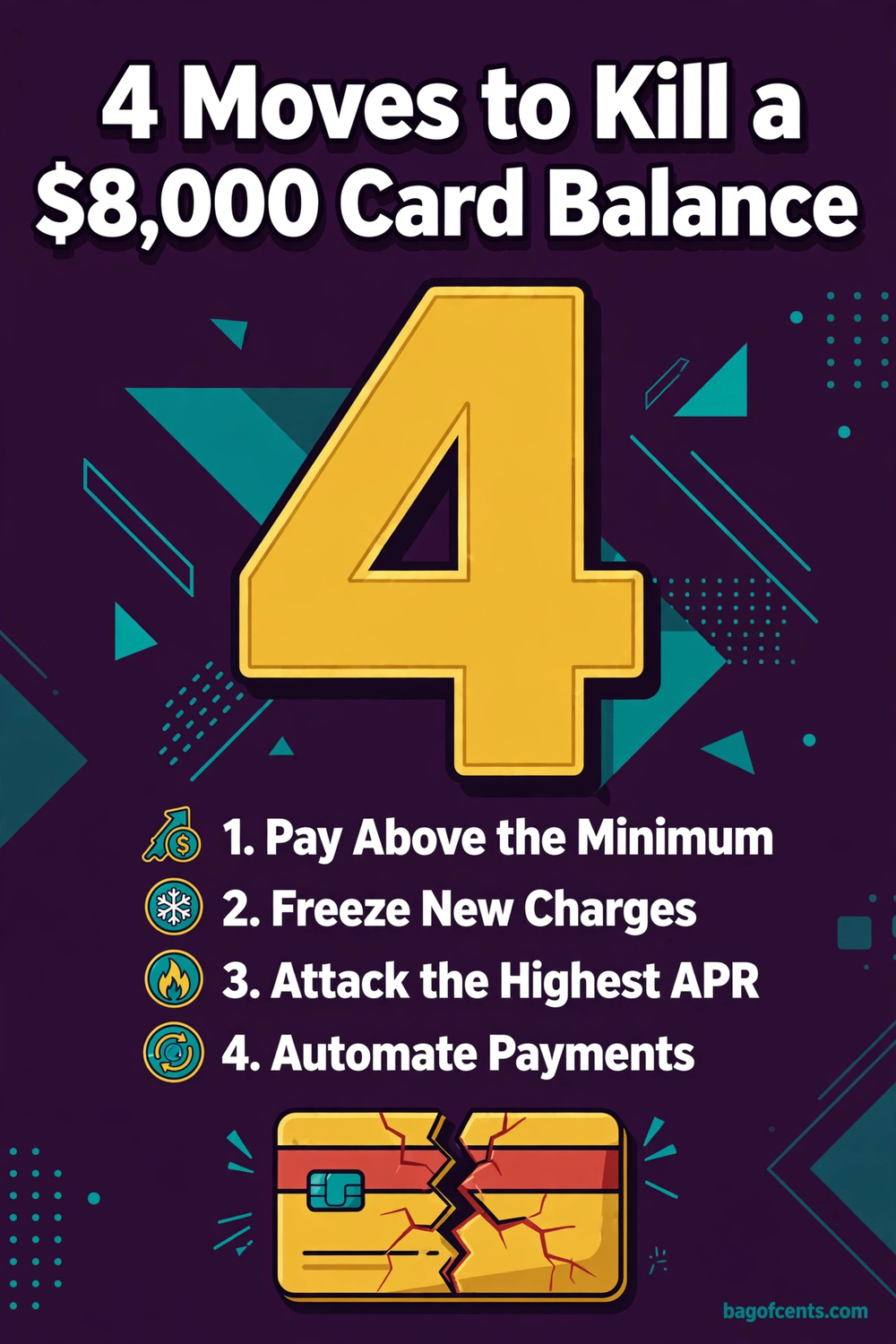
Step 1: Freeze the Balance — Stop Adding New Charges
You can’t drain a bathtub with the tap running. Before anything else, stop putting new purchases on the card you’re trying to pay off and switch daily spending to debit for a while. Every new charge resets part of your progress, because new purchases on a card with a revolving balance often start accruing interest immediately. A frozen balance is a balance you can actually plan against.
Step 2: Find Your Real Number — Payment Above the Minimum
Look at last month’s minimum, then set a fixed amount above it that you can sustain every month — as a rule of thumb, at least double the minimum. A fixed payment means that as the interest portion shrinks each month, more of your money attacks the principal. That’s the acceleration that collapses a 23-year sentence into a 4-year plan. If double isn’t possible yet, pay the minimum plus $50. It’s not magic; it’s just math working for you instead of against you.
Step 3: Rank Your Debts and Attack the Expensive One First
If you carry more than one balance, list them by interest rate and throw every extra dollar at the highest-rate card while paying minimums on the rest. This is the avalanche approach — it usually saves the most interest over time. (If you need quick wins to stay motivated, the snowball method — smallest balance first — is a legitimate alternative.) Minimums spread thinly across three cards is the slowest possible strategy. Concentrated payments on one card at a time is the fastest.
Step 4: Automate the Payment the Day After Payday
Willpower is a terrible debt strategy. Set up an automatic payment for your fixed amount, scheduled the day after your paycheque lands. The money leaves before you can reassign it to takeout or a sale. If your issuer only lets you auto-pay the minimum, set that up too — then schedule a second transfer for the rest on the same day and treat it as non-negotiable as the rent. People who automate debt payments generally pay debt off faster than people who “remember” to do it. Not a guarantee — just how human behaviour usually works.
Step 5: Track the Balance Monthly and Celebrate Milestones
Write down the balance on the 1st of every month — a note on your phone is fine. Watching the number fall is the fuel that keeps the plan alive, especially early on when interest still eats a big share of each payment. Set milestones: under $6,000, under $4,000, under $2,000, gone. When the balance hits zero, redirect that entire fixed payment straight into savings before lifestyle creep notices it’s available.
A Real-Numbers Example: $8,000 at 20.99%
Let’s put the two strategies side by side. Same starting point: $8,000 balance, 20.99% APR, minimum payment calculated as interest plus 1% of the balance (minimum $25) — the standard Canadian formula.
Strategy A — minimum payments only:
| Year | Balance at Year-End | Paid That Year | Interest That Year |
|---|---|---|---|
| 1 | $7,091 | $2,499 | $1,590 |
| 2 | $6,285 | $2,215 | $1,409 |
| 3 | $5,571 | $1,963 | $1,249 |
| 4 | $4,938 | $1,740 | $1,107 |
| 5 | $4,377 | $1,542 | $981 |
After five full years of on-time minimum payments — $9,959 handed over — you still owe $4,377. More than half the original debt remains. The full payoff takes 275 months (nearly 23 years), with a total paid of about $20,951 — roughly $12,951 in interest on an $8,000 purchase.
And that’s at 20.99%. On a typical Canadian store card at 24.99%, the same minimum-payment path costs about $23,525 over 23½ years. Add a couple of $40 late fees along the way — extremely common over two decades — and you’re staring at $25,000 for $8,000 of spending.
Strategy B — fixed $250/month:
| Minimum Payments Only | Fixed $250/Month | |
|---|---|---|
| Time to debt-free | ~23 years | 4 years |
| Total paid | ~$20,951 | ~$11,828 |
| Total interest | ~$12,951 | ~$3,828 |
| Balance after 1 year | $7,091 | $6,544 |
| Balance after 2 years | $6,285 | $4,752 |
The difference is staggering: 19 years sooner, about $9,100 less paid. The $250 payment isn’t even heroic — it’s $30 more than the first month’s minimum of $220. But because it’s fixed, every month the interest portion shrinks and the principal portion grows, and the debt collapses instead of lingering. That’s the whole trick: not a bigger shovel, but a shovel that doesn’t get smaller every month.
5 Mistakes That Keep You in the Trap
1. Paying the minimum while still using the card. This is the big one. New purchases on a card with a revolving balance often start accruing interest immediately — there’s no grace period when you already carry a balance.
2. Treating “no late fee” as “making progress.” An on-time minimum protects your credit score, which matters — but it is not a payoff strategy. It’s a holding pattern, and the trap is perfectly comfortable with you holding it for 23 years.
3. Waiting until you can “really attack it.” The math rewards starting now with a smaller fixed amount far more than starting later with a bigger one. Interest doesn’t pause while you wait for the bonus, the refund, or the better job.
4. Ignoring the interest rate — especially store cards. That 24.99% store card you opened for 10% off one purchase is now the most expensive debt you own. Check every statement, and if you consider a balance transfer, read the transfer fee and the promo rate’s expiry date first.
5. Raiding savings for one big payment, then re-borrowing. Emptying your emergency fund to kill the card feels decisive — until the furnace dies and the charge goes right back on the card. Keep a small buffer intact while you pay the debt down.
Your Questions, Answered
Q: Is it ever okay to pay just the minimum?
Yes — in a genuine emergency month. If paying more would mean missing rent or an essential bill, pay the minimum, protect your housing and credit standing, and return to the fixed payment next month. One minimum month is a speed bump; twenty years of them is the trap.
Q: What about a balance transfer card — is that worth it?
It can be, as a rule of thumb, if the math works: a 1–3% transfer fee on $8,000 is $80–$240, versus thousands in interest at 20.99%. But the promo rate expires — often after 6 to 12 months — and the trap version of this move is transferring the balance and then spending on the old card again.
Q: My minimum is only $25. How is that a trap?
That $25 floor is the trap’s sharpest edge. At 20.99%, $8,000 generates about $140 in interest per month — a $25 payment doesn’t even cover the interest, so the balance grows while you pay. Always pay more than the monthly interest charge; that’s the bare minimum for the word “minimum” to make sense.
Q: I have three cards with minimums. Where do I start?
Write down each card’s balance, rate, and minimum. Pay minimums on all three, then aim every extra dollar at the highest-rate card first — the avalanche, which usually minimizes total interest. Want to see the strategies compared on your numbers? The free debt payoff calculator linked below runs the math for you.
 Final Thought
You don’t need a windfall to escape. You need a fixed payment above the minimum, a frozen balance, and the month you decide to start — which can be this one. Run your own numbers first: the free debt payoff calculator lets you plug in your actual balances and rates and see your debt-free date under the snowball, avalanche, and hybrid strategies. It’s general information to help you decide — not advice — but seeing your own finish line has a way of making the first payment easier.
Liked this? Take it further.
Once the debt is shrinking, the next move is building the savings habit that keeps you out of the trap for good. The free 52-Week Savings Challenge Tracker gives you a week-by-week plan for the whole year — follow it all the way through and you’ll have $1,378 saved by year end. Grab it below and start this week.
Join the Bagofcents weekly money tips email. Unsubscribe anytime.
Happy Budgeting!
Stanley
Leave a Reply