
You check your bank balance, and it looks a little lower than you expected. Not by a lot. Not by enough to panic. Just by enough to make you frown and think, “Wait, where did that go?”
You did not buy anything big. You did not forget a bill. And yet, a few dollars here and a few dollars there have quietly gone missing, month after month.
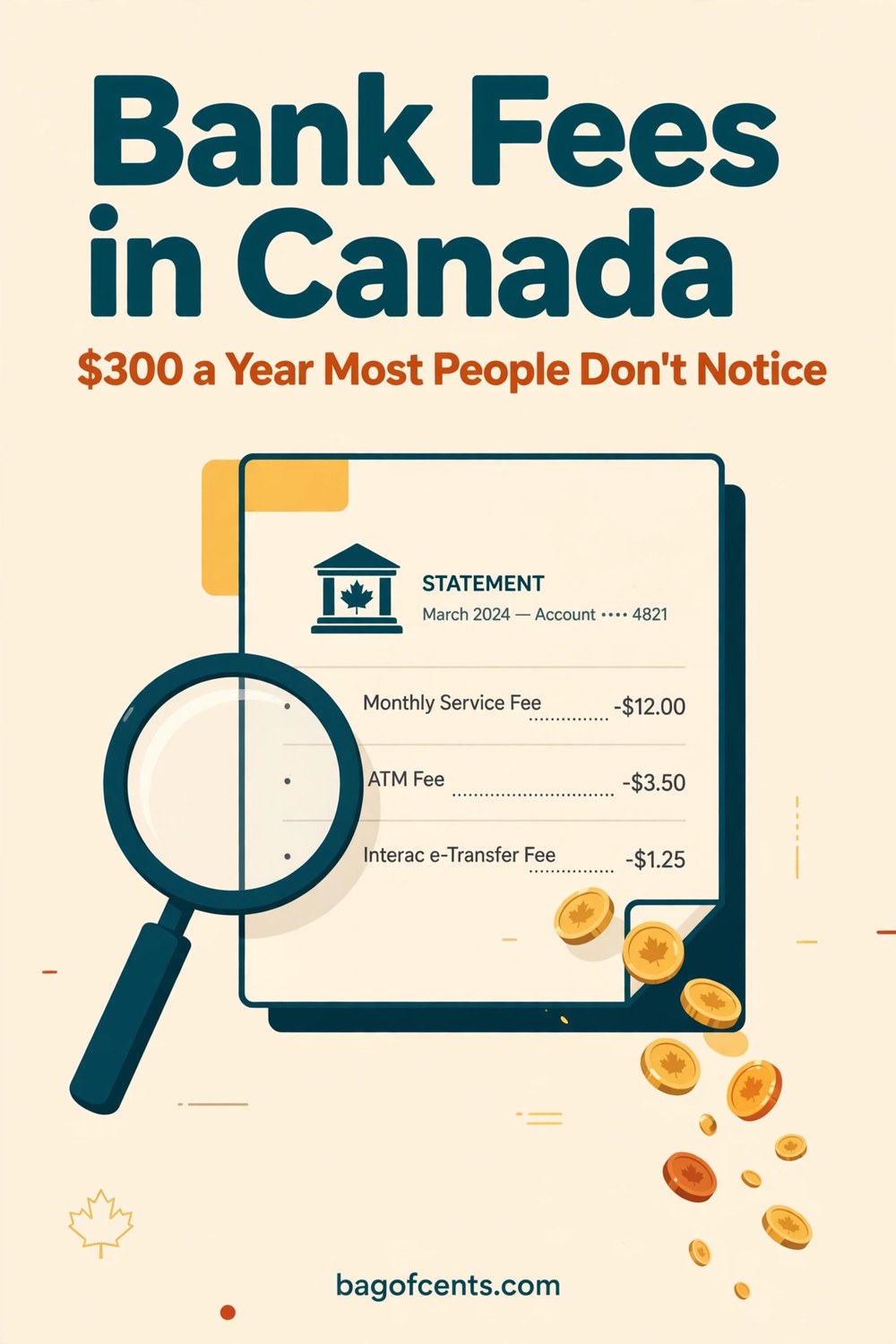
That is how bank fees work. They rarely arrive as one big charge you would notice and question. They arrive as small, regular amounts — a monthly account fee, a couple of ATM charges, a foreign transaction fee on a purchase you barely remember — and because each one is small, most of us never add them up.
So let us add them up. For a lot of Canadians, the total is around $300 a year. Sometimes more. And the frustrating part is that much of it is avoidable, once you can see where it is coming from.
This is not about switching banks in a panic, or about finding some perfect account that charges nothing for anything. It is about knowing what you are paying for, deciding whether it is worth it, and keeping the rest in your pocket.
1. The monthly account fee: the one you pay just for having an account
The biggest bank fee for most people is also the most boring one: the monthly fee for your chequing account.
A basic chequing account at one of Canada’s big banks usually costs about $3.95 to $4.00 a month. That covers a limited number of transactions — often 12 a month — and if you go over that limit, you can pay extra for each additional transaction.
An unlimited chequing account usually costs about $16.95 to $17.95 a month. A premium plan, with extra perks, can cost about $29.95 to $30.95 a month.
So the range is wide: from about $48 a year for a basic account to about $360 a year for a premium one. And many people are sitting in the middle, paying $17 a month — about $204 a year — for an unlimited account they chose years ago and have not thought about since.
Here is the question to ask yourself: how many transactions do you actually do in a month?
If you tap your card a few times a week, pay a couple of bills, and send the odd e-transfer, you might be well under 12 transactions a month. In that case, a basic account could be enough, and you could be paying $13 a month — about $156 a year — for transactions you are not using.
If you tap your card every day, pay a lot of bills, and move money around often, an unlimited account may genuinely be worth it. Paying for extra transactions one by one can add up fast, and an unlimited plan can be cheaper than a basic plan plus overage charges.
The point is not that one account is always better. The point is that your account should match how you actually bank now, not how you banked when you opened it five years ago.
And there is one more thing to check: the minimum balance. Many unlimited and premium accounts waive the monthly fee entirely if you keep a minimum balance — often $4,000 or $5,000. If you already keep that much in your chequing account, you may be paying a fee you do not need to pay. If you do not, ask yourself whether keeping that money in chequing is worth the fee you save, or whether it would earn more somewhere else. There is no single right answer, but it is worth doing the math.
2. ATM fees: small charges, in places you do not expect
ATM fees are the classic small charge. You need cash, you are nowhere near your own bank’s machine, so you use the one in front of you. It costs $2 or $3. You shrug. It is only $2.
Do that twice a month and it is $48 to $72 a year. Do it once a week and it is over $100.
There are usually two parts to an ATM fee. Your own bank may charge you for using another bank’s machine, and the machine’s owner may charge you too. The exact amounts vary, so check your own account’s fee schedule — but the pattern is the same: the fee is small enough to ignore once, and big enough to notice over a year.
The fix is simple, and a little boring, which is probably why it works. Take out cash when you are near your own bank’s ATM, or get cash back at the grocery store when you are already there. If you travel a lot, or you live far from your bank’s machines, an account with free access to a wider ATM network — or a no-fee online bank account — might save you more than you think.
3. Overdraft and NSF fees: the expensive ones
These are the fees that hurt the most, because they usually arrive on a day when money is already tight.
An NSF fee — non-sufficient funds — is charged when a payment tries to come out of your account and there is not enough money to cover it, so the payment bounces. It used to be one of the most expensive bank fees in Canada, typically $45 to $48 for a single bounced payment at the big banks.
That changed on March 12, 2026. Since then, federally regulated banks cannot charge more than $10 for an NSF fee on a personal account. That is a real improvement — $10 still stings, but it is not $48 — and it is worth knowing about, because if you were charged more than $10 by a federally regulated bank after that date, something is wrong.
There are limits to the cap. It covers federally regulated banks, not provincial credit unions, which are regulated by the provinces. And the payment still bounces, so you may also face a late fee or a returned-payment charge from the company you were trying to pay. The $10 cap makes the bank’s part cheaper. It does not make the missed payment go away.
Overdraft protection is the other side of the same problem. With overdraft protection, the bank covers the payment instead of bouncing it, up to an approved limit. You pay for that: usually about $5 a month on a monthly plan, or about $5 per use on a pay-per-use plan, plus interest of about 21% to 22% a year on the amount you are overdrawn.
Overdraft protection can be useful — it can save you from a bounced rent payment or a missed bill. But it is not free money, and it is not a good way to borrow. At 21% interest, even a small overdraft gets expensive fast if you leave it there.
The best protection against both kinds of fee is the least exciting one: a small cushion in your chequing account, and a low-balance alert. Even $100 sitting in chequing as a buffer can be the difference between a payment going through and a $10 fee — or worse, a late fee on top of it.
4. Foreign transaction fees: the holiday and online-shopping surprise
You buy something online in US dollars. Or you travel, and you tap your card in another country. The price looks right, and then your statement shows a little more than you expected.
That extra amount is usually a foreign transaction fee, often around 2.5% of the purchase on top of the exchange rate. On a $100 purchase, that is $2.50. On a $1,000 trip, it is $25. It is not a huge percentage, but it is charged on every foreign purchase, and most people do not notice it until they add it up.
Some credit cards waive foreign transaction fees, and some bank accounts include it as a perk. If you shop online in US dollars often, or you travel even once a year, it is worth checking whether your card charges this fee — and if it does, whether a no-foreign-transaction-fee card would save you more than it costs.
5. The worked example: Maya’s $300 a year
Let us put this together with a real example. Meet Maya — not a real person, but a very common one.
Maya has an unlimited chequing account at a big bank. She pays $16.95 a month, which is $203.40 a year. She chose it years ago because she liked the idea of unlimited transactions, and she has never looked at it since.
She uses another bank’s ATM about twice a month, at about $3 a time. That is $72 a year.
She shops online in US dollars a few times a year, spending about $600 in total. At 2.5%, that is $15 in foreign transaction fees.
And once this year, a bill came out a day before her paycheque landed. The payment bounced, and she was charged a $10 NSF fee.
Add it up: $203.40 + $72 + $15 + $10 = $300.40 a year.
Maya did not make a big mistake. She did not buy anything silly. She just paid $300 for the privilege of having a bank account, using cash machines, and buying a few things online.
Now imagine Maya makes three small changes. She checks her transactions and realises she does about 10 a month, so she switches to a basic account at $4 a month — saving about $155 a year. She starts taking cash out at her own bank’s ATM — saving $72. And she switches her online shopping to a card with no foreign transaction fee — saving $15.
That is about $242 back in her pocket, every year, for changes that took her an afternoon to make. The NSF fee is harder to promise away, but a $100 cushion and a low-balance alert make it much less likely.
Your numbers will be different. Maybe your account fee is lower, and your ATM habit is worse. Maybe you never travel, but you pay for overdraft protection every month. The point is the same: add it up, and the total is usually bigger than you expected.
5 common mistakes
1. Paying for unlimited transactions you do not use. Count your transactions for a month before you assume you need unlimited. Twelve is more than it sounds like.
2. Keeping a premium account for perks you never use. Free safety deposit boxes, travel perks, and premium rewards are only worth it if you actually use them. If you do not, you are paying $30 a month for a list of benefits.
3. Ignoring the minimum-balance waiver. If your account waives the fee at $4,000 or $5,000 and you already keep that much in chequing, check whether the waiver is actually applied. If it is not, ask why.
4. Treating overdraft protection as a safety net you can lean on. It is a short-term bridge, not a loan. At about 21% interest, leaving an overdraft in place for weeks is an expensive way to borrow.
5. Never reading the fee schedule. Banks do change their fees, and they do send notices — usually in the kind of envelope or email most of us skip. Once a year, spend ten minutes reading your account’s fee list. It is the highest-paid ten minutes of your year.
FAQ
Do all Canadian banks charge a monthly account fee?
No. Many online banks and credit unions offer chequing accounts with no monthly fee at all, and some big-bank accounts are free for students, seniors, or youth. The trade-off is usually fewer branches and in-person services, so it depends on how you bank.
Is the $10 NSF cap real?
Yes, for federally regulated banks, since March 12, 2026. Before that, NSF fees at the big banks were typically $45 to $48. Provincial credit unions are not covered by the federal cap, so check with yours if that is where you bank.
What is the difference between an NSF fee and an overdraft fee?
An NSF fee is charged when a payment bounces because there is not enough money and you have no overdraft protection. An overdraft fee is charged when the bank covers the payment instead, and you pay a fee plus interest for that cover.
How many transactions do I actually do in a month?
Check your last two bank statements and count them — debit purchases, bill payments, e-transfers, and ATM withdrawals all count. Most people are surprised, in one direction or the other.
Should I switch to a no-fee online bank?
It can save you $150 to $300 a year, and for a lot of people it is the simplest fix. Just check first that it covers what you need: ATM access, e-transfers, bill payments, and a way to deposit cheques or cash if you still do that.
Do bank fees affect my credit score?
Bank fees themselves do not, but a bounced payment can. If a bill goes unpaid because it bounced, and the company reports it late, that can affect your credit. That is another reason a small chequing cushion matters.
Final Thought
Bank fees are not a sign that you are bad with money. They are a sign that the system is set up to charge you in small amounts you are unlikely to notice — and that most of us are too busy to check.
You do not need to switch banks tomorrow, or spend a weekend comparing every account in Canada. You just need to do three things: find out what you are paying now, count how you actually use your account, and change the one or two fees that are costing you the most.
For most people, that is the monthly account fee and the ATM habit. Fix those two, and you have probably found $200 or more a year — money that can go to your emergency fund, your sinking funds, or just a little breathing room.
Your bank is not going to call you to tell you that you are overpaying. So this weekend, take ten minutes, open your statements, and add it up. You might be pleasantly surprised at how much of it you can keep.
This article is general information only, not financial advice. Bank fees vary by bank, account, and province, and they change over time. Check your own bank’s current fee schedule before making a change, and talk to your bank or a licensed advisor if you need advice for your situation.
Leave a Reply