
December is the month Canadians give the most — and it is also the last month a gift can count on this year’s tax return.
That is not a sales pitch from a charity. It is just how the donation tax credit works: a gift made by December 31 is a donation for that tax year. The same gift made on January 2 is a donation for next year. The charity gets the same money either way. You are the one whose timing changes.
How the Credit Actually Works
A donation to a registered charity is not a deduction — it is a non-refundable tax credit, calculated in two tiers at the federal level for 2026:
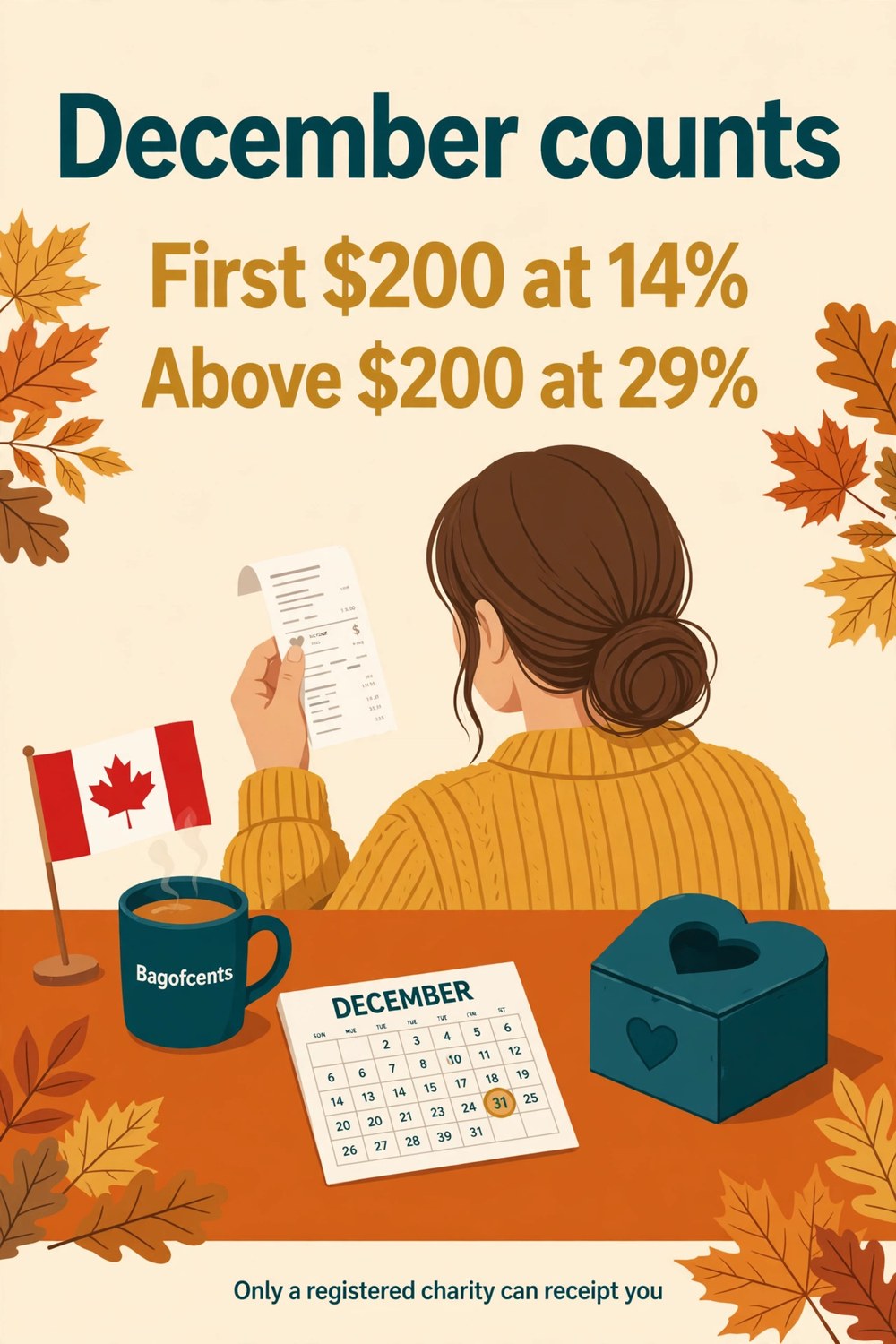
- First $200 you claim in a year → 14% federal credit.
- Everything above $200 → 29% federal credit (and 33% on the portion tied to income taxed at the top federal rate).
Your province or territory then adds its own credit on top, at its own two-tier rates. Combined, the credit is worth noticeably more once you are past that first $200 — which is why the next two sections matter more than the rate table.
One limit to know: the credit can reduce your tax owed to zero, but it cannot create or increase a refund, and you can generally claim donations up to 75% of your net income for the year. For most households giving a few hundred dollars, neither limit is close.
Why Bunching Beats Sprinkling
Because the first $200 is credited at the low rate every year, small donations scattered across years each pay that low-rate toll. The same total, claimed in one year, pays it once.
Say you give $300 a year. Claimed year by year, each year is $200 at 14% plus $100 at 29% federally. Claim two years together — you are allowed to carry unclaimed donations forward up to five years — and it becomes $200 at 14% plus $400 at 29%. Same $600 given, more of it credited at the higher rate. The gain is modest, not magic, but it costs nothing: give when you want, claim when it counts.
Couples get the same lever: spouses can combine their donations and have one partner claim them all, so the household crosses the $200 low-rate tier once instead of twice.
Maya’s Version: $50 a Month, One Decision in December
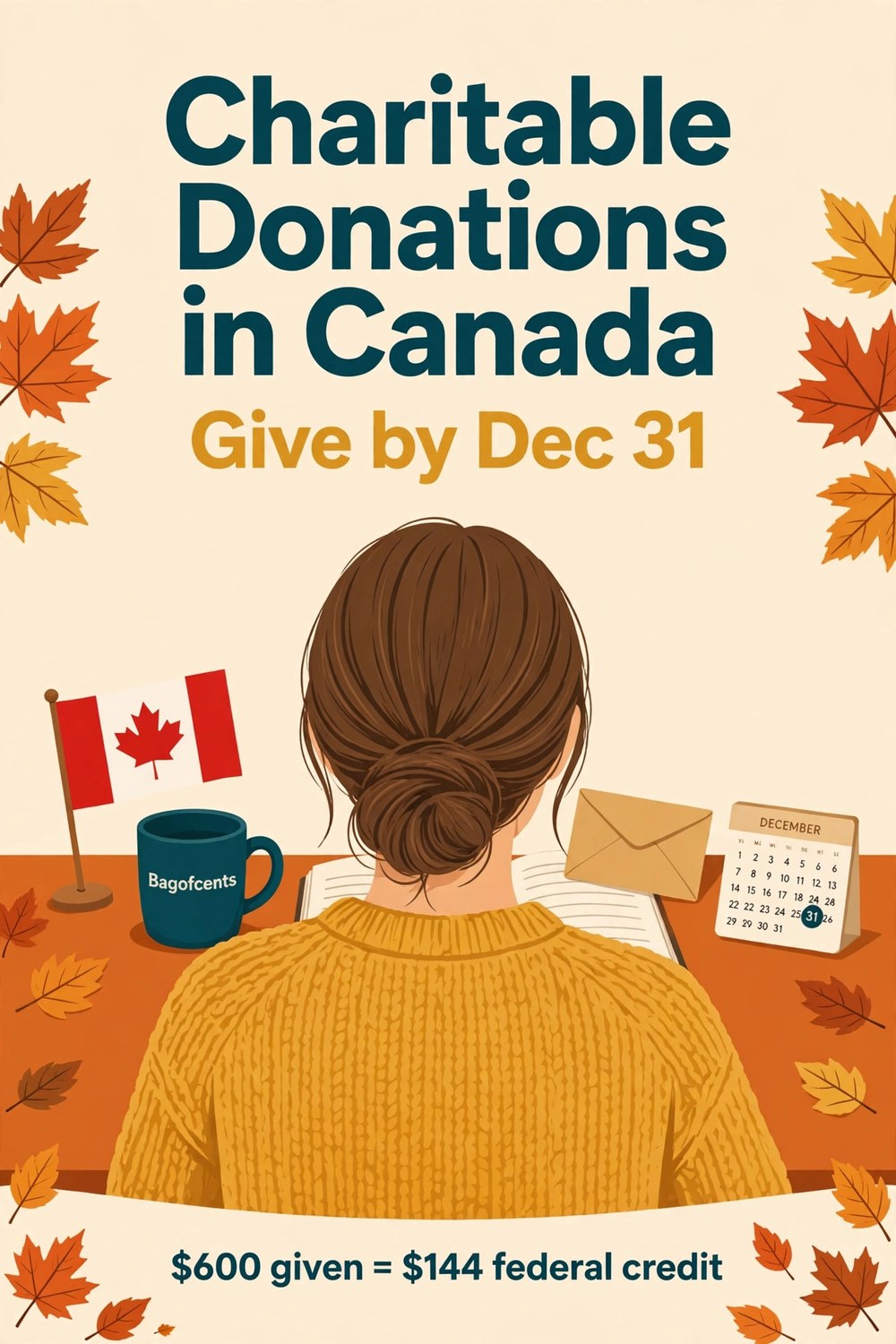
Maya — the same $4,000-a-month paycheque from this month’s series — gives $50 a month to a food bank and a shelter: $600 for 2026. Her federal credit, if she claims it all for 2026:
| Portion | Rate (federal, 2026) | Credit |
|---|---|---|
| First $200 | 14% | $28 |
| Remaining $400 | 29% | $116 |
| Total federal | $144 |
Her provincial credit stacks on top of that $144. Nothing about her giving changes — the only decision is timing and claiming: gifts made by December 31 stay in 2026, and if a lean year ever made the credit unusable, she could carry the claim forward instead of losing it.
Three Rules That Protect the Credit
Only registered charities can receipt you. A gift to a registered charity or other qualified donee comes with an official donation receipt. A gift to a GoFundMe, a neighbour, or an unregistered group may be generous — it is just not claimable. The CRA keeps a searchable list of registered charities; a two-minute check before a big gift protects the credit.
Keep the receipt. No official receipt, no claim. Online gifts usually arrive by email — file them somewhere you will find in April, not in an inbox you will search in a panic.
December 31 is about when the gift is made, not when you file. You claim 2026 donations on the return you file in spring 2027, but the gift itself has to happen in 2026. A January gift is a 2027 donation, claimable in spring 2028 — or carried and claimed within five years, but never backdated into 2026.
FAQ
Is a donation a tax deduction?
No. It is a non-refundable tax credit. It reduces the tax you owe, down to zero, but it does not reduce your taxable income and cannot create a refund on its own.
How much do I get back on a $100 donation?
Federally for 2026, a $100 claim earns 14% — $14 — plus your provincial credit, because it sits inside the first-$200 tier. The credit gets richer per dollar once your year’s claimed donations pass $200, which is why bunching and spousal pooling exist.
Can I claim a donation my spouse made?
Yes. Spouses can combine donations and have one partner claim the total. It is often the better move, because the household then passes the $200 low-rate tier only once.
What if I forgot to claim last year’s donations?
You likely have not lost them. Unclaimed donations can generally be carried forward and claimed in any of the next five years — another reason bunching works. Keep the original receipts.
Does donating to a GoFundMe count?
Usually no. Crowdfunding gifts to individuals are not donations to a registered charity, so there is no official receipt and no credit, however worthy the cause. If the tax credit matters to you, give through the charity itself.
Is there a maximum I can claim?
Generally up to 75% of your net income for the year, with unused amounts carried forward up to five years. Most households giving from a normal paycheque are nowhere near that ceiling.
Final Thought
Giving should be decided by the cause, not the calendar. But once you have decided to give, the calendar decides what the gift is worth to you at tax time — and it is the same December 31 line this whole month has run on. Give by December 31 and the credit belongs to this year. Give in January and it waits a full extra year. Same money, same charity, different year — and only one of those years was about to run out.
General information only, not tax or financial advice. Donation credit rates and rules are set by the federal and provincial governments and change over time; confirm the figures for your province and your situation before relying on them.
Leave a Reply