
Friday’s article was about one account: the FHSA, and why opening it before December 31 matters even if you put $0 in it.
Today’s question is the one that comes right after it — usually from someone who already has an RRSP: “Wait. Do I have to choose between the two?”
No. And the difference between choosing and stacking is about $60,000.
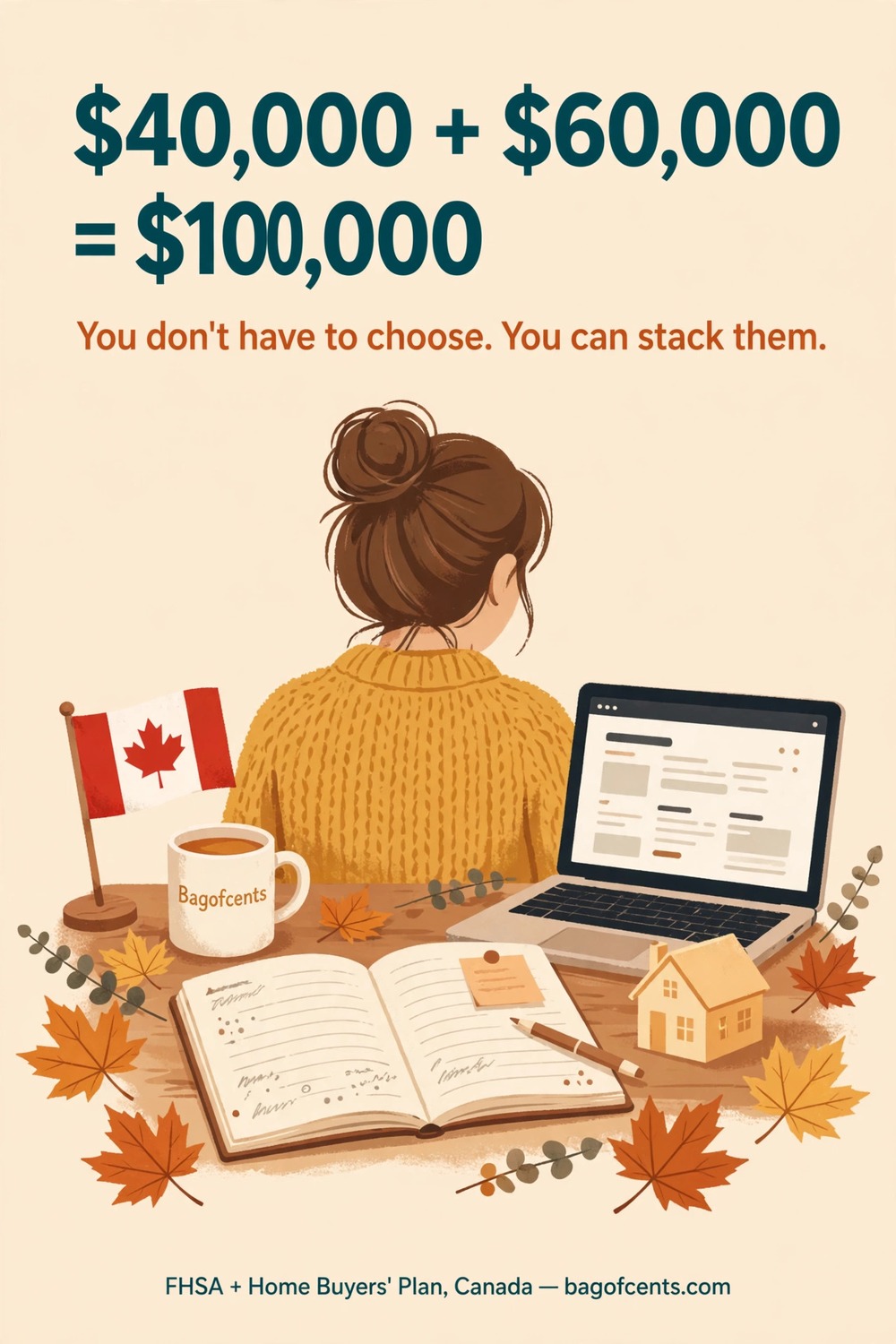
The Two Programs in Plain English
The FHSA is new savings. You contribute up to $8,000 a year, to a $40,000 lifetime limit. Contributions can be deducted from your taxes. When you buy a qualifying first home, the money comes out tax-free — and it never has to be paid back. That last part is what makes it different from everything else in this article.
The Home Buyers’ Plan is old savings, borrowed from yourself. If you already have money inside an RRSP, the HBP lets you withdraw up to $60,000 of it to buy or build a qualifying home, with no tax taken off when it comes out. The catch is in the name of the deal: it is a loan from your future self. You repay it into your RRSP over 15 years, and if you miss a year’s required repayment, that amount is added to your taxable income for that year.
One is a gift you give yourself and keep. The other is a loan you give yourself and repay. They are not rivals. They stack.
The Stack, With Real Numbers
Say Maya has been saving for a first home. She opened her FHSA in 2026 (Friday’s article explains why the year matters) and, over the next few years, fills it to the $40,000 lifetime limit. She also has $60,000 inside her RRSP from years of workplace contributions.
When she buys:
- FHSA withdrawal: up to $40,000 (plus any growth the money earned inside the account). Tax-free. Nothing to repay, ever.
- HBP withdrawal: up to $60,000 from the RRSP. No tax at withdrawal. Repaid over 15 years — on the full $60,000, that is $4,000 a year once her repayments begin.
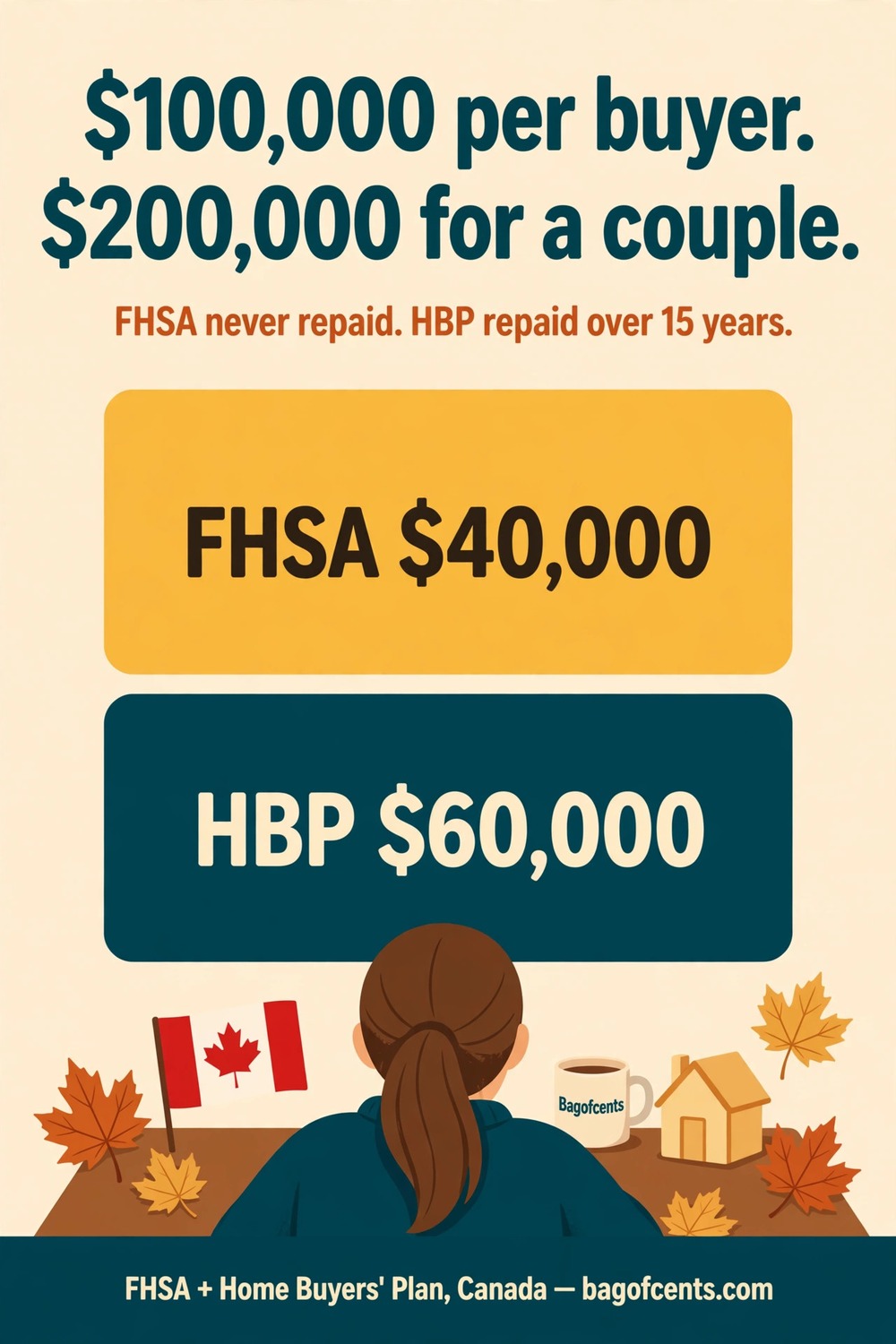
Total down payment room from the two programs: up to $100,000 — from one buyer.
Now make it a couple. If her partner also qualifies, has their own FHSA filled to $40,000, and has their own RRSP with $60,000 in it, the same stack doubles: up to $200,000 between the two of them. The limits are per person, not per house — but each person has to qualify on their own, and each withdrawal has to meet its own program’s conditions at the time it is made.
The Order Matters: FHSA First
If you are still building your savings, fill the FHSA first. Three reasons:
- It is the only one that is never repaid. Every FHSA dollar you withdraw for your home is simply yours.
- Its room is use-it-in-time. FHSA room only starts the year you open the account, and the account has a participation window — money you never use for a home can transfer to your RRSP, but you cannot rewind the years you did not open it.
- The HBP only works on money that is already in an RRSP. There is nothing to “fill” ahead of time beyond your normal RRSP saving.
Think of it as: FHSA is the foundation, HBP is the top-up if your RRSP already has the savings and you need more down payment than the FHSA holds.
The Part People Forget: The Repayment Is a Bill
A $60,000 HBP withdrawal feels free on closing day. It is not. It is a commitment to put $4,000 a year back into your RRSP for 15 years once repayments begin — on top of a new mortgage, property tax, and everything else a first home costs. Miss a year and that year’s amount becomes taxable income instead.
When do repayments begin? For a first withdrawal made between January 1, 2022 and December 31, 2028, the CRA’s temporary repayment relief pushes the start to the fifth year after the withdrawal — a first withdrawal in 2026 means the first repayment year is 2031, then $4,000 a year for 15 years on a full $60,000 withdrawal.
That does not make the HBP a bad deal — borrowing from yourself at no interest beats most alternatives. It just means the honest question is not “how much can I take out?” but “can my future budget carry the repayment?” A down payment that leaves you unable to repay yourself is quietly taxing you later.
Budget for the $4,000 a year the same way Friday’s FHSA readers budget for the contribution: as a line in the plan from day one, not a surprise when the first repayment year arrives.
Who This Does NOT Work For
- You have no RRSP savings. The HBP withdraws what is there; it creates nothing. Your stack is the FHSA alone — which is still $40,000 of room, and Friday’s deadline still applies.
- You are not a first-time buyer under the CRA’s test. Both programs have their own eligibility conditions, and each withdrawal is judged on its own conditions at the time you make it.
- Your home does not qualify, or the timing is off. Each program has rules about the home and when you must buy or build it. Check the conditions before you withdraw, not after — a withdrawal that misses the conditions can be taxed.
FAQ
Can I really use both for the same home?
Yes. The CRA allows an HBP withdrawal from your RRSPs and a qualifying FHSA withdrawal for the same qualifying home, as long as you meet all the conditions of each program at the time of each withdrawal.
What if I take FHSA money out and the purchase falls through?
The conditions are checked at withdrawal time and there are rules and deadlines around completing the purchase. This is exactly the situation to confirm with the CRA pages (or a tax professional) before withdrawing — do not withdraw first and read later.
Does the HBP withdrawal use up my RRSP room?
No. Repayments go back into your RRSP without needing new room, but they also do not give you a second tax deduction — you already got the deduction when the money first went in.
What happens to FHSA money I never use for a home?
It can be transferred directly to your RRSP (or RRIF) without using your RRSP room, within the program’s deadlines. It is not lost — but it stops being tax-free-on-the-way-out money and becomes regular RRSP money.
Should I put money into an RRSP just to use the HBP?
Be careful: if you made contributions to your RRSPs during the 89-day period before you withdrew the amount for your HBP withdrawal, your RRSP contribution may not be deductible. If this is your situation, check the CRA’s HBP conditions before contributing.
Final Thought
Friday’s move was small and urgent: open the FHSA before December 31 so this year’s $8,000 of room exists at all. Today’s is the bigger picture that move belongs to.
A first home in Canada does not come from one account. For a buyer who plans ahead, it can come from $40,000 that is never repaid, stacked under $60,000 borrowed from yourself and repaid on a schedule you chose with your eyes open — $100,000 per buyer, before a partner’s stack doubles it.
Open the first account on time. Fill it first. Then stack.
For general education only, not financial advice. FHSA and Home Buyers’ Plan limits and rules are set by the CRA and can change; check canada.ca for the current rules and confirm your own eligibility before withdrawing under either program.
Leave a Reply