
Wednesday’s article was about how much TFSA room you have. Thursday’s was about what goes inside it. Today’s is about the account that works backwards from both of them — because with this one, the room does not even start until you open it.
It is called the FHSA — the First Home Savings Account. If you are saving for a first home in Canada, it is probably the best tax deal available to you: a deduction on the way in, like an RRSP, and tax-free money on the way out for your home, like a TFSA. And the catch that costs people the most is not the limit. It is the calendar.
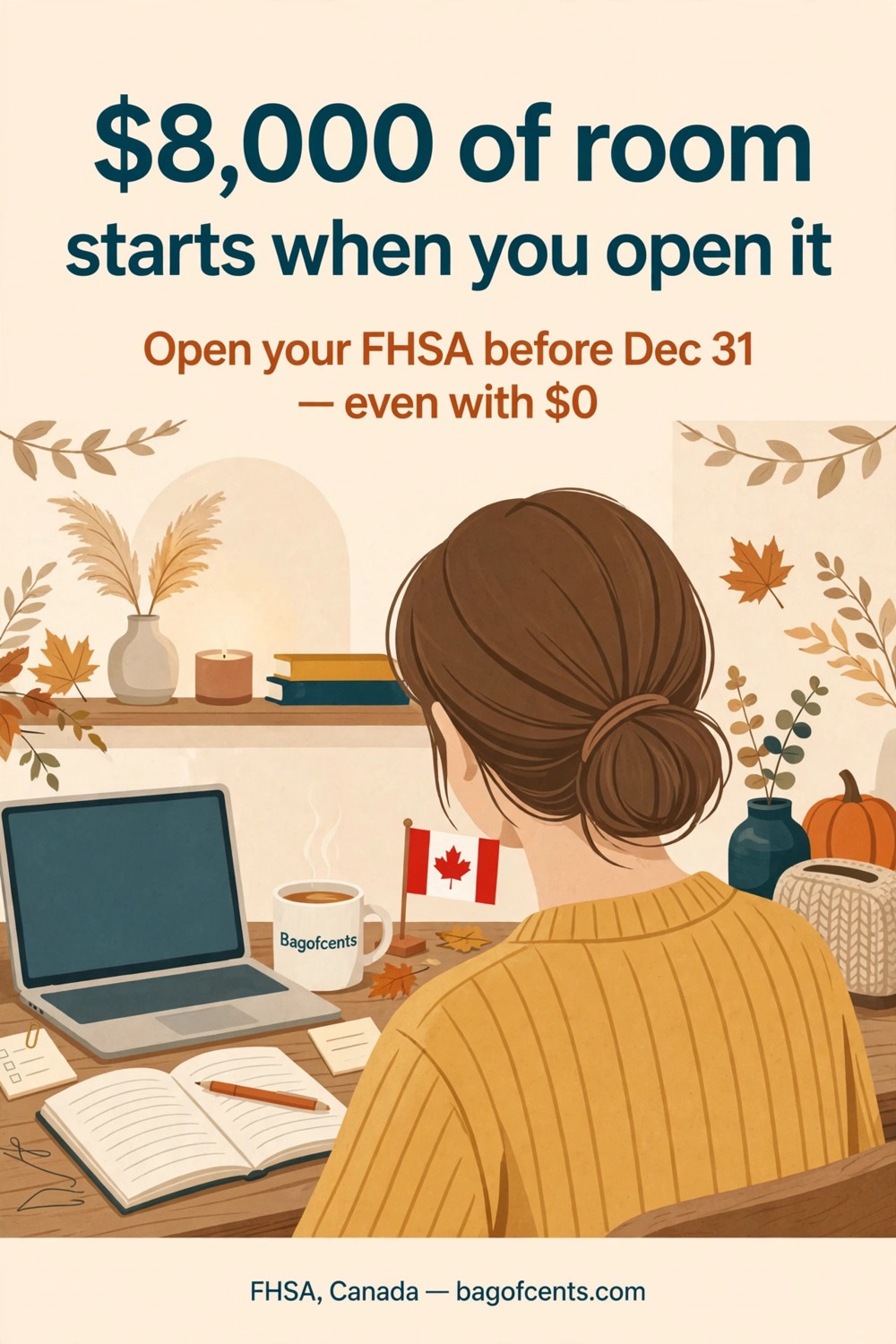
The One Rule That Changes Everything: Room Starts When You Open It
A TFSA builds room whether you use it or not — turn 18, and the room starts adding up. The FHSA does not work that way.
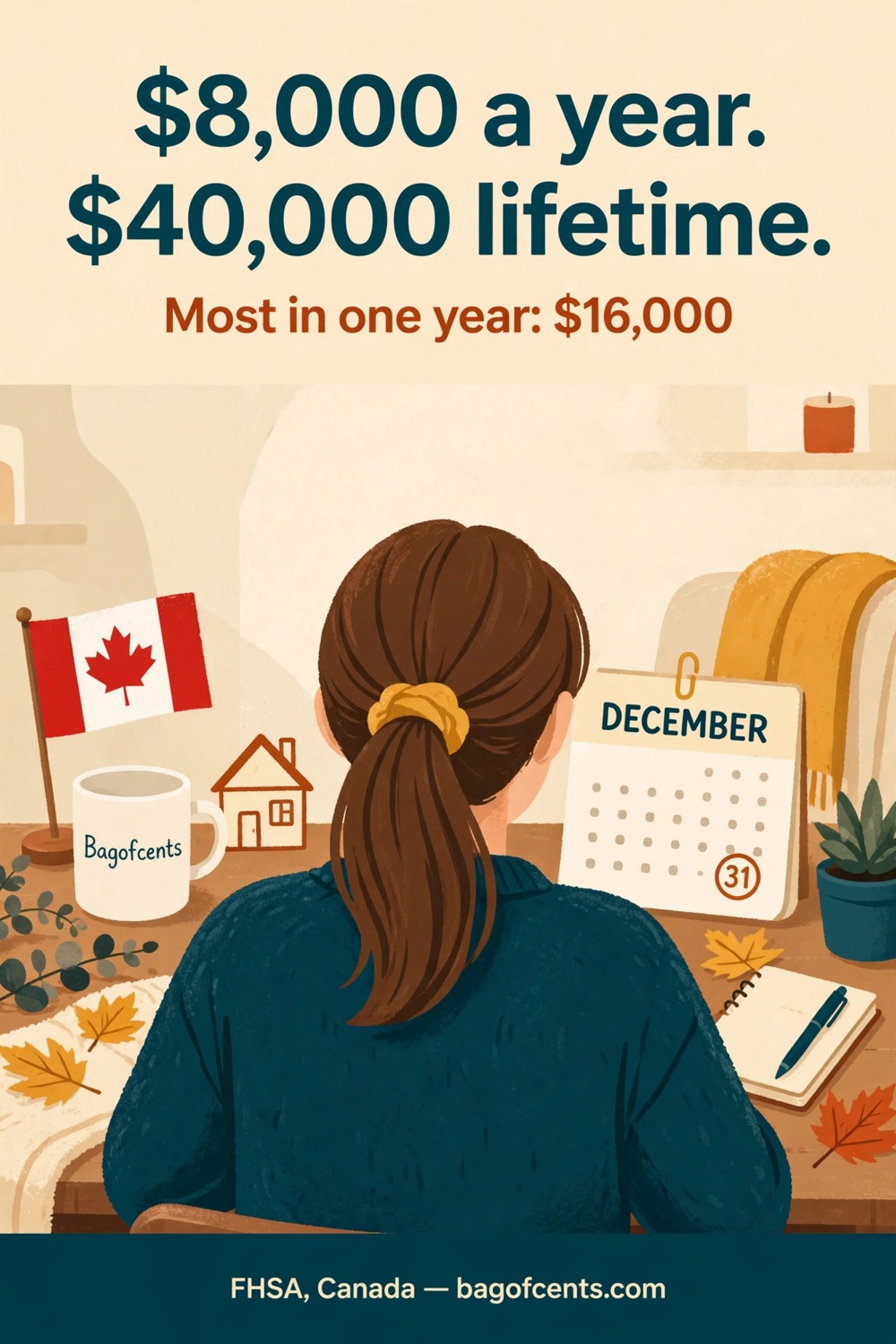
Your FHSA room is $8,000 for the year you open your first account, and $8,000 for each year after that, up to a $40,000 lifetime limit. Before the account exists, there is no room at all. Nothing carries in from 2023, 2024 or 2025 if you were not open yet.
That makes opening the account — on its own, before you save a single dollar — the most valuable step:
- Open in 2026, contribute nothing: you carry $8,000 of room into 2027, and get another $8,000 that year. By the end of 2027 you can have up to $16,000 of room waiting.
- Wait and open in 2027 instead: your first year of room is 2027’s $8,000. The 2026 room is simply gone. It never comes back.
Same person, same savings, one December deadline apart — and an $8,000 difference in how much can ever go in tax-advantaged, because the lifetime limit is $40,000 either way and the clock runs out.
Who Can Open One
You have to meet every condition on the day you open it:
- A resident of Canada.
- At least 18 — 19 in provinces and territories where that is the age you can sign a contract, including BC.
- 71 or younger on December 31 of the year you open it.
- A first-time home buyer, in the CRA’s specific sense: in this calendar year, and in the previous four calendar years, you did not live in a home you owned (or jointly owned) as your principal residence.
Note the wording: it is about living in a home you owned, in a five-calendar-year window — not about whether you have ever owned property at any point in your life. Someone who owned a home long ago, sold it, and has rented for the last five years can qualify. Someone who bought last year cannot.
How the Money Works
Going in. Contributions are generally tax-deductible, like RRSP contributions. You can claim the deduction in the year you contribute or carry it to a later year — useful if your income is low now and will be higher later, when the deduction is worth more.
While it is there. Like a TFSA, an FHSA is a container, not an investment (Thursday’s article covers this in full). Inside it, money can sit in a savings account, a GIC, or a fund, and growth inside the account is not taxed.
Coming out for a home. A qualifying withdrawal to buy or build your first home is tax-free — and unlike the RRSP Home Buyers’ Plan, it never has to be paid back. You complete CRA Form RC725 and give it to your FHSA provider when you withdraw.
If you do not buy. This is the part that removes most of the risk of opening one. If the home never happens, the money can transfer directly into your RRSP or RRIF without being taxed at the time — and without using up any of your RRSP room. Opening an FHSA does not trap the money in a house purchase.
The clock. An FHSA can stay open for 15 years. It must close by December 31 of the earliest of: the 15th anniversary of opening your first one, the year you turn 71, or the year after your first qualifying withdrawal.
The Worked Example: $100 a Week, Two Start Dates
Take the Save With Me pace: $100 a week, $5,200 a year — comfortably inside the $8,000 annual room.
- Open in November 2026, start saving in January: 2026 gives you $8,000 of room even though you contributed $0 that year. From 2027 on, $5,200 a year fits easily, and the carried-forward room is a buffer for a bonus, a tax refund, or a bigger year later.
- Open in January 2027 instead: identical savings, identical paycheques — but $8,000 less lifetime room to work with, and one year less on the 15-year clock before you have even started.
The habit is the same either way. The account-opening date is what changes the math. That is why the opening comes first, even at $0.
FHSA, TFSA or RRSP for a Down Payment?
They are not rivals; they do different jobs, and many buyers use more than one:
- FHSA first, if you qualify: it is the only one that gives a deduction going in AND a tax-free withdrawal for the home, with no repayment. That combination exists nowhere else. $40,000 lifetime, per person — a couple who both qualify have $80,000 of FHSA room between them.
- TFSA next: flexible, tax-free out for anything, and room comes back the January 1 after a withdrawal. Good for the part of the down payment above the FHSA limit, or for anyone who does not qualify for an FHSA.
- RRSP Home Buyers’ Plan: up to $60,000 can be withdrawn for a home, but it has to be repaid over 15 years or the missed amounts become taxable income. The FHSA has no repayment — one reason it usually goes first.
How to Open One in About 20 Minutes
Step 1: Check you qualify today. Resident, age, and the five-year first-time-buyer window above. If you are not sure about the window, check before you open — opening while ineligible creates a tax problem, not room.
Step 2: Open it before December 31, 2026. At your bank, credit union or online brokerage — wherever you already bank is fine to start. Opening it is what creates the 2026 room; the amount you put in on day one can be $0.
Step 3: Put something in, even small, when you can. $100 a week is the pace used throughout this series, but $25 on opening day starts the habit and starts your contribution record.
Step 4: File Schedule 15 at tax time. The CRA only knows about your FHSA once you file Schedule 15 with your return for the year you opened it — file it even if you contributed nothing.
Step 5: Decide where the money sits. Money for a home in a year or two belongs somewhere safe and reachable, like a savings account inside the FHSA. Money for a home in five-plus years has time to work harder. Same rule as Thursday’s TFSA article: match the money to the date.
5 Mistakes That Waste the FHSA
1. Waiting until you have money to open it. The room starts at opening, not at your first contribution. Every December 31 you let pass unopened is $8,000 of room that never exists.
2. Assuming you are not a “first-time buyer.” The test is the current year plus the previous four, and it is about living in a home you owned. Plenty of people who owned years ago qualify and never check.
3. Contributing before you open, or over-contributing. Room is across all your FHSAs combined, and the CRA charges 1% per month on an excess until it is removed — the same penalty style as a TFSA over-contribution.
4. Claiming the deduction in a low-income year without thinking. The deduction can be carried to a later year. If your income will be higher soon, waiting can make the same contribution worth more.
5. Forgetting the 15-year clock. Open at 25, and the account must close by the end of the year you turn 40 (the 15th anniversary year). If there is no home by then, plan the direct transfer to your RRSP — it is tax-free and does not use RRSP room, but it does not happen by accident; you arrange it before the deadline.
FAQ
Can I open an FHSA and a TFSA at the same time?
Yes. They are separate accounts with separate room. Many first-time buyers hold both — FHSA first for the deduction-plus-tax-free combination, TFSA for everything above it or anything more flexible.
Can I use the FHSA and the RRSP Home Buyers’ Plan together?
Yes, for the same home — $40,000 from the FHSA (no repayment) plus up to $60,000 under the HBP (repayable over 15 years) is $100,000 of tax-advantaged down-payment money per person.
What if I open one and never buy a home?
The money transfers directly to your RRSP or RRIF without immediate tax and without using your RRSP room, before the account’s closing deadline. Or you can withdraw it as taxable income. Opening one does not force a purchase.
Do I have to contribute the year I open it?
No. Opening creates the room; unused room carries forward, capped at $8,000 carried in — so the most you can contribute in any single year is $16,000 ($8,000 new room + $8,000 carried forward).
Can my partner and I each have one?
Yes, if you each qualify on the day you open yours. That is $40,000 of lifetime room each — $80,000 combined toward the same first home.
I turned 18 this year. Should I open one already?
If you qualify and a first home is even a distant possibility, the room argument says yes: opening starts the $8,000-a-year clock and the 15-year window, and the RRSP transfer means the money is not wasted if plans change. Read the eligibility rules first, and open only if you meet them.
Final Thought
Most accounts reward you for saving. This one rewards you first for simply opening it — $8,000 of room that exists only because the account does, and another $8,000 every year after, up to $40,000.
If a first home is anywhere in your future, the move before December 31 is not a deposit. It is twenty minutes and an open account, even at $0. The saving can start in January. The room cannot.
For general education only, not financial advice. FHSA limits and rules are set by the CRA and can change; check canada.ca for the current rules and confirm your own eligibility before opening an account or making a large contribution.
Leave a Reply