
You have $10,000 saved, and it is sitting in a savings account earning next to nothing. A five-year GIC pays a better rate — but locking every dollar away for five years feels wrong, because life happens. What if the car breaks down in year two, or a better opportunity shows up in year three?
There is a middle path: the GIC ladder. Split your money across several terms, and every year one rung matures — cash back, plus the chance to grab the best rate available then. You earn more than a one-year GIC, and you are never more than twelve months away from money.

What Is a GIC Ladder?
A GIC ladder is a simple strategy: divide your savings into equal parts and buy Guaranteed Investment Certificates with different maturity dates — one year, two years, three years, four years, and five years. Each GIC is one “rung” of the ladder.
A GIC (Guaranteed Investment Certificate) is a deposit with a bank or credit union for a fixed term at a fixed rate. Your principal is guaranteed, and CDIC member institutions protect deposits up to $100,000 per category. Unlike the stock market, a GIC cannot go down.
Here is what the ladder looks like with $10,000:
- Rung 1: $2,000 in a 1-year GIC
- Rung 2: $2,000 in a 2-year GIC
- Rung 3: $2,000 in a 3-year GIC
- Rung 4: $2,000 in a 4-year GIC
- Rung 5: $2,000 in a 5-year GIC
Each year a rung matures: take the $2,000 plus interest and buy a new 5-year GIC at the rate available then. Within five years your whole ladder is 5-year GICs — the highest-rate rung — yet one-fifth of your money still comes back to you every year.
Why a Ladder Beats One Big GIC
Locking everything into a 5-year GIC earns the best rate but freezes your money: need cash in year two and you either break the GIC — usually losing most or all of the interest — or borrow at a much higher rate. Parking everything in a 1-year GIC keeps your money flexible, but if rates fall next year, your whole $10,000 renews at the lower rate.
The ladder splits the difference:
- Liquidity every year. One rung matures every twelve months, so you are never more than a year away from 20% of your money — and you can always stop re-laddering a rung if you need the cash.
- A better average rate. Longer terms usually pay more, so most of your money sits in 3-, 4- and 5-year GICs earning higher rates than a 1-year term ever would.
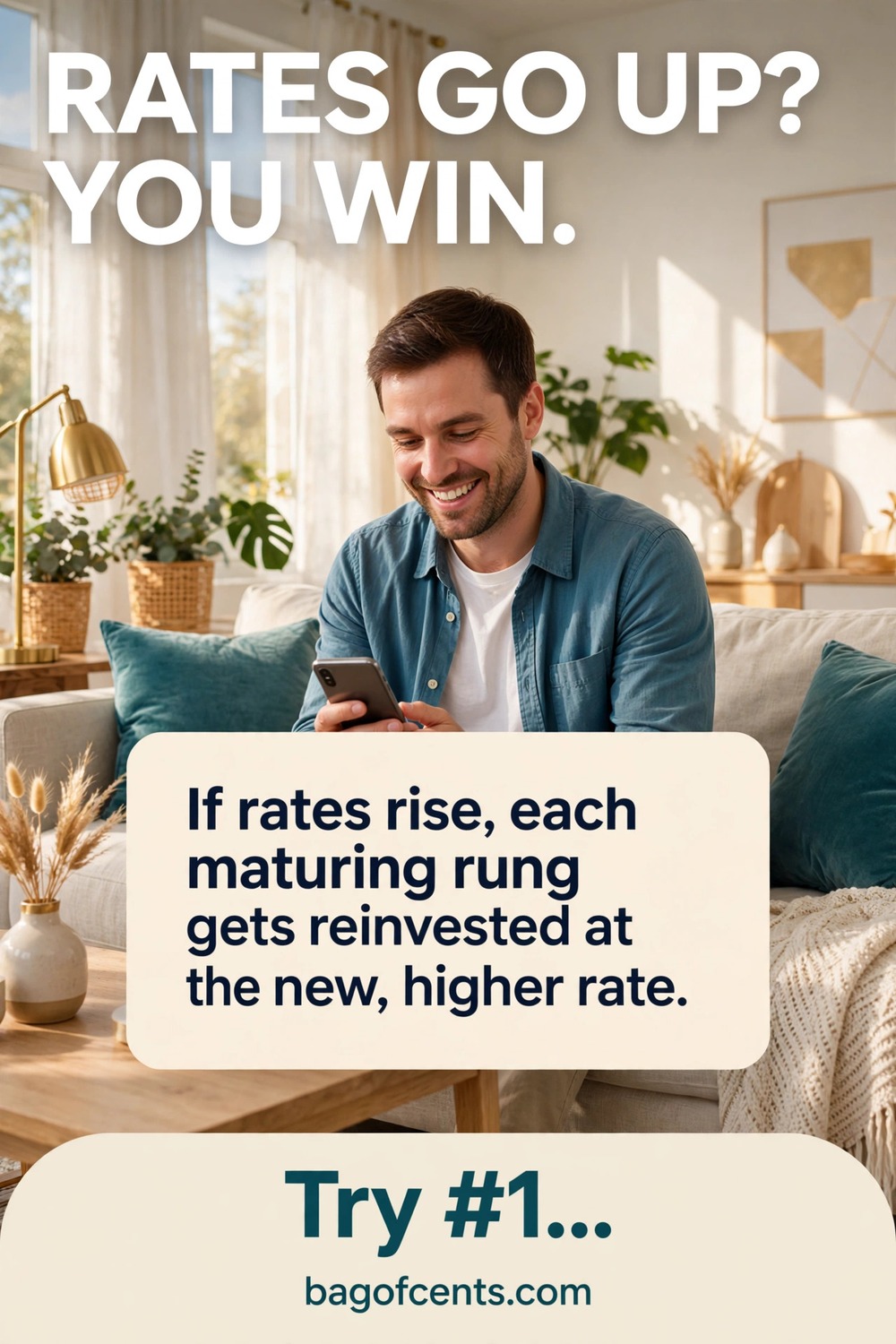
- Built-in rate protection. If rates rise, each maturing rung gets reinvested at the new, higher rate. If rates fall, most of your money is already locked in at the old, higher rates. You never have to guess which way rates are going, because the ladder spreads your bet across five years.
How to Build a GIC Ladder in 5 Steps
Step 1: Decide How Much Goes in the Ladder
A ladder works best with money you will not need for at least a year, ideally with a medium-term job: a house down payment two to five years out, a car replacement fund, or savings you want to protect from yourself. It is not for your emergency fund — that money needs to be reachable in days.
Any amount works: $5,000 divides into five $1,000 rungs, $25,000 into five $5,000 rungs. Check minimums first — most institutions require $500 to $1,000 per GIC.
Step 2: Pick the Right Account — TFSA, RRSP, or Non-Registered
GICs can live inside a TFSA, an RRSP, or a non-registered account. TFSA interest is tax-free; RRSP interest grows tax-sheltered until withdrawal; non-registered interest is taxed in full as income. If you have TFSA room, that is usually the best home for a ladder; the RRSP works for retirement savings, and non-registered is the fallback when registered room is full.
Step 3: Shop Rates Beyond the Big 5
The Big 5 rarely pay the best GIC rates in Canada. Online banks and credit unions often pay noticeably more for the same CDIC protection. Compare rates across at least three institutions before buying a rung. Non-redeemable GICs pay more but cannot be cashed early; a ladder normally uses these, since maturing rungs provide the flexibility.
Step 4: Buy the Five Rungs
Open the GICs on the same day, one for each term: 1, 2, 3, 4 and 5 years, the same amount in each. If your bank lets you set maturity instructions at purchase, choose “reinvest into a new 5-year GIC” as the default — but only if you are confident you will not need that cash. Otherwise choose “deposit to savings at maturity” and decide each year. Write down every maturity date and set calendar reminders a week before each one.
Step 5: Maintain the Ladder Every Year
When a rung matures, reinvest it into a new 5-year GIC (the default), spend it if the goal has arrived, or park it in a 1-year GIC if rates have jumped and you want to wait. That annual decision takes about ten minutes; the rest of the year, the ladder runs itself.
A Real-Numbers Example: $10,000 Over Five Years
Let us run the numbers with stated, illustrative rates — example rates for teaching the math, not a promise of what any bank pays today. Always check current rates before you buy.
Maya in Ottawa has $10,000 saved for a future home down payment, three to five years away. She builds a 5-year ladder with $2,000 per rung, using these illustrative annual rates: 1-year at 3.00%, 2-year at 3.25%, 3-year at 3.50%, 4-year at 3.75%, and 5-year at 4.00%. For clarity, interest is calculated as simple interest on each rung (principal × rate × years), before tax.
| Rung | Amount | Term | Illustrative rate | Interest earned |
|---|---|---|---|---|
| 1 | $2,000 | 1 year | 3.00% | $2,000 × 3.00% × 1 = $60 |
| 2 | $2,000 | 2 years | 3.25% | $2,000 × 3.25% × 2 = $130 |
| 3 | $2,000 | 3 years | 3.50% | $2,000 × 3.50% × 3 = $210 |
| 4 | $2,000 | 4 years | 3.75% | $2,000 × 3.75% × 4 = $300 |
| 5 | $2,000 | 5 years | 4.00% | $2,000 × 4.00% × 5 = $400 |
Total interest over five years: $60 + $130 + $210 + $300 + $400 = $1,100. Maya’s $10,000 becomes $11,100, and along the way she gets $2,000 back (plus interest) at the end of every year.
Compare the alternatives at the same illustrative rates. All $10,000 in a 1-year GIC at 3.00% earns $300 in year one — but if rates fall to 2.00%, the whole balance earns less from then on. All $10,000 in a 5-year GIC at 4.00% earns $2,000 over five years, more than the ladder’s $1,100, but with zero access for five years. All $10,000 in a savings account at 1.50% earns roughly $750 over five years, with no rate lock at all.
The ladder earns $350 more than the savings account over five years while keeping a rung maturing every year, and gives up $900 versus the locked 5-year GIC in exchange for that annual access. Inside a TFSA, Maya’s $1,100 of interest is tax-free; in a non-registered account at a 20% marginal rate, roughly $220 of it would go to tax.
Common Mistakes That Weaken a Ladder
Building the ladder with emergency-fund money. Your emergency fund needs to be available in days. A GIC rung that matures in eleven months is not available in days. Keep the emergency fund in a high-interest savings account and ladder only the money with a longer horizon.
Buying all five rungs at the same bank without comparing rates. The difference between the best and worst 5-year GIC rates in Canada is often a full percentage point or more. On $10,000, one percentage point is $100 a year — $500 over five years — for the same CDIC protection. Ten minutes of comparison shopping is the highest-paid work in this whole strategy.
Ignoring taxes on non-registered GICs. GIC interest is taxed as regular income, not at the lower capital-gains rate. A 4% GIC in a non-registered account at a 30% marginal rate is really a 2.8% return after tax. Do the after-tax math before comparing a GIC to other options.
Frequently Asked Questions
How much money do I need to start a GIC ladder?
Most institutions require $500 to $1,000 per GIC. With $5,000 you can build a clean five-rung ladder at $1,000 per rung. Below that, start with a 3-rung ladder (1, 2 and 3 years) and add rungs as you save more.
Are GICs safe?
GICs from CDIC member institutions are protected up to $100,000 per category, per institution, covering principal and interest. Credit unions have provincial deposit insurance, often with higher limits.
Can I hold a GIC ladder in a TFSA?
Yes. Most banks and brokerages let you buy GICs inside a TFSA, an RRSP, or a non-registered account. Inside a TFSA the interest is tax-free, which makes it the best home for most ladders — as long as you have the contribution room.
What happens if interest rates rise after I build my ladder?
That is exactly what the ladder is designed for. Each year a rung matures and gets reinvested at the new, higher rate. Within five years your whole ladder is earning the higher rates. You never have to predict the Bank of Canada’s next move.
What if rates fall?
Then the ladder protects you the other way: most of your money is already locked in at the older, higher rates, and only one rung per year renews at the lower rate.
Final Thought
A GIC ladder is not exciting, and that is precisely the point. It turns a lump sum that would otherwise sit in a low-interest account — or get locked away for five years — into a system: higher rates than a savings account, cash back every year, and protection in both directions when rates move.
The $10,000 example above earns $1,100 over five years at illustrative rates, with $2,000 maturing every year. The exact numbers will differ with real rates, but the structure is what matters: five rungs, one decision a year, and money that is always working but never fully out of reach.
This is general information, not personalized financial advice. Always confirm current rates and CDIC coverage before you buy.
Liked this? Take it further.
Get the free 52-Week Savings Challenge Tracker — the printable that turns “I should save” into $1,378. Print it, stick it on your fridge, check off Week 1 today.
Join the Bagofcents weekly money tips email. Unsubscribe anytime.
Happy Budgeting!
Stanley
Leave a Reply