
Most people do not blow their budget in one big purchase. They lose it $20 at a time, in upgrades that felt small when they happened and invisible a month later.
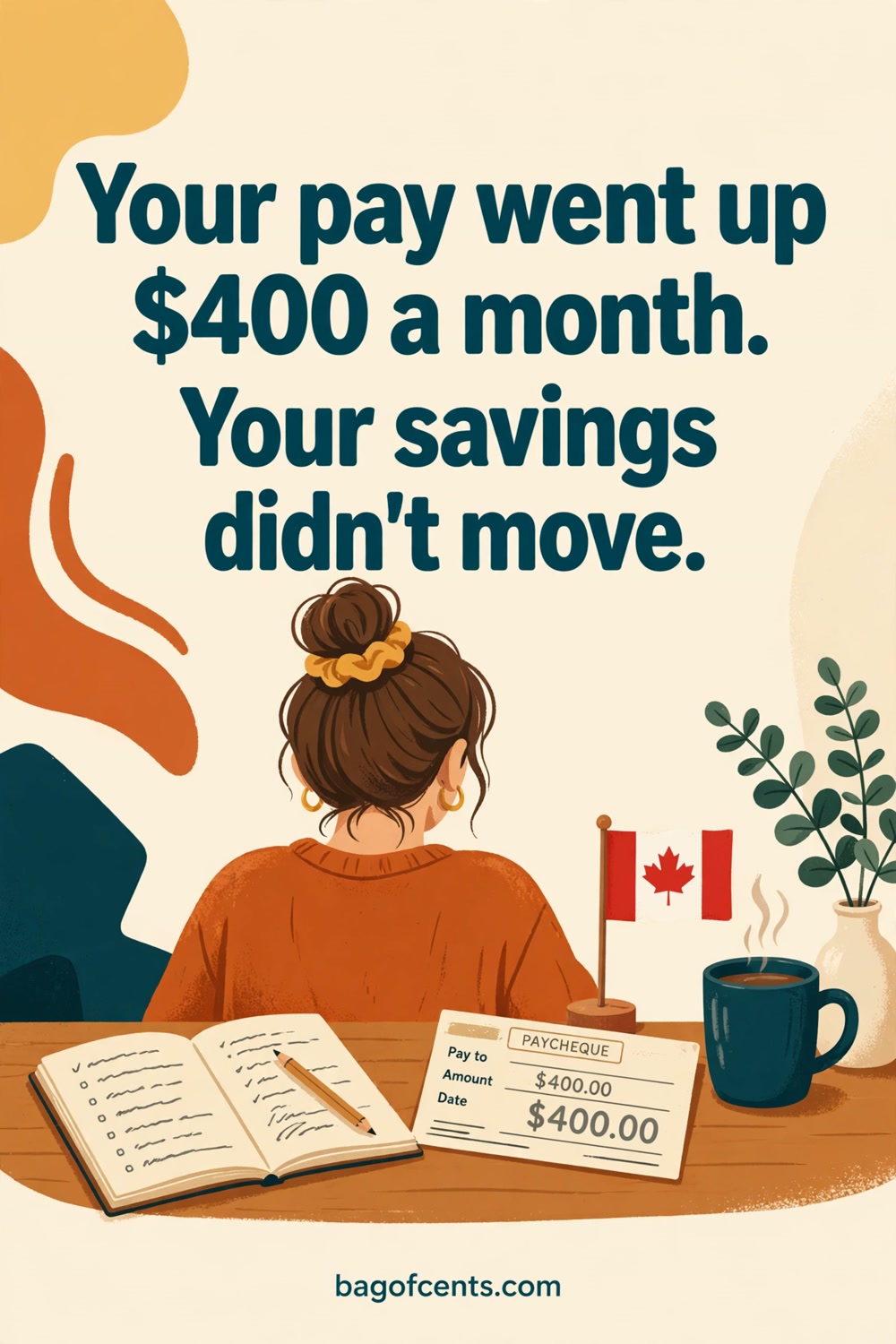
That is lifestyle creep. Your pay goes up, your spending goes up with it, and a year later you earn more and save exactly the same amount — or less. Nothing feels wrong, because no single purchase was reckless. The leak is the pattern.
This article finds the leak. A real $200-a-month example, five places it usually hides, and a reset that takes one evening, not a whole new personality.
What Lifestyle Creep Actually Is
Lifestyle creep is spending that rises to match income, automatically. A raise lands, and within a few months the new money has a job: a better phone plan, lunch out instead of lunch packed, the premium streaming tier, groceries from the nicer store.
None of those is a bad purchase on its own. The problem is that none of them was a decision either. The old budget never got updated, so the new spending just moved in.
The test is simple. If your income went up in the last two years and your savings did not go up with it, you have lifestyle creep. It does not matter how careful you feel. The numbers are the test.
The $200-a-Month Leak, Found
Meet Maya. She earns $4,000 a month after tax and deductions — the same paycheque as yesterday’s 50/30/20 article. Two years ago she earned $3,600. Her savings are still $300 a month, exactly where they were. Where did the extra $400 go?
About $200 of it went to her fixed costs going up — rent and groceries genuinely cost more than they did two years ago. The other $200 went here:
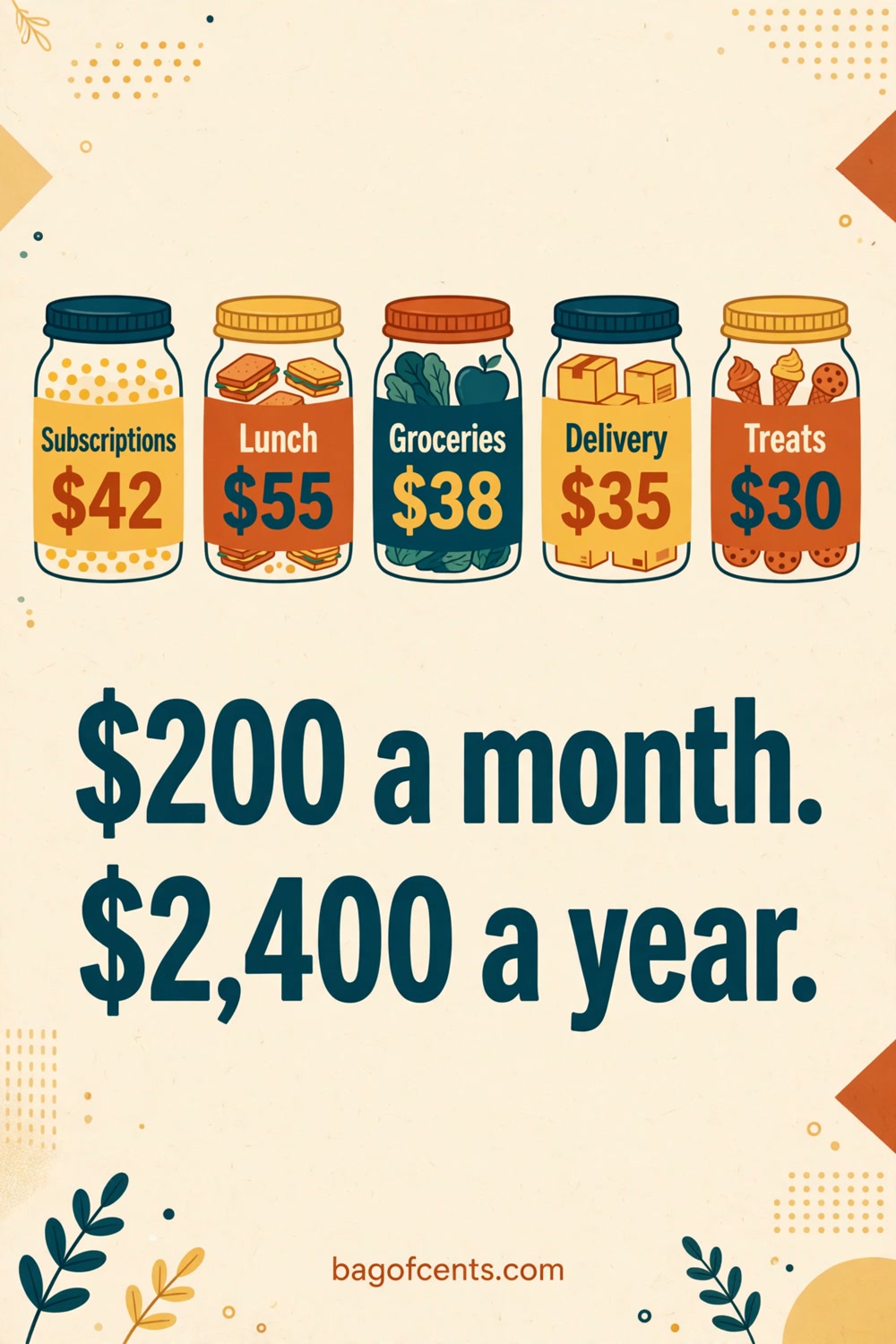
Subscriptions — $42 a month. Two streaming services she watches, one she forgot she had, a music app, a cloud storage plan, and a fitness app she opened twice. None of them is expensive. Together they are $42.
Lunch and takeout — $55 a month. She used to pack lunch four days a week. Now it is two. The difference is about $13 a week in takeout and coffee — $55 a month.
Grocery upgrades — $38 a month. Same shop, nicer version of everything: the brand-name cereal, the pre-cut vegetables, the fancy coffee. About $9 a week.
Delivery and convenience — $35 a month. Delivery fees, tips, and the odd ride instead of the bus when it rains. Small, frequent, and easy to forget.
“Treat yourself” shopping — $30 a month. A candle, a book, a top on sale. Nothing over $25. It adds up to $30.
Add it up: $42 + $55 + $38 + $35 + $30 = $200 a month. That is $2,400 a year. Over ten years, that is $24,000 before any interest or growth — money that quietly became someone else’s revenue instead of Maya’s savings.
How to Find Your Own Leak in One Evening
You do not need a budgeting app and you do not need to track every dollar for a month. You need one evening and your last two bank statements.
Step 1: Compare, do not categorise. Open last month’s statement next to the same month last year, or next to your last pay rise. Look for the lines that are new, bigger, or more frequent. Those are the creep.
Step 2: Circle the subscriptions. List every recurring charge. For each one, ask: did I use this in the last 30 days? If the answer is no, cancel it tonight. A subscription you do not use is not a small cost. It is a leak with a direct debit.
Step 3: Price the upgrade, not the purchase. Lunch out is not the problem. Lunch out five days a week when you used to do it once is. Work out what the upgraded version costs versus the old version. That difference is the creep.
Step 4: Give the raise a job before it arrives. The next time your pay goes up, decide in advance where half of it goes — straight to savings or extra debt payments, on payday, automatically. If you wait until you “see how it goes,” the spending will decide for you.
Step 5: Keep one upgrade. This is the part most budgets get wrong. Pick the one upgrade that genuinely makes your life better — the better coffee, the gym you actually go to — and keep it, on purpose. Cutting everything is a budget you will quit. Cutting the four leaks you do not even enjoy is a budget you will keep.
What Maya Did With Her $200
Maya cancelled the forgotten streaming service and the fitness app ($24), went back to packing lunch three days a week instead of two ($28 back), and switched the grocery upgrades she did not notice back to the regular versions ($38 back). She kept the music app, the better coffee, and one takeout lunch a week.
That is $90 a month found, not $200 — and that is the point. She did not need to find all of it. $90 a month is $1,080 a year, and she set it to move to her emergency fund automatically on payday. Her savings went from $300 to $390 a month without her life feeling smaller, because the things she cut were things she was not enjoying.
If you find the full $200, that is $2,400 a year. If you find half of it, that is still $1,200 a year. The win is not the exact number. It is that the money now has a decision attached to it.
5 Mistakes That Keep the Leak Going
- Treating a raise as free money. A raise is not extra spending money until you have decided how much of it is savings. Decide first, spend second.
- Auditing once a year. Subscriptions and habits change monthly. A ten-minute check every three months catches a leak while it is still small.
- Cutting the thing you love. If you cut the one upgrade that makes your week better, you will resent the budget and quit it. Keep the joy, cut the autopilot.
- Comparing yourself to people who earn more. Lifestyle creep is not about keeping up with your neighbours. It is about keeping up with your own last paycheque.
- Waiting for a big fix. Nobody needs a new budgeting system to cancel a subscription. The small fix tonight beats the perfect system next month.
FAQ
Is lifestyle creep always bad? No. Spending more because you earn more is normal, and some of it is the point of earning more. It is only a problem when it happens without a decision, and your savings stay flat while your income grows.
How much should I save from a raise? A good starting point is half. If your pay goes up $400 a month, send $200 to savings or extra debt payments automatically on payday, and let the other $200 improve your life. Adjust the split to your situation — the habit matters more than the exact percentage.
What if my costs went up because prices went up? Then that is not creep, that is inflation, and it is real — rent and groceries cost more than they did two years ago. The test is the part of the increase you chose: the upgrades, the extras, the subscriptions. Find those first.
Do I need to track every dollar to fix this? No. Two statements, one evening, and the five steps above will find most of the leak. Tracking helps if you want precision later, but it is not the starting point.
What is the fastest $50 a month to find? For most people, subscriptions. List every recurring charge, cancel anything you have not used in 30 days, and check for duplicates — two services doing the same job is the most common leak of all.
I already live paycheque to paycheque. Does this apply to me? Yes, and it matters more, not less. If your income went up and your savings did not, the leak is eating the money that could have been your buffer. Even $25 or $50 a month found and moved automatically is the start of an emergency fund.
Final Thought
Lifestyle creep is not a character flaw. It is what happens when money arrives faster than decisions do. The fix is not to stop enjoying your money. It is to decide, once, where the next $200 goes — and then let the automatic transfer do the deciding for you every month after that.
Tonight, open your last statement. Find one subscription you do not use, one upgrade you do not notice, and cancel or reverse one of them. That is the whole first step. The rest of the leak will be easier to see once the first one is gone.
For general education only, not financial advice. Your numbers will look different from Maya’s — use the method, not her exact amounts, and adjust it to your own paycheque and costs.
Leave a Reply