
Every December, one piece of free education money quietly resets — and most parents never hear about it until January, when the year is already gone.
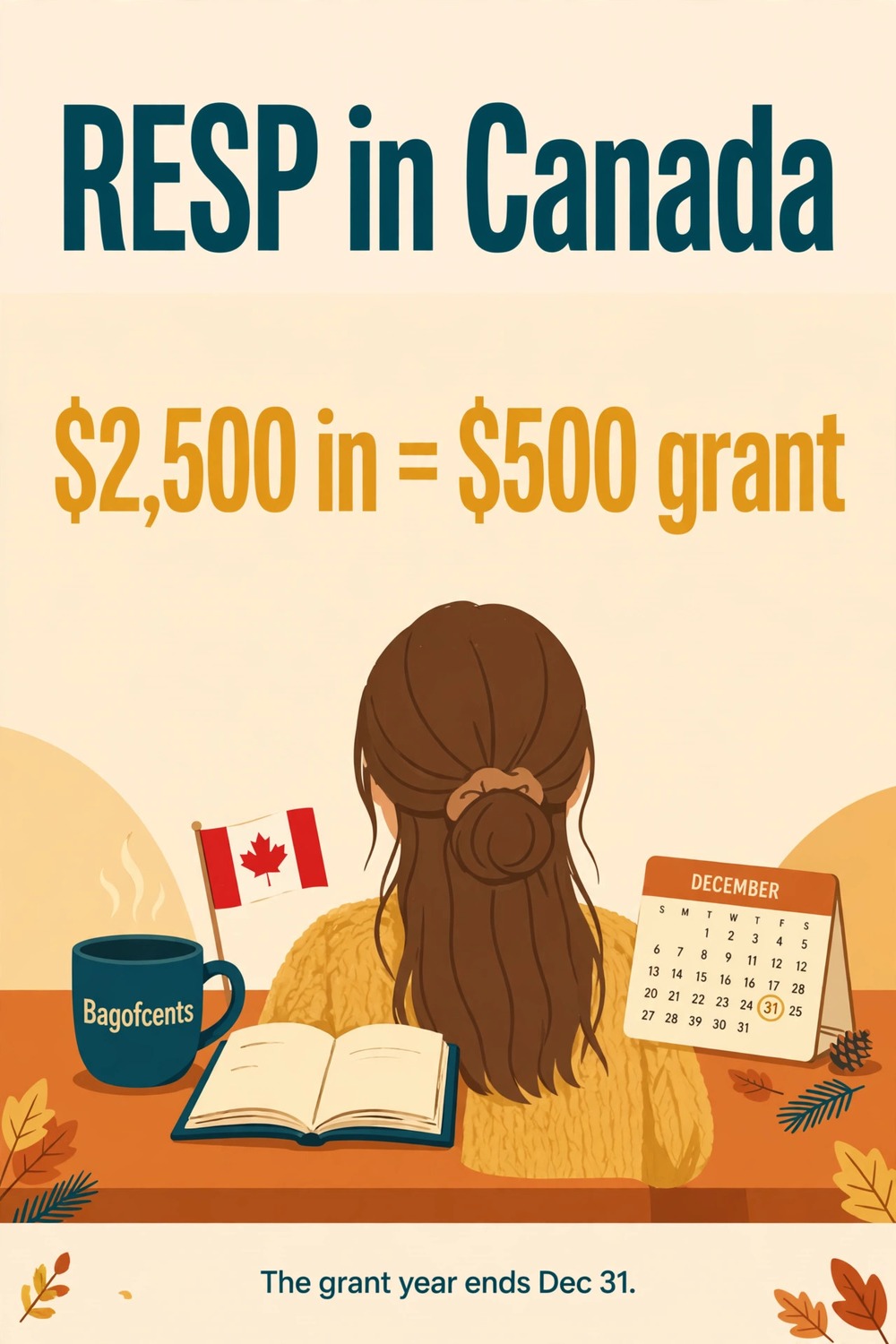
The Registered Education Savings Plan (RESP) comes with a federal grant called the Canada Education Savings Grant. The government adds 20% to what you put in, up to a point: contribute $2,500 for a child in a year and $500 of grant lands in the account on top of it. No forms to chase, no separate application in most cases — the provider applies for it when you contribute. The catch is the calendar: the $500 maximum is measured per year, and December 31 is where the year ends.
How the $500 Year Works
The grant math is simple enough to do on a napkin:
- Contribute $2,500 in a calendar year → $500 of grant.
- Contribute $1,000 → $200 of grant.
- Contribute more than $2,500 in the same year → still $500 for that year, unless you are catching up (below).
The grant goes into the RESP itself, where it grows alongside your contributions, tax-sheltered until it is withdrawn for the student’s education. Over a childhood, the grant alone can reach $7,200 per child — that is the lifetime maximum — and it only gets there if enough years get their $2,500.
The Part That Softens the Deadline: Catch-Up Room
Missed years are not lost the way an unopened FHSA’s first year is lost. Unused grant room carries forward. If you put in nothing when your child was five, that year’s $500 of potential grant is still waiting when they are six, seven, or twelve.
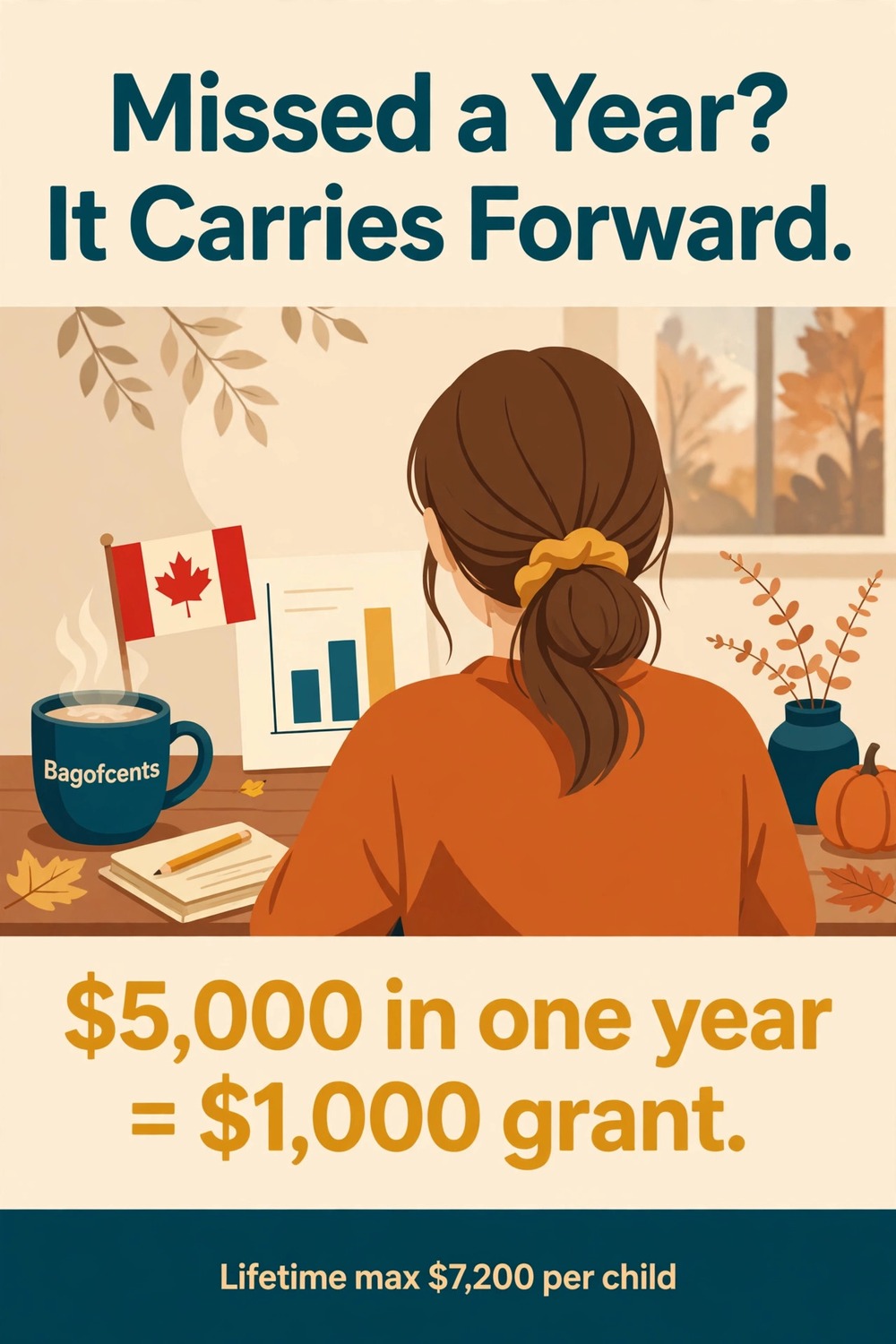
But the catch-up has a speed limit: in any one calendar year, you can claim at most two years’ worth of grant — the current year plus one missed year. That means contributing $5,000 in one year can bring in $1,000 of grant, and no contribution, however large, brings in more than that in a single year.
That speed limit is exactly why December still matters. A family that is three years behind needs three separate calendar years of $5,000 contributions to fully catch up. Every December 31 that passes unused pushes the finish line a year later — and the grant stops for good after the year a child turns 17. Starting the catch-up this December instead of next January can be the difference between finishing in time and not.
Maya’s Version: $100 a Month, and One December Top-Up
Maya — the same $4,000-a-month paycheque from this month’s series — has a daughter, age 7. She opened an RESP two years ago and puts in $100 a month: $1,200 a year, which earns $240 of grant. She is leaving $260 of grant on the table each year, and she has one missed year from before the account existed.
Her December move is not heroic. She adds a one-time $1,300 top-up before December 31, bringing 2026 to $2,500 and claiming the full $500 for the year. The missed year stays on her list for 2027, when a $5,000 year — her monthly $100 plus a bigger top-up — could claim $1,000: 2027’s grant plus the carried-forward year, done in one go.
| Year | Maya contributes | Grant received | Why |
|---|---|---|---|
| 2026 | $2,500 ($100/mo + $1,300 top-up) | $500 | Full current-year grant |
| 2027 | $5,000 (planned catch-up year) | $1,000 | Current year + one missed year |
| 2028 onward | $2,500 a year | $500 a year | Back on pace toward the $7,200 lifetime max |
No new account, no new system — one top-up in the right month, and a plan for the year after.
Three Things Worth Knowing Before You Contribute
The grant is the government’s money until school starts. If the child never enrols in eligible post-secondary education, the grant money is repaid. Your own contributions are always yours to take back. This is not a reason to skip the account — plans, siblings, and part-time and trade programs cover more situations than most people expect — but it is a reason to know the rule going in.
The account needs a SIN for the child. Opening an RESP and receiving the grant requires the child to have a social insurance number and be a resident of Canada. If your child does not have one yet, applying for it is the real first step — and it is free.
Teenagers have an extra rule. For a child who is 16 or 17, the RESP can receive the grant only if, before the end of the year the child turned 15, either at least $2,000 had been contributed to (and not withdrawn from) the RESP, or at least $100 a year had been contributed in at least four of those years. In plain terms: start before the end of the year your child turns 15 if you want the grant in those last two years.
Some provinces add their own grants. A few provinces top up RESPs with programs of their own, with their own amounts and rules. If your province has one, it is found money on the same contributions — worth a five-minute check before you assume the federal $500 is the whole story.
FAQ
Do I have to contribute $2,500 to get any grant? No. The grant is 20% of whatever you contribute, up to the $500 annual maximum. $50 a month is $600 a year and earns $120 of grant — a smaller start beats no start, and the room carries forward.
I missed several years. Is it too late? Probably not. Missed grant room carries forward, and you can claim up to $1,000 of grant in a single year by contributing $5,000. Count the years left before your child turns 18 and work backwards — that count, not guilt, should set the plan.
What happens to the money if my child skips university? Your contributions come back to you. The grant portion is repaid to the government, with some exceptions — for example, the plan can often stay open for years in case they change their mind, and in a family plan a sibling may be able to use it. When in doubt, ask the provider before closing anything.
Can grandparents contribute? Yes — anyone can open an RESP for a child or contribute to one, though coordinating matters: the $500 annual grant maximum is per child, not per contributor, so two uncoordinated accounts can split contributions and still only claim the same $500.
Is there a contribution deadline for 2026? For the 2026 grant year, yes in effect: contributions made by December 31, 2026 count toward 2026’s grant. A January contribution counts toward 2027. Unlike the TFSA, where timing mostly affects room, here timing affects which grant year you are filling.
How much can I put in overall? The lifetime contribution limit is $50,000 per child across all their RESPs — but for most families the practical limit is the grant: $2,500 a year, or $5,000 in a catch-up year, is where the free money stops and ordinary saving begins.
Final Thought
The RESP grant is one of the few genuinely free returns in Canadian personal finance: 20%, paid by the government, on money many families were going to save anyway. It does not demand $2,500 or nothing — it rewards whatever you can do, carries your missed years forward, and asks only that you respect its one real constraint: the calendar. A contribution made in December fills this year’s grant. The same contribution made in January fills next year’s. Same money, different year — and only one of those years was about to run out.
General information only, not financial advice. RESP and CESG rules are set by the Government of Canada and administered through your provider; if your situation involves a large catch-up or an older teenager, confirm the grant room with the provider before contributing.
Leave a Reply