
December arrives, and with it the same bill as last year. The gifts, the food, the travel to see family — it adds up to about $900, and it goes on the credit card because there is no money set aside for it. Then January arrives, and the card still has a balance. Then the car needs new brakes in February, and that goes on the card too.
None of these were surprises. Christmas comes every year, on the same date. Cars wear out on a schedule. Vacations are planned months ahead. But because no money was set aside for them while there was time, each one feels like an emergency — and emergencies go on credit.
A sinking fund fixes that. It is a small amount of money, set aside every month, for a cost you already know is coming. Not a vague savings goal. A named pot, with a job and a date.
What a sinking fund actually is
A sinking fund is money you save a little at a time for a specific future expense. Christmas. Car repairs. A vacation. Back-to-school. The annual car insurance renewal. You decide the amount, divide it by the number of months until you need it, and move that amount every payday.
It is different from an emergency fund, and the difference matters. Your emergency fund is for the things you cannot predict — a job loss, a broken furnace in January, a vet bill at midnight. A sinking fund is for the things you can predict. If you can put a date on it, it gets a sinking fund. If you cannot, that is what the emergency fund is for.
That distinction is what keeps the emergency fund intact. Without sinking funds, every predictable cost raids the emergency fund, and then a real emergency finds it empty. With them, the emergency fund only has to handle actual emergencies.
How to set one up in an afternoon
Start with a list, not a budget app. Sit down with a calendar and write out everything you know is coming in the next twelve months that your regular monthly budget does not already cover. Christmas. Birthdays. The car insurance renewal. Summer camp or back-to-school. A vacation, even a small one. Home costs you keep putting off, like the roof or the furnace filter or the new tires.
Next to each one, write roughly what it costs. You do not need the exact number — last year’s number is a fine starting point, and you can adjust as you go.
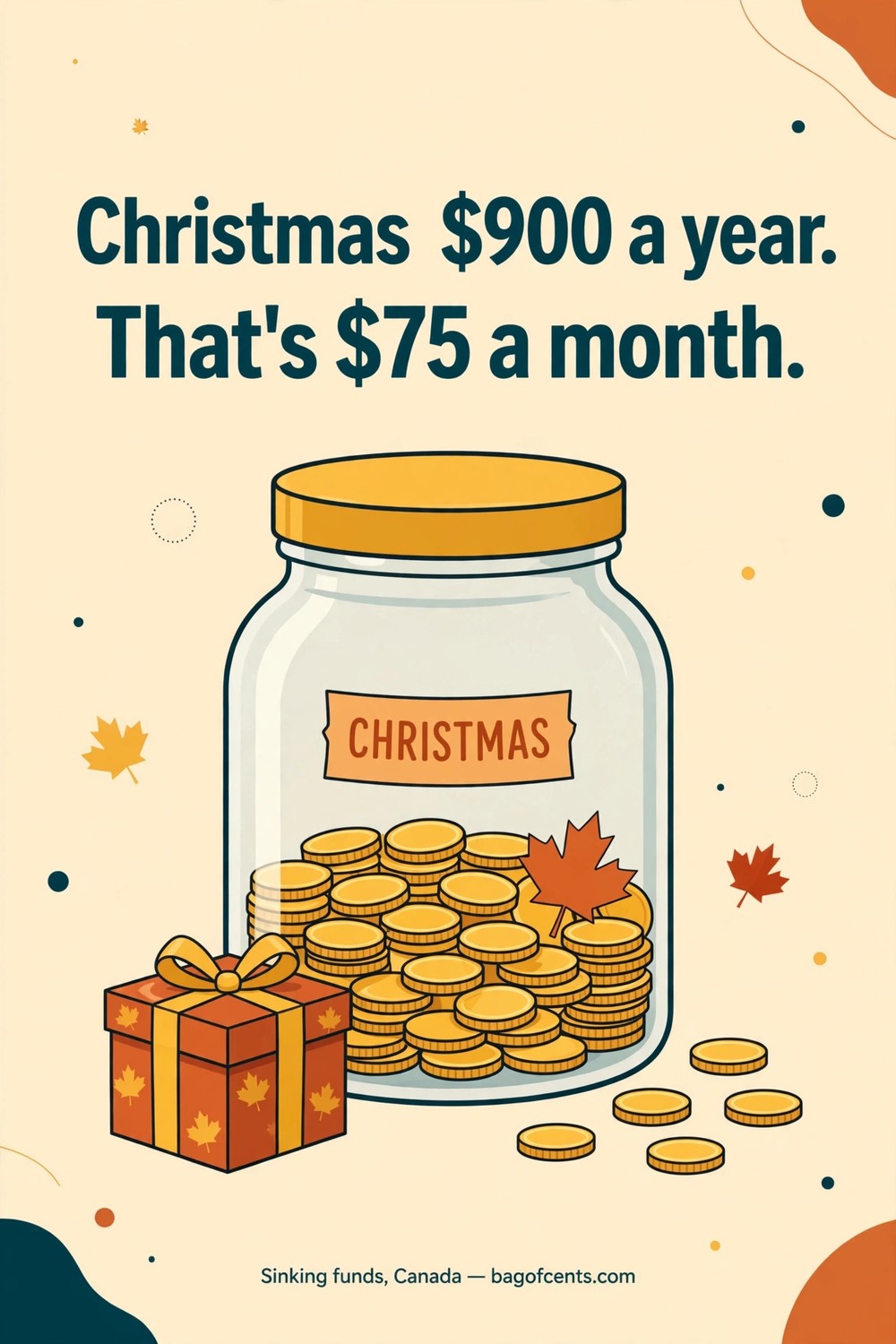
Then divide each cost by the number of months until you need it. A $900 Christmas, twelve months away, is $75 a month. A $600 car repair fund, built over a year, is $50 a month. That monthly number is the whole system. Small, regular, and decided in advance.
Then give each fund its own place. Most Canadian banks let you open extra savings accounts, and many online banks let you open several with no monthly fee and give each one a nickname. Christmas. Car. Vacation. The nickname is the point — money with a name is much harder to spend on something else than money sitting in one big pile.
Finally, automate it. Set the transfers for payday, the same day the money lands, before you have a chance to spend it. A sinking fund that depends on remembering to move the money is a sinking fund that will not happen.
The worked example: $200 a month, four funds
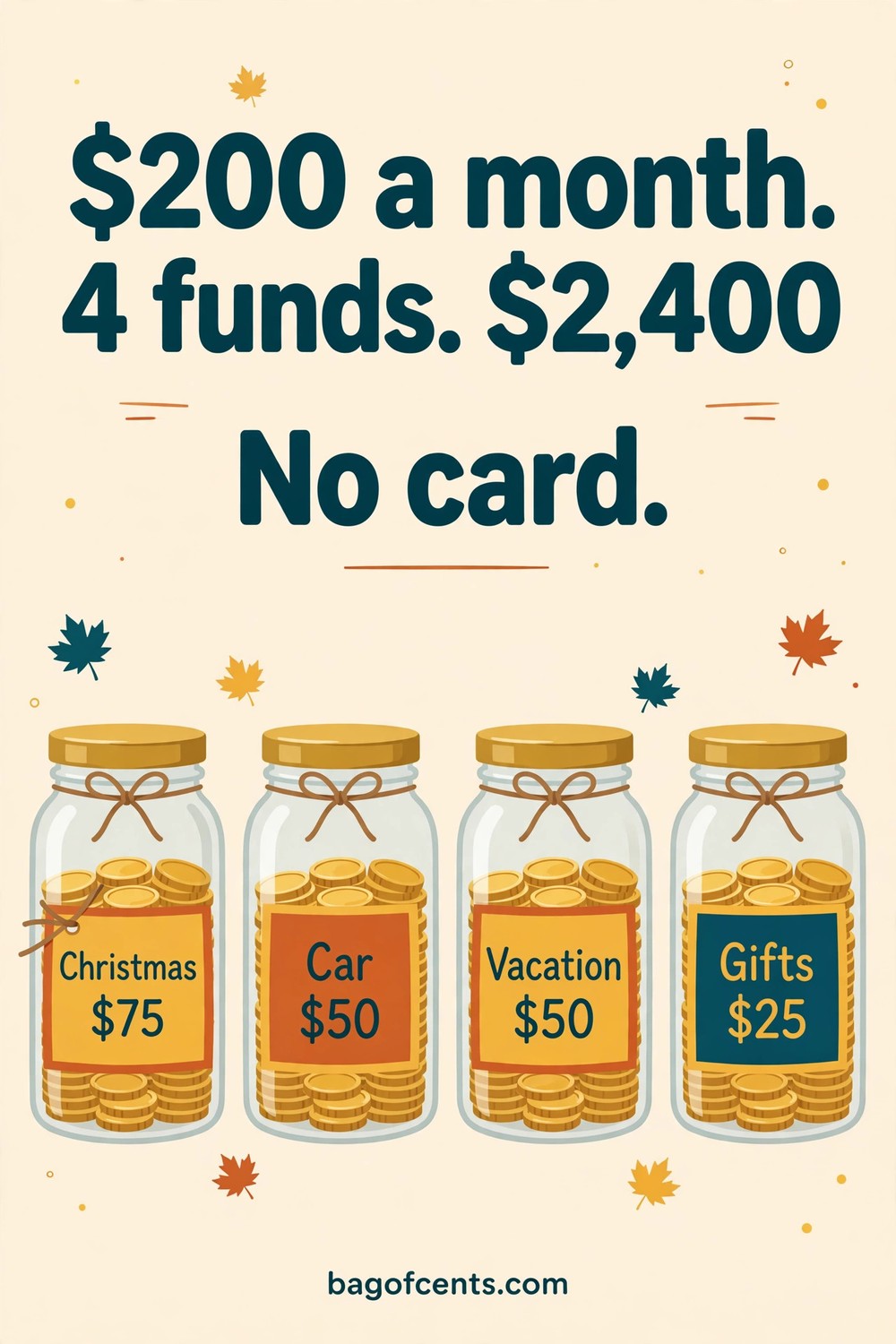
Let us put this together with a real example. Meet Maya — not a real person, but a very common one. Maya earns a steady paycheque, budgets month to month, and every December she ends up putting Christmas on her credit card. This year she tries something different: $200 a month, split across four funds.
| Fund | Per month | Per year | What it covers |
|---|---|---|---|
| Christmas | $75 | $900 | Gifts, food, hosting, travel to family |
| Car repairs | $50 | $600 | Brakes, tires, the repair that always comes at the worst time |
| Vacation | $50 | $600 | A modest trip, or a staycation with the extras paid for |
| Gifts, home and back-to-school | $25 | $300 | Birthdays, school supplies, the small home costs |
| Total | $200 | $2,400 |
That is $2,400 a year, set aside before it can be spent on anything else. When December comes, Maya has $900 waiting in an account called Christmas. She spends it, and January starts with a zero balance on the credit card instead of a $900 one.
Compare that with last year. Last December, Maya put the same $900 on a credit card charging 19.99% and paid it off at $75 a month — the same $75 a month, just after the fact instead of before it. It took her 14 months to clear, and she paid about $113 in interest on top of the $900. Same monthly amount, same gifts. The only difference was the order: saving first cost her nothing. Borrowing after cost her $113 and fourteen months of payments.
That is the whole argument for sinking funds. They do not require earning more. They require deciding earlier.
Where to keep the money
A sinking fund should be easy to reach when the expense arrives, and hard to reach before then. That rules out two places: your everyday chequing account, where it will quietly get spent, and investments, where the value can drop right when you need it.
The usual home is a high-interest savings account, separate from your chequing account, ideally one account per fund or one account with nicknamed sub-accounts. The interest will not make you rich — that is not the point — but it keeps the money slightly ahead of inflation instead of sitting idle, and the separation is what does the real work.
A few practical points. First, make sure you can move the money out without a fee or a waiting period when the expense arrives — some savings accounts limit free withdrawals, so check before you commit. Second, if your bank charges for extra accounts, an online bank with free accounts is often the simpler home for funds like these. Third, do not put sinking fund money in your TFSA unless you have room to spare and understand the trade-off: TFSA room is precious, and short-term money that you will spend within the year usually belongs in a plain savings account, not in your long-term tax-sheltered room.
5 common mistakes
1. Treating the sinking fund like an emergency fund. When the car fund is full and a sale comes along, it is tempting to borrow from it. But a fund with no boundary is just a savings account with a nickname. If you do have to raid a fund, write down what you took and pay it back on a schedule, the same way you would repay a loan.
2. One big pot with no labels. A single account called “savings” with $2,400 in it feels like spare money. Four accounts called Christmas, Car, Vacation and Gifts feel like money that already has a job. The labels are the system.
3. Saving what is left over instead of saving first. Whatever is left at the end of the month is usually nothing, because spending expands to fill the money available. The transfer has to happen on payday, automatically, before the month’s spending starts.
4. Forgetting the irregular costs. The fund list should include the unglamorous ones: the annual car insurance renewal, the property tax instalment, the back-to-school costs, the yearly subscriptions that renew all at once. The costs people forget are the ones that end up on the credit card.
5. Setting the amount once and never revisiting it. Christmas cost more this year than last. The car is older now. Review the funds twice a year — January and July are good moments — and adjust the monthly amounts to match what things actually cost.
FAQ
How much should I put in sinking funds each month?
Start with what you can afford, even if it is $50 a month. List your known costs for the year, add them up, divide by twelve, and if the number is more than you can manage, fund the most urgent ones first — usually Christmas and the car — and add the rest as your budget allows. A partial sinking fund still beats a credit card.
How many sinking funds should I have?
As many as you have predictable costs, but keep it manageable. Three to five funds cover most households. If you have twelve tiny funds, the admin becomes the burden. Group the small ones — gifts, school and home odds and ends — into one fund.
What is the difference between a sinking fund and an emergency fund?
A sinking fund is for costs you can see coming, with a rough date and amount. An emergency fund is for costs you cannot see coming. Build both, keep them separate, and the emergency fund will last much longer.
What if the expense comes before the fund is full?
That happens, especially in the first year. Use what is in the fund, pay the rest from your budget or — if you must — the credit card, and then keep funding it. A half-full fund still cuts the amount you borrow. By the second year, the fund is usually full when the expense arrives.
Can I keep sinking funds in the same account as my emergency fund?
You can, but it is a bad idea. The moment the money is mixed, you lose track of which dollars are for Christmas and which are for a real emergency. Separate accounts — or at least separately nicknamed sub-accounts — cost nothing and prevent the most common mistake.
What if my income changes month to month?
Fund the sinking funds as a percentage of each paycheque instead of a fixed dollar amount, or fund them in good months and pause in tight ones. The system bends; the habit is what matters.
Final Thought
Sinking funds are not exciting. There is no clever trick, no high return, no app that does the thinking for you. They are just a decision, made early, that a known cost will be paid for with saved money instead of borrowed money.
That decision is worth about $113 on a $900 Christmas, and it is worth much more than that in January, when the credit card statement arrives and there is nothing on it to pay off. The holiday was the same. The gifts were the same. The only difference is that Maya paid for them before she enjoyed them, instead of after.
Start with one fund. Christmas is the easiest, because the date never moves and the amount is easy to guess. Put $75 a month aside — or $25, if that is what fits — and watch what December feels like when the money is already there.
This article is general information only, not financial advice. Costs vary by household, bank, and province, and they change over time. Check your own bank’s current account terms before opening new accounts, and talk to your bank or a licensed advisor if you need advice for your situation.
Leave a Reply