
Most year-end money deadlines in Canada are December 31. This one is not — and the difference is exactly why people miss it.
If you hold an investment in a regular, non-registered account that is worth less than you paid for it, selling it before the end of the year turns that paper loss into a capital loss you can actually use: it cancels out capital gains you realized this year, dollar for dollar, before the tax calculation starts. It is one of the few moves where a loss does real work.
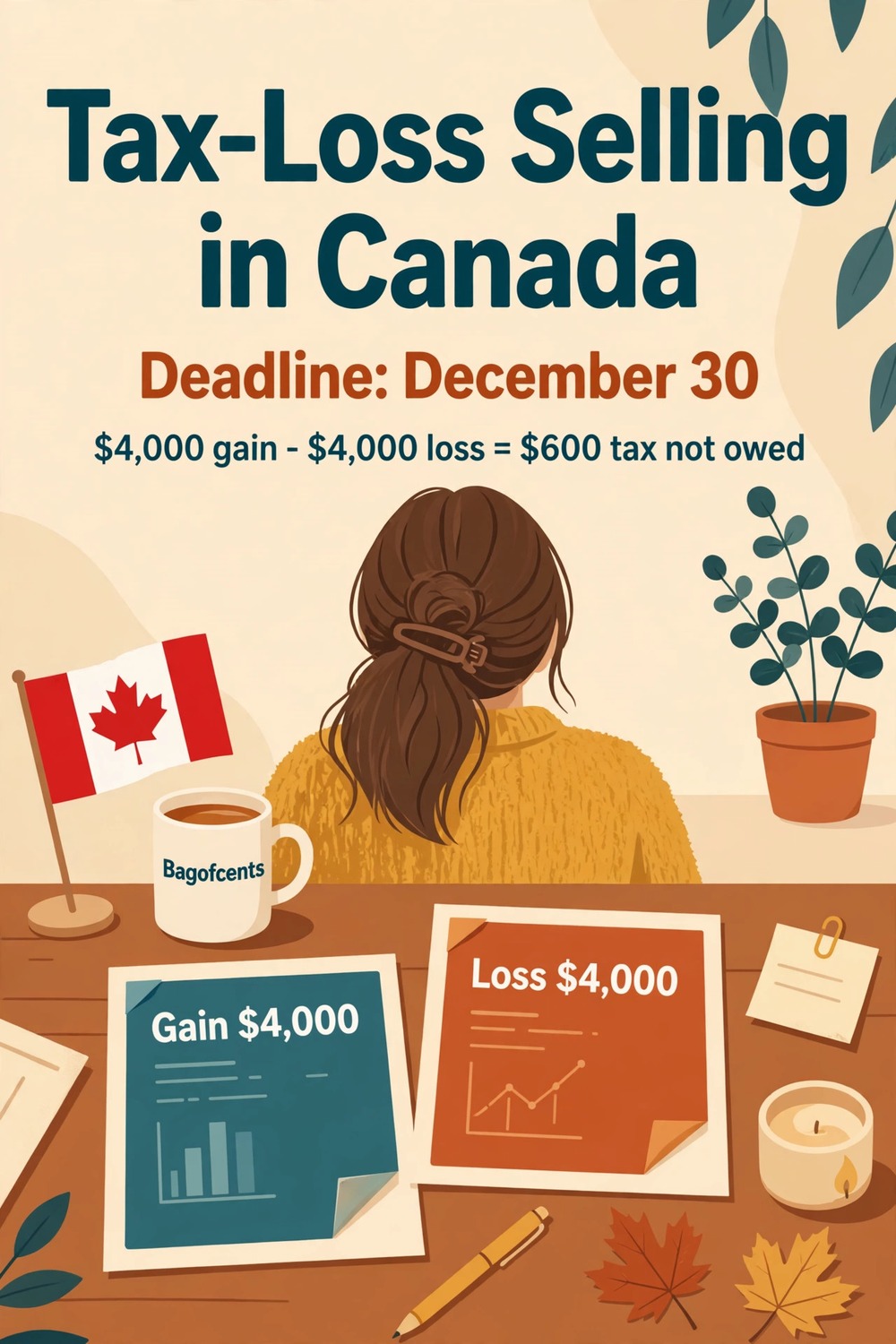
But a sale does not count when you click the button. It counts when it settles — and that one detail moves the real deadline to Wednesday, December 30.
Why December 30, Not December 31
Canadian and US stock and ETF trades settle one business day after the trade. The exchange is closed on December 25 and December 28, so the calendar runs like this:
- Sell on Wednesday, December 30 → settles December 31 → the loss belongs to 2026.
- Sell on Thursday, December 31 → settles in January → the loss belongs to 2027, a full year later for tax purposes.
One day’s delay, one year’s wait. And in practice, do not aim for December 30 at all: brokers set their own year-end cutoffs, orders fail, and December is not the month to test any of it. Treat the week before Christmas as your real deadline and December 30 as the cliff edge behind it.
The First Rule: Registered Accounts Don’t Count
This only works in a non-registered account — the regular taxable investing account that is not a TFSA, RRSP, FHSA or RESP.
Inside a registered account, gains are never taxed and losses are never reported. Selling a losing holding inside your TFSA gives you no capital loss, nothing to carry back or forward, nothing at all for tax purposes. Readers who hold everything in registered accounts can stop here — this article is not for them, and that is a perfectly good place to be.
How the Loss Actually Saves Tax
Only half of a capital gain is taxable in Canada — the inclusion rate is 50%. Losses work the same way in reverse: half of a capital loss is an allowable capital loss, and it applies against the taxable half of your gains.
Worked example, kept deliberately simple:
- Earlier in 2026, Maya sold an investment in her non-registered account for a $4,000 capital gain. Half of it — $2,000 — would normally be added to her income.
- She also holds a second investment in the same account that is down $4,000 from what she paid, and she no longer wants to hold it.
- She sells it in December, while the loss still counts for 2026. The $4,000 loss cancels the $4,000 gain.
- At an illustrative combined marginal rate of about 30%, the $2,000 of taxable gain she no longer reports is worth roughly $600 of tax not owed.
Your rate will differ by province and income — the point is the order of operations: find the gain first, then decide whether a loss you were going to take anyway can cancel it.
No gain this year? The loss is not wasted. A net capital loss can be carried back three years — file Form T1A to apply it against gains you already paid tax on and get that tax back — or carried forward indefinitely against future gains. Report the loss on Schedule 3 either way, or the CRA has no record of it to carry anywhere.
The 30-Day Rule That Can Cancel Your Loss
This is the trap, and it catches people every December.
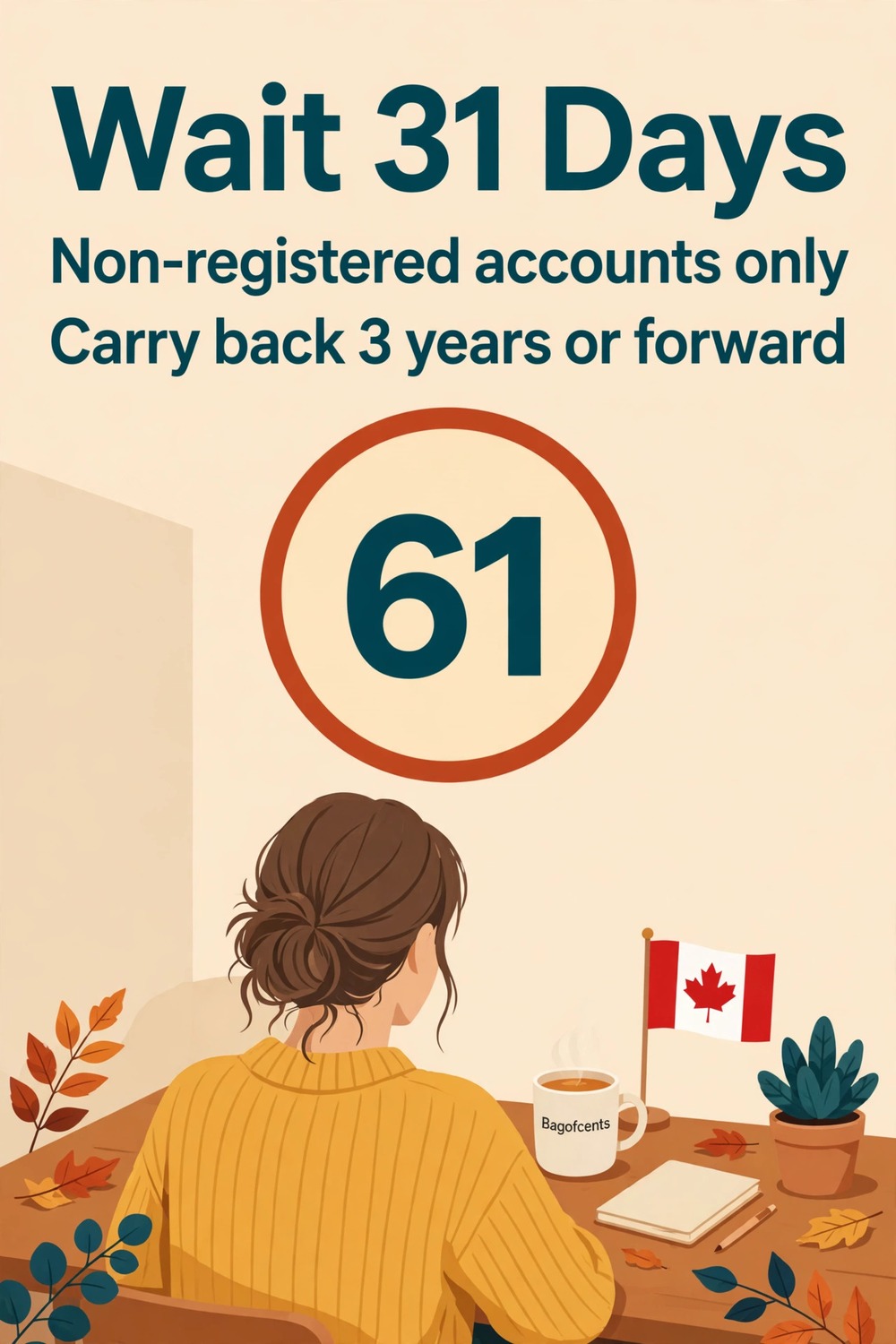
Under the superficial loss rule, your loss is denied if you — or your spouse or common-law partner, a corporation you control, or your own RRSP or TFSA — buys the same or an identical investment during the period from 30 days before your sale to 30 days after it, and still holds it at the end of that period. It is a 61-day window, and it runs in both directions.
What that means in practice:
- Sell and buy the same thing back next week → loss denied.
- Your spouse buys it in their account → loss denied.
- You sell in your non-registered account and rebuy inside your TFSA or RRSP → loss denied — and this version is the expensive one, because a loss denied on a registered-account repurchase is gone permanently. It is not added to any cost base anywhere.
- Sell and wait 31 days, then buy it back → loss allowed.
- Sell one ETF and buy a similar ETF that tracks a different index → generally allowed, because it is not the identical property. “Similar” is doing real work in that sentence — two funds tracking the same index are the grey zone, and that is a question for a tax professional, not a blog post.
The simplest safe route is the boring one: sell, calendar 31 days, then decide if you still want it back.
Sell the Investment, Not the Plan
One guardrail before the checklist. A tax saving is a percentage of a loss — roughly your marginal rate applied to half of it. Selling a good long-term holding you believe in, purely to manufacture a loss, trades a real investment decision for a fraction of it back in tax. That is backwards.
This move makes sense when the holding was already on your sell list — a position you no longer want, a fund you were replacing anyway, a concentration you meant to trim. The tax loss is the bonus on a decision you had already made, not the reason for the decision.
A Short Checklist for December
- List your 2026 realized capital gains in non-registered accounts — and check 2023–2025 for gains a carryback could reach.
- List your non-registered holdings trading below what you paid (your adjusted cost base, not just the purchase price — reinvested distributions and return of capital move it).
- Match them: losses you were going to take anyway, sized against the gains.
- Check the 61-day window before you sell — including your spouse’s accounts and any automatic purchases, like a dividend reinvestment plan buying the same holding.
- Sell well before December 30 — the week before Christmas is the practical deadline; December 30 is only the legal one.
- If you hold US-listed securities, remember the gain or loss is calculated in Canadian dollars — exchange movement is part of your number.
- Keep the trade confirmations. You will want them at tax time for Schedule 3, and for Form T1A if you carry back.
FAQ
What is the last day to sell for a 2026 capital loss? Wednesday, December 30, 2026. The sale must settle by December 31 to count for 2026, trades settle one business day after they are placed, and the exchange is closed December 25 and 28. A trade placed December 31 settles in January and counts for 2027. Check your broker’s own cutoff — some set an earlier one.
Can I claim a loss inside my TFSA or RRSP? No. Gains and losses inside registered accounts are never reported to the CRA, so a loss there cannot offset anything. Tax-loss selling only works in a non-registered account.
How much of a loss can I use? Half of a capital loss is an allowable capital loss (the inclusion rate is 50%), and it applies against the taxable half of capital gains. Losses cancel gains first — they do not reduce salary or other income directly.
What if I have no capital gains this year? The loss is not wasted. A net capital loss can be carried back up to three years against gains you already paid tax on (Form T1A), or carried forward indefinitely against future gains. Report it on Schedule 3 so the CRA has it on record.
Can I just buy the same investment back right away? No — that is the superficial loss rule. If you or an affiliated person (spouse, a corporation you control, your own RRSP or TFSA) buys the same or an identical property within 30 days before or after the sale and still holds it at the end of that window, the loss is denied. Wait 31 days, or buy something that is not the identical property.
What happens if my loss is denied? Outside a registered account, the denied loss is generally added to the cost base of the replacement property, so it is deferred rather than destroyed. But if the repurchase happened inside an RRSP or TFSA, the loss is denied permanently — it cannot be added to anything. That is the version to avoid at all costs.
Final Thought
Every other deadline in this series is December 31. This one is December 30, for no more dramatic reason than that trades take a day to settle — and it only helps if you sold something this year at a gain, or did in the last three years.
So the December move is a matching exercise, done early: gains on one side of the page, losses you were taking anyway on the other, and the 61-day window checked before anything is sold. Do it the week before Christmas, and December 30 can be just another Wednesday.
General information only, not financial or tax advice. Capital-loss rules, adjusted cost base calculations and the superficial loss rule have details this summary cannot cover; confirm your own situation with the CRA’s guide T4037 or a tax professional before acting.
Leave a Reply