
It usually starts with a good intention. You take money out of your TFSA, life settles down, and you put the money back — proud of yourself for restoring it so quickly. Or you move money between two TFSAs at two banks and lose track of which contributions counted. Or CRA My Account showed a room figure in January that did not yet include everything your bank had reported.
Then a letter arrives, or you do the math yourself and your stomach drops: you have put in more than your room allows. You are over-contributed.
Here is the good news first: this is fixable, and it is one of the most common TFSA mistakes in Canada. Here is the part that matters: it is only cheap to fix if you fix it fast, because the tax runs by the month. This article shows exactly how the 1% tax works, walks through a worked example in dollars, and gives you the step-by-step fix in the right order.
How the 1% Tax Actually Works
The rule, in plain English:
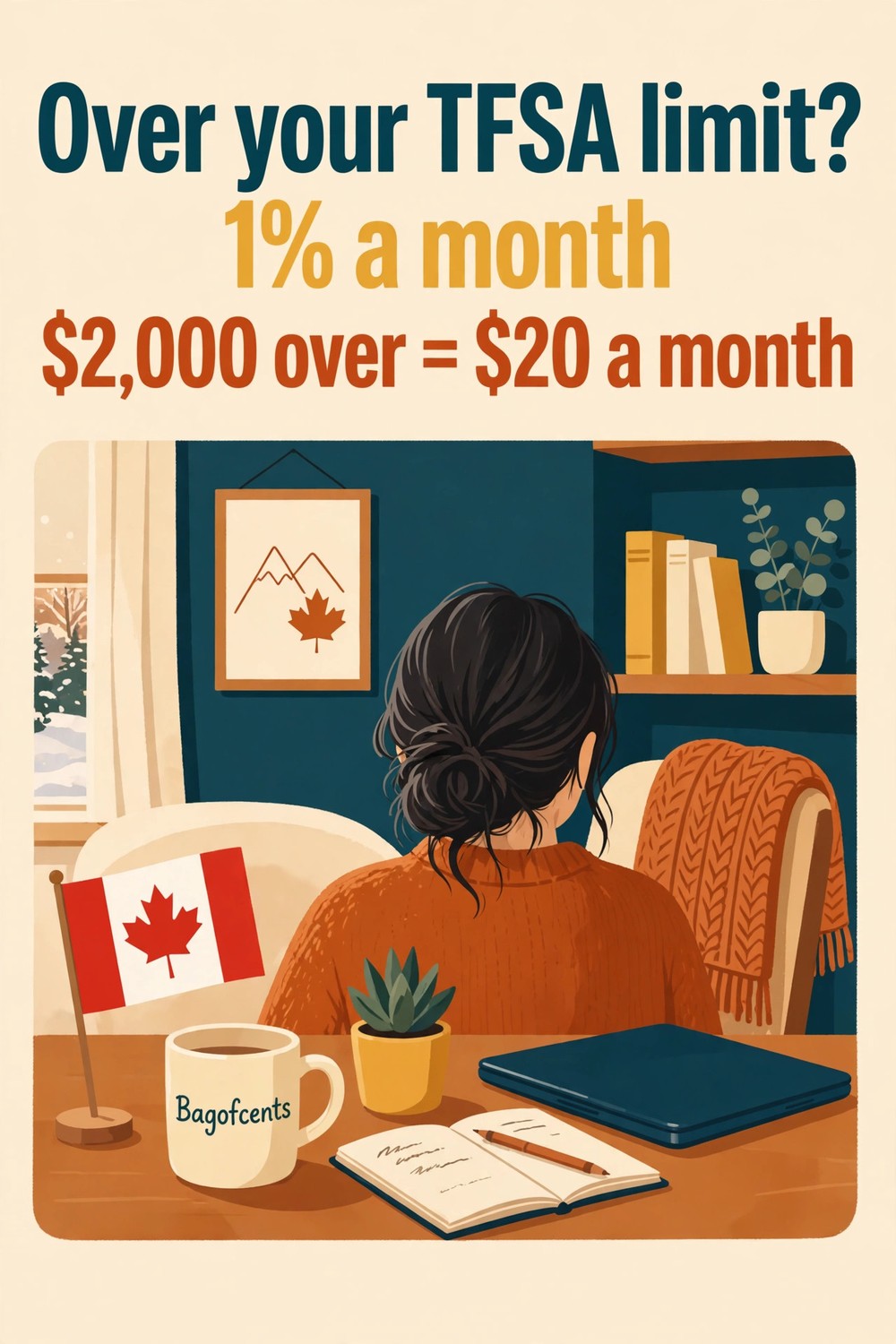
If you have an excess amount in your TFSA, the CRA charges a tax of 1% per month on the highest excess amount in the account during that month — for every month the excess stays there.
Three parts of that sentence do all the damage, so take them one at a time:
- Highest excess in the month. It does not matter if the excess was only there for a few days. If at any point in the month your excess hit $2,000, that month’s tax is based on $2,000.
- Every month it stays. The tax does not stop on its own. It keeps running until the excess is withdrawn — or until new room on January 1 absorbs it.
- No grace amount. There is no small overage the CRA lets slide. The tax applies from the first $1 of excess.
The math is simple, which is exactly why it stings: 1% a month is $10 a month on a $1,000 excess, $20 a month on a $2,000 excess, $50 a month on a $5,000 excess. Leave a $2,000 excess sitting for six months and you have paid $120 for a paperwork mistake — money that buys nothing.
One thing the tax is not: it is not a fine for trying to cheat. The CRA treats an ordinary over-contribution as a timing and tracking error with a monthly price tag. Deliberately over-contributing to game the system is a different and much more serious story — this article is about the honest mistake, which is the one almost everybody makes.
Maya’s $2,000 Mistake, Month by Month
Maya is our recurring example — a $4,000-a-month paycheque, saving steadily since she fixed her budget in the fall. On Sunday we left her with a TFSA withdrawal and a plan to put the money back. Here is where that plan can go wrong.
Earlier this year Maya withdrew $5,000 from her TFSA for a car repair. In October, with the bill behind her, she put $5,000 back — forgetting that a withdrawal only becomes room again on January 1 of the next year, and that she had already used most of her room. Of the $5,000 she put back, $2,000 was over her limit. She created a $2,000 excess without knowing it.
Watch what the calendar does to her:
| Month | What happens | Tax for the month |
|---|---|---|
| October 2026 | $2,000 excess created | $20 |
| November 2026 | Excess still sitting there | $20 |
| December 2026 | Excess still sitting there | $20 |
| January 2027 | New January 1 room absorbs the excess — tax stops | $0 |
If Maya does nothing and simply waits for January, the mistake costs her $60 — three months at $20. Annoying, not ruinous. But look at the same table if she discovers the problem and acts in the month she made it: she withdraws the $2,000 excess in October, and the total tax is $20 — one month only. The difference between noticing in October and noticing in the spring is not the tax rate. It is the number of months you let it run.
And if the excess were bigger — say $5,000 instead of $2,000 — the same three months of waiting would cost $150, and a full year of not noticing would cost $600. Speed is the whole strategy.
The Fix, Step by Step, In Order
Step 1 — Work out your real room before you touch anything. Add up every contribution you have made this year across every TFSA you hold, at every bank. Compare it with your actual available room — and be careful with the CRA My Account figure, which is calculated as of January 1 and lags what your banks have reported since. Your own contribution records are the source of truth.
Step 2 — Withdraw the excess as soon as possible. Not part of it — the full excess amount. A partial withdrawal only lowers the tax starting the following month, because each month is taxed on the highest excess in that month. Do not wait for a letter from the CRA; the tax runs whether they have written to you yet or not.
Step 3 — Do not put it back until you actually have room. The withdrawn excess becomes room again on January 1, like any other withdrawal. Putting it back earlier just restarts the problem.
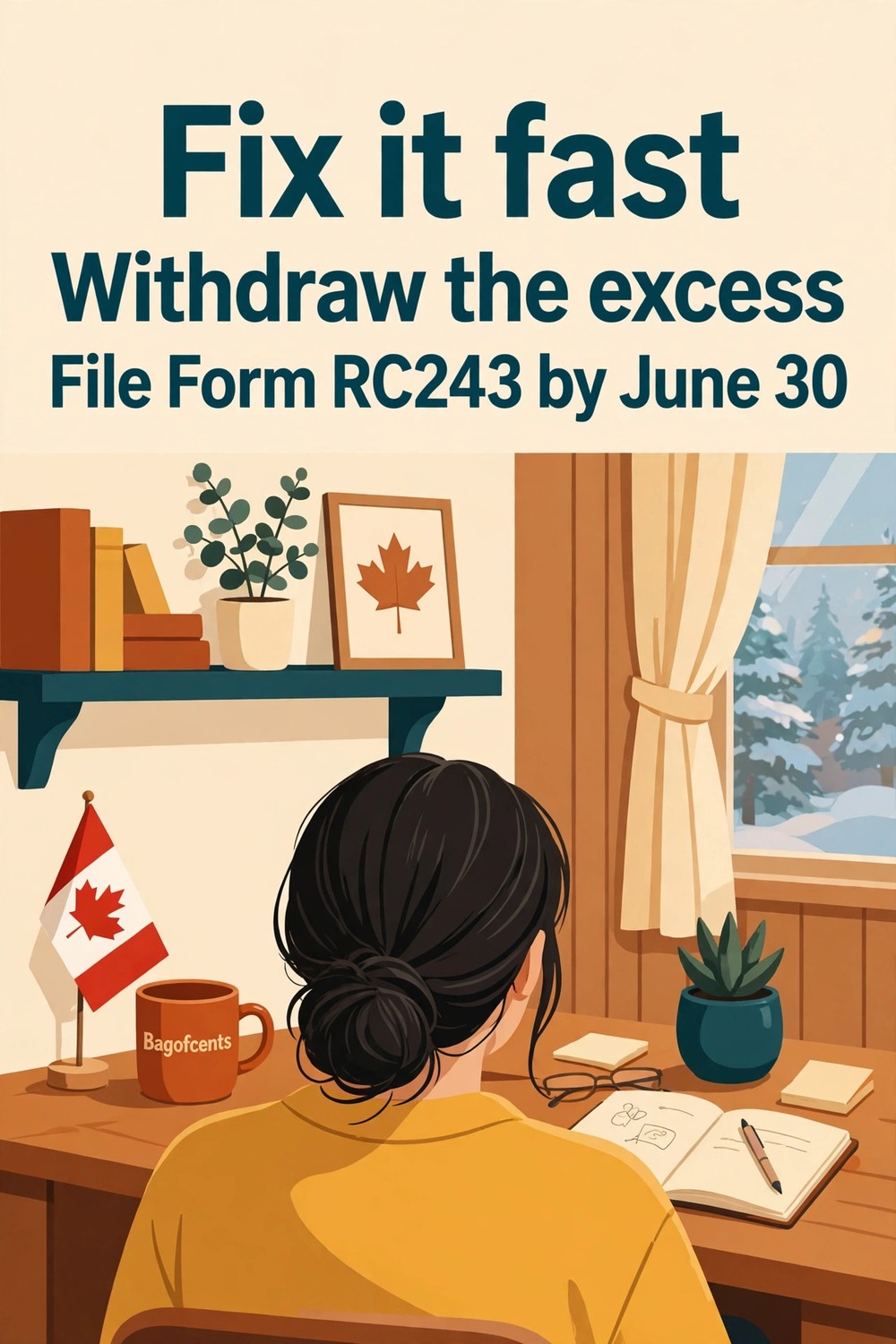
Step 4 — File Form RC243 and pay the tax. The TFSA Return (Form RC243, with Schedule A for excess amounts) works out the tax month by month. For an excess that arose in 2026, the return and any tax owing are due by June 30, 2027. This is a separate return from your regular income tax return — filing your T1 does not cover it.
Step 5 — If it was an honest error, ask for the tax to be waived. The CRA can waive or cancel the 1% tax where the excess arose because of a reasonable error and the excess was withdrawn without delay. That is one more reason Step 2 comes first: withdrawing quickly is both what stops the tax and what supports a waiver request. The request is made in writing, explaining what happened and showing the excess was removed promptly. A waiver is never guaranteed — but you cannot get one for an excess that is still sitting in the account.
The Three Ways People End Up Over
Almost every over-contribution comes from one of three doors:
- Putting a withdrawal back in the same year. The classic. The room from a withdrawal returns on January 1 of the next year — Sunday’s article covered this rule in full.
- Two TFSAs, one memory. Contributions at a second bank or a new investing app are easy to forget when you are checking your room.
- Trusting a stale room figure. The number in CRA My Account on any given day reflects January 1 plus whatever financial institutions have reported so far. Early in the year especially, it can overstate the room you truly have left after recent contributions.
The prevention is boring and it works: keep your own running total of this year’s contributions, in one place, and check it before every deposit — not after.
FAQ
Is there any grace amount before the tax starts? No. The 1% tax applies from the first $1 of excess. There is no buffer.
I withdrew the excess the same month I created it. Do I still owe tax? Yes — for that one month. The tax is based on the highest excess in the month, even if it was only there briefly. Withdrawing in the same month keeps it to a single month, which is why acting immediately matters.
What if I just leave the excess until January 1? New room on January 1 can absorb the excess, and the monthly tax stops once it does. But you owe 1% for every month the excess sat there first — and if the excess is larger than your new January room, the leftover keeps being taxed. Withdrawing is the cleaner fix.
Does the CRA always find out? Financial institutions report your TFSA contributions and withdrawals to the CRA. Assume they know; the only question is when the letter arrives. Fixing it before the letter does not change the tax for the months that already passed, but it stops the count and supports a waiver request.
Do I file the RC243 with my normal tax return? No. It is a separate return with its own deadline — June 30 of the year after the year the excess arose — sent separately from your T1.
Can the tax really be waived? It can, where the excess came from a reasonable error and was withdrawn without delay. It is the CRA’s decision, not an entitlement — withdraw first, document what happened, and ask in writing.
Final Thought
An over-contribution is not a catastrophe and it is not a character flaw — it is a clock. The tax is 1% a month, the meter runs until the excess comes out, and the person who notices in the same month pays a fraction of what the person who waits pays. If you think you might be over, do the math today, take the excess out, and file the form. December is the best month of the year to clean this up: fix it now and January 1 hands you a clean slate and fresh room to start again — this time with a running total you keep yourself.
General information only, not financial advice. TFSA rules are set by the CRA; if your situation involves a large excess or a CRA letter, a tax professional can review your specific numbers.
Leave a Reply