
The TFSA is one of the best deals in Canadian personal finance: contribute after-tax dollars, grow them tax-free, withdraw them tax-free. Millions of Canadians use it exactly as intended — and thousands get a nasty surprise every year from the Canada Revenue Agency.
That surprise is the overcontribution penalty: 1% per month on every dollar you contribute above your limit, charged for every month the excess sits in the account. It sounds small. It is not small. A $6,000 overcontribution left alone for a year costs you $720 — plus interest if you don’t pay on time — and the CRA will find you even if your broker never warned you.
The painful part? Most overcontributions are accidents. Re-contributing a withdrawal too soon. Misunderstanding when contribution room comes back. Losing track across multiple accounts. All of it is preventable once you understand the rules. This article explains exactly how the penalty works, how overcontributions actually happen, how to fix one, and how to never get hit again.
What the 1% Monthly Penalty Actually Is
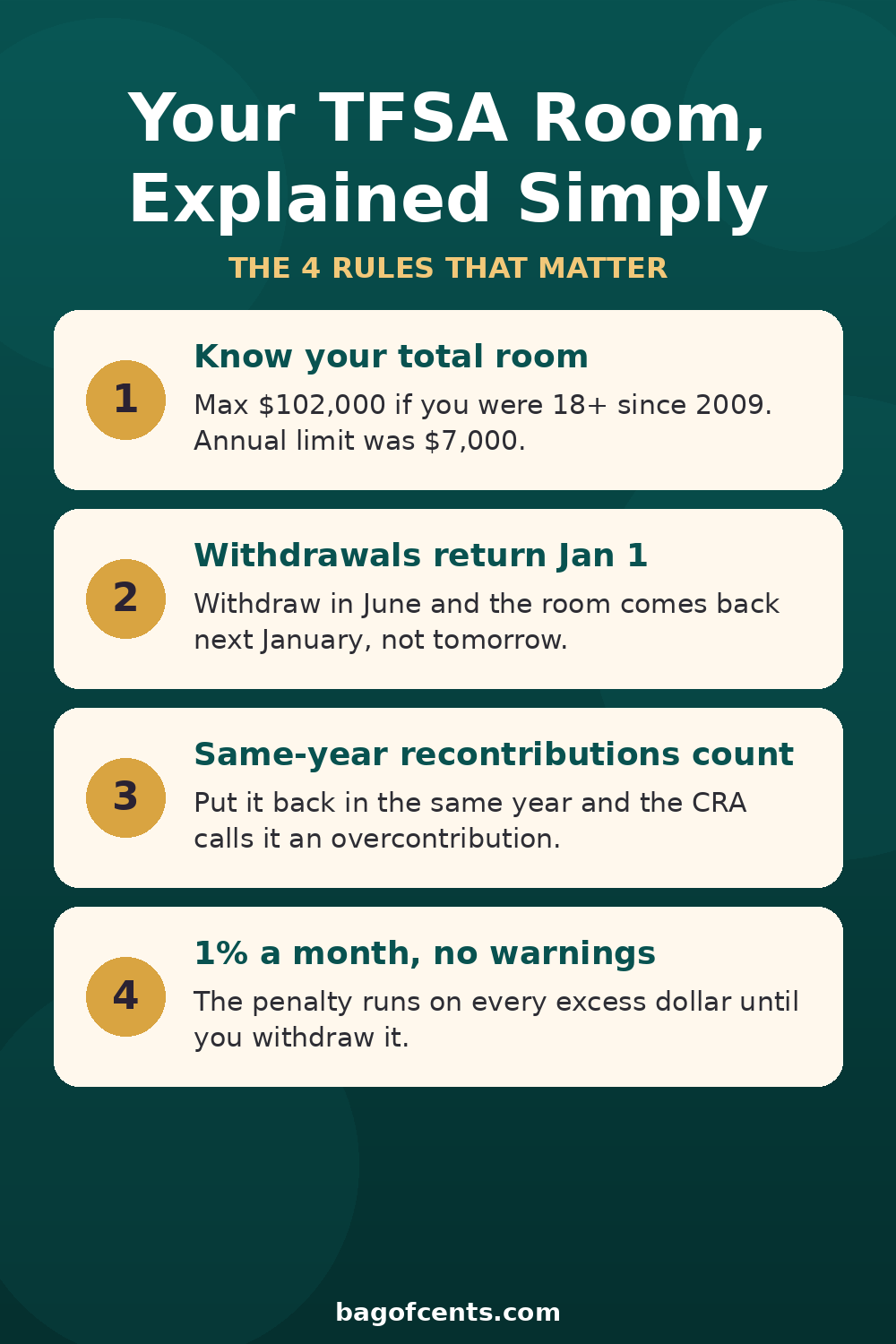
Your TFSA contribution room is a lifetime limit set by the CRA. Every year you get new room (currently $7,000 per year for adults who were 18+ in 2009 and have always been residents). If you have never contributed, your total room in 2026 could be over $100,000. Contributions reduce your room; withdrawals add it back — but only at the start of the next calendar year.
Contribute even one dollar more than your available room and you’ve overcontributed. The CRA charges a tax of 1% per month on the highest excess amount in the account for that month. Key points:
- The penalty applies monthly, not annually — 1% each month the excess remains.
- It applies to the highest excess during the month, so a large deposit counts in full even if you withdraw it days later.
- It compounds with CRA interest if unpaid: the penalty itself accrues interest at the CRA’s prescribed rate, compounded daily.
- There is no “oops” exemption built in — the tax is automatic once the excess exists.
One dollar over the limit technically triggers the penalty, though in practice the CRA assesses on real dollar amounts and you’d receive a notice of assessment. The point stands: the limit is a hard line, not a suggestion.
How Overcontributions Actually Happen (The 5 Classic Traps)
1. The Withdrawal Re-Contribution Trap (the #1 cause)
This is how most Canadians get burned. You withdraw $10,000 from your TFSA in March to cover an expense. In June, things stabilize and you put the $10,000 back. Seems sensible — it’s your money, you just took it out.
But your contribution room doesn’t come back until January 1 of the next year. Re-contributing that $10,000 in June without fresh room means you’re $10,000 over your limit from June through December — seven months at 1% per month, or roughly $700 in penalties. The rule is simple: never re-contribute a withdrawal in the same calendar year unless you’re certain you have unused room for it.
2. Multiple TFSA Accounts
You have a TFSA at your bank, another at your brokerage, maybe a third from an old job’s group plan. Each institution only sees its own account. The CRA sees all of them combined. If you have $5,000 of room left and contribute $5,000 at each of two institutions, you’re $5,000 over — and neither institution will warn you, because neither knows about the other.
3. The $2,000 Buffer Misunderstood
The CRA allows a one-time lifetime $2,000 buffer: the first $2,000 of excess in your lifetime is exempt from the penalty. This is real, but it has strict limits:
- It is once per lifetime, not per year.
- It only covers the first $2,000 — dollar $2,001 gets penalized.
- It doesn’t mean you can overcontribute freely; it just softens a small first mistake.
Many people treat the buffer as free room they can use every year. They cannot.
4. Automatic Contributions That Keep Running
Pre-authorized contributions are great until your situation changes. If you set up $500/month auto-contributions years ago and never adjusted them, they keep running against your shrinking room until they cross the line. Review auto-contributions every January.
5. Not Checking CRA “My Account”
Your CRA My Account shows your TFSA contribution room — but it’s often out of date. Institutions report contributions once a year (by late February for the prior year), so the number you see online can be months behind your actual activity. If you contributed in November, CRA My Account might not reflect it until March. Always track your own contributions; treat the CRA number as a cross-check, not gospel.
Real Numbers: What a Penalty Actually Costs
Let’s run three scenarios so the math is vivid.
Scenario A — The re-contribution trap. You withdraw $10,000 in March and re-contribute it in June, with no room. Excess: $10,000. Months penalized: June through December = 7 months. Penalty: $10,000 × 1% × 7 = $700.
Scenario B — The slow bleed. Auto-contributions of $600/month push you $3,600 over the limit by December. The excess grows month by month, and the penalty applies to the highest excess each month. Roughly: the excess climbs from $600 to $3,600, so the penalty lands around $250–$260 for the year — plus daily-compounded interest if you don’t pay promptly.
Scenario C — The big mistake. You move $50,000 into your TFSA believing it’s all fresh room, but only $20,000 was actually available. Excess: $30,000. You don’t notice for a full year. Penalty: $30,000 × 1% × 12 = $3,600 — plus interest. That’s a vacation’s worth of money, gone, for a clerical error.
Now compare that to doing nothing: zero penalty. The entire tax is avoidable. It exists to punish only those who don’t track their room.
How to Fix an Overcontribution (Do This Immediately)
If you discover you’re over the limit, speed matters — every month of delay is another 1%.
Step 1: Withdraw the Excess Right Now
Calculate how much you’re over and withdraw that amount from the TFSA immediately. Do not wait until January. The penalty stops accruing once the excess is gone. Note: the withdrawal itself doesn’t create new room (that comes next January), but it stops the bleeding.
Step 2: File Form RC339
The CRA requires you to report the overcontribution by filing Form RC339 (Individual Return for an RRSP, PRPP, SPP, or TFSA Overcontribution). This is how you calculate and pay the 1% monthly tax. The form walks you through month-by-month excess amounts.
Step 3: Pay What You Owe, On Time
The tax is due by June 30 of the following year. Miss that deadline and the CRA charges interest on the unpaid penalty, compounded daily at the prescribed rate. Paying promptly is the cheapest way out.
Step 4: Ask for Penalty Relief (Worth a Try)
If the overcontribution was a genuine mistake — and especially if it’s your first — you can write to the CRA requesting relief under the fairness provisions. Explain what happened, show it was inadvertent, and demonstrate that you fixed it quickly. The CRA sometimes waives penalties for first-time, small, promptly corrected errors. There’s no guarantee, but the letter costs you nothing. Be honest, be specific, and include documentation (contribution statements showing you withdrew the excess right away).
Withdrawal Timing Traps to Watch
Withdrawals are where the whole system gets confusing. Three rules to tattoo on your brain:
- Withdrawn amounts restore your room on January 1 of the next year — not the day you withdraw. A December 30 withdrawal and a January 2 withdrawal have completely different consequences for re-contributing.
- Withdrawals don’t erase penalties already incurred. If you were over the limit from June to December, withdrawing in December stops future penalties but doesn’t cancel the ones already assessed.
- Transfers between your own TFSA accounts are not contributions — but only if done as a direct transfer. If you withdraw from one TFSA and deposit into another yourself, that’s a withdrawal plus a contribution, and the room rules apply. Ask your institution for a direct TFSA-to-TFSA transfer form instead.
Common Mistakes That Trigger the Penalty
- Re-contributing a withdrawal in the same year. The #1 cause, by far. Wait until January.
- Forgetting about old accounts. That TFSA from three jobs ago still counts. Consolidate or track everything.
- Trusting CRA My Account as current. It’s months behind. Keep your own running tally.
- Treating the $2,000 buffer as annual room. Lifetime, one time, first $2,000 only.
- Letting auto-contributions run blind. Review them every January against your actual room.
- Assuming your bank will warn you. They won’t — and legally, they can’t know your full picture.
FAQ: TFSA Overcontributions
How do I find my real contribution room?
Start with the CRA’s published total for your situation, subtract every contribution you’ve ever made (across all accounts), and add back withdrawals — but only withdrawals from prior calendar years. Keep a simple spreadsheet with dates and amounts. Your own records beat the CRA portal because the portal lags.
What if my overcontribution is tiny, like $50?
The 1% monthly tax technically applies, which would be 50 cents a month. The CRA generally won’t chase trivial amounts, but the cleanest move is still to withdraw the excess. Don’t leave it out of laziness.
Can I just move the excess to my RRSP instead?
Withdrawing from the TFSA and contributing to an RRSP doesn’t dodge the penalty — the TFSA overcontribution still existed for those months, and the tax still applies. Fix the TFSA excess first, then make RRSP decisions separately.
Does the penalty apply to gains on the excess?
No — the 1% is calculated on the excess contribution amount, not on any growth. But any income the excess earns inside the TFSA is still tax-free; the penalty is purely on the over-contributed principal. (If the CRA later determines the whole arrangement was abusive, that’s a different and much rarer issue.)
What happens if I ignore the CRA’s penalty notice?
The penalty keeps accruing interest daily, the CRA can offset it against future tax refunds, and ignoring it turns a small fixable mistake into a growing debt. File the RC339, pay it, move on.
Is the $2,000 buffer really automatic?
Yes — the CRA applies it when calculating your penalty. You don’t need to claim it. But remember: once in your lifetime, first $2,000 only.
Final Thought
The TFSA is a genuinely great tool — tax-free growth, tax-free withdrawals, total flexibility. The overcontribution penalty exists because that flexibility has edges, and the edges are sharp.
But here’s the reassuring part: nobody who tracks their contributions gets penalized. One spreadsheet, one January review of your auto-contributions, and one iron rule — never re-contribute a withdrawal in the same year — and you’ll never pay the CRA a single cent of this tax.
Check your room today. It takes ten minutes, and it might be the highest-value ten minutes of your financial year.
Liked this? Take it further.
Avoiding penalties is great — but the real win is putting your TFSA room to work growing your money. Grab our free 52-Week Savings Challenge Tracker and build the savings habit that fills your TFSA (and your emergency fund) one week at a time.
Join the Bagofcents weekly money tips email. Unsubscribe anytime.
Happy Budgeting!
Stanley
Leave a Reply