
Most Canadians have more TFSA room than they think — and a surprising number have less than they think, because they guessed instead of checking.
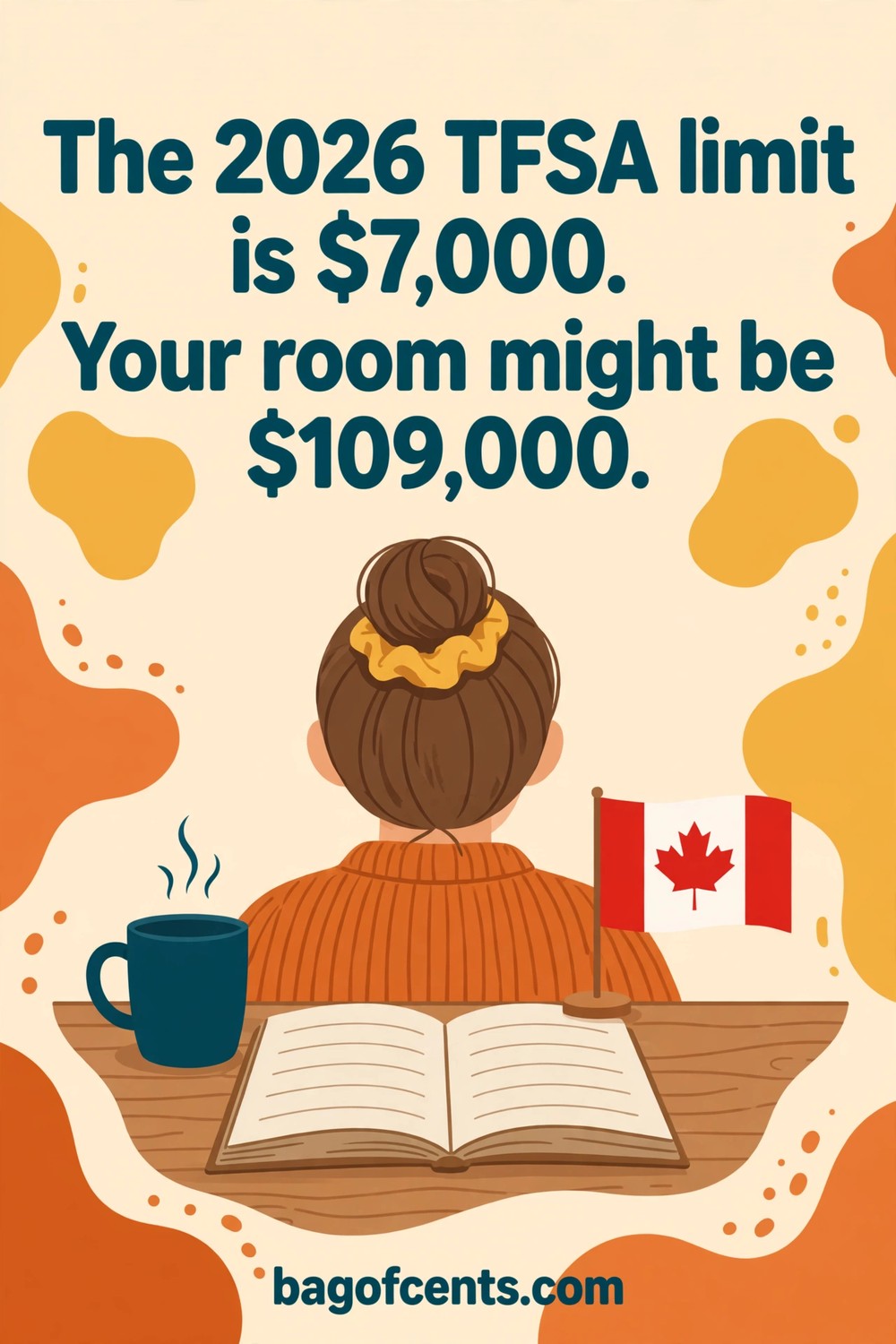
The 2026 TFSA limit is $7,000 a year. That is the number everyone quotes. It is not the number that matters for you. What matters is your total room: every year of room you have built up since you turned 18, minus everything you have already put in, plus anything you took out in a previous year.
For someone who was 18 and living in Canada when the TFSA started in 2009 and has never contributed, that total is $109,000. Not $7,000. One hundred and nine thousand dollars of room, sitting there, whether or not they have ever opened an account.
This article works out your number, shows you where to check the official one, and covers the one mistake — putting money back in too soon after a withdrawal — that costs $20 a month on a $2,000 error.
How TFSA Room Actually Works
Your room starts building the year you turn 18, as long as you are a Canadian resident with a valid SIN. You do not need to open an account for it to build. You do not need income. The room just accumulates, year after year, and unused room carries forward forever. It never expires.
The formula is simple:
Your room = all the room you have earned since you turned 18 − everything you have ever contributed + everything you withdrew in previous years.
Three rules do most of the damage when people get them wrong:
Withdrawals do not give room back straight away. If you take money out in 2026, that room comes back on January 1, 2027 — not the day you withdraw. Put it back in the same year and you may have over-contributed, even though the money was yours a week ago.
Room is across all your TFSAs, not per account. Two TFSAs at two banks share one room. The CRA adds them together. Opening a second account does not create a second limit.
The annual limit is not your room. $7,000 is what is added this year. Your room is the running total. Confusing the two is how people either leave tens of thousands unused or over-contribute without realising it.
Three Worked Examples, So You Can Find Yours
Example 1: Eligible since 2009, never contributed. $5,000 a year in 2009–2012, $5,500 in 2013–2014, $10,000 in 2015, $5,500 in 2016–2018, $6,000 in 2019–2022, $6,500 in 2023, $7,000 in 2024, 2025 and 2026. Add it up and the total is $109,000 of room. Even if this person only opens their first TFSA this week, all $109,000 is available.
Example 2: Turned 18 in 2020, never contributed. 2020 $6,000 + 2021 $6,000 + 2022 $6,000 + 2023 $6,500 + 2024 $7,000 + 2025 $7,000 + 2026 $7,000 = $45,500 of room. At $100 a week — the Save With Me pace — that is almost nine years of contributions before the room runs out.
Example 3: Alex, 28, turned 18 in 2016. Alex has earned $68,000 of room in total: $5,500 a year in 2016–2018, $6,000 a year in 2019–2022, $6,500 in 2023, and $7,000 a year in 2024–2026. Alex has contributed $12,000 over the years and withdrew $3,000 in 2024. That withdrawal came back as room on January 1, 2025, so Alex’s room today is $68,000 − $12,000 + $3,000 = $59,000. Alex could put in $7,000 this year, or $59,000 — both are within the room. The $7,000 is just this year’s addition.
Now Maya, from Monday’s 50/30/20 article and Tuesday’s lifestyle-creep fix. She saves $390 a month now — $4,680 a year. That fits comfortably inside a $7,000 annual addition, and it is well inside her total room. The question for her is not whether she has room. It is what to do with it, and in what order: her emergency fund first, then the TFSA for money she will not need in the next year or two.
How to Check Your Official Number in 5 Minutes
Your own records are a good start, but the CRA’s number is the one that counts if there is ever a dispute. Check it before a large contribution, not after.
Step 1: Log in to CRA My Account at canada.ca. Your TFSA room is shown there, and also on your notice of assessment.
Step 2: Read the date on the number. The CRA figure is your room as of January 1, updated after financial institutions report the previous year’s transactions. It can lag your bank’s records by months. If you contributed in the last few months, the CRA figure may not include it yet.
Step 3: Do your own subtraction. Take the CRA number, subtract anything you have contributed since January 1, and add nothing for withdrawals you made this year — those do not come back until next January 1. What is left is your real room today.
Step 4: Keep a one-line record. One note — total contributed this year, total withdrawn this year, and the CRA figure with its date — prevents almost every over-contribution. Most of them happen because nobody wrote the number down, not because the rules are complicated.
Step 5: When in doubt, wait a month. If a contribution would take you close to your limit and you are not sure of the number, waiting costs nothing. An over-contribution costs 1% a month until it is fixed.
The $20-a-Month Mistake
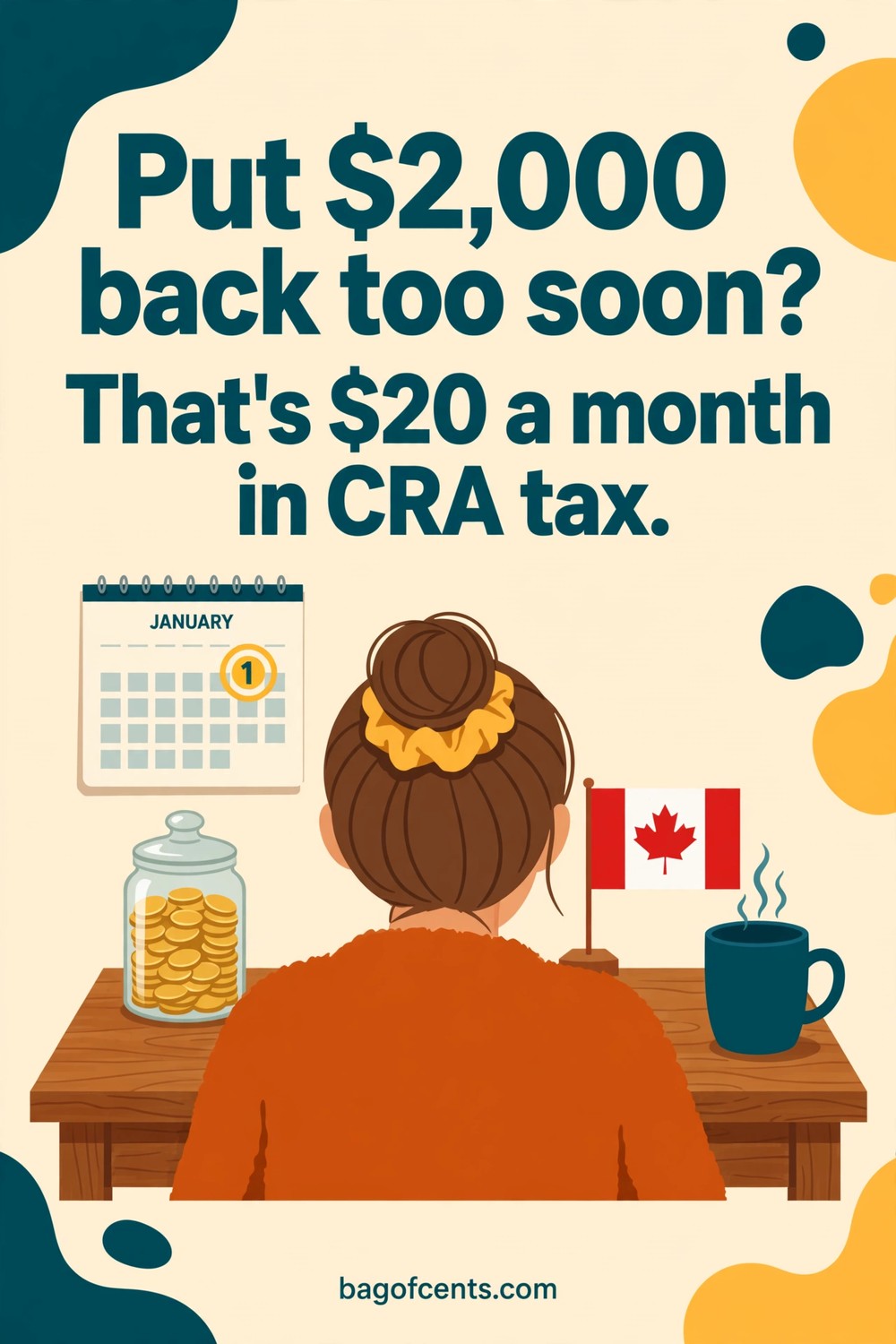
This is the mistake from the TFSA Mistake Short, and it is worth spelling out because it is so easy to make: withdraw $2,000, put $2,000 back in the same year on top of a full $7,000 contribution, and you are $2,000 over. The CRA charges 1% per month on the highest excess amount in each month it stays in the account. On $2,000, that is $20 a month — $240 a year — until you take the excess out.
The fix is unglamorous: withdraw the excess amount as soon as you spot it, and do not re-contribute it until the room comes back on January 1 of the next year. If you are not sure whether you are over, check CRA My Account and call the CRA before moving more money in. A month of waiting beats a year of penalties.
5 Mistakes That Shrink Your Room (or Cost You Money)
1. Re-contributing a withdrawal in the same year. The room comes back next January 1. This is the single most common over-contribution, and it is entirely avoidable once you know the rule.
2. Treating $7,000 as your total room. It is this year’s addition. If you have been eligible for years and never contributed, your room is far bigger — and if you have already used most of it, $7,000 this year may still be too much.
3. Counting each TFSA separately. Two accounts, one room. Add the contributions across every TFSA you hold before deciding what you can still put in.
4. Trusting the CRA figure without checking the date. It lags. A contribution from last month may not be in it yet, which makes your room look bigger than it is. Subtract this year’s contributions yourself.
5. Contributing while non-resident. Room only builds while you are a resident, and contributing while non-resident can trigger the same 1% monthly tax. If you moved away and came back, check which years counted before you contribute.
FAQ
How much TFSA room do I have if I have never contributed?
It depends on when you turned 18. Eligible since 2009: $109,000. Turned 18 in 2020: $45,500. Your room starts the year you turn 18, so the later you turned 18, the smaller the total — but it is still usually far more than $7,000.
Does my room go away if I do not use it?
No. Unused room carries forward indefinitely. There is no deadline and no use-it-or-lose-it rule.
Can I check my room without CRA My Account?
Your notice of assessment shows it too. Your bank can tell you what you contributed to the TFSA you hold with them, but only the CRA sees all your accounts together.
What happens if I over-contribute by accident?
The CRA charges 1% per month on the highest excess amount. Withdraw the excess as soon as possible, and file Form RC243 if the CRA asks for it. Do not put the money back in until you have room for it again.
Is the TFSA better than the RRSP for my savings?
They do different jobs. TFSA withdrawals are tax-free and do not affect benefits, which makes the TFSA the flexible choice for money you might need before retirement. The RRSP gives a tax deduction now and is taxed on withdrawal. The RRSP vs TFSA article from Friday covers which one first when you cannot max both.
I withdrew money this year. When can I put it back?
January 1 of next year, when that amount is added back to your room. If you have unused room from previous years, you can contribute up to that unused room now — the withdrawal itself just does not create new room until January.
Final Thought
The TFSA rewards the person who checks before they contribute, not the person who contributes the most the fastest. Your room is probably bigger than $7,000 — and the only way to know by how much is to look it up, write it down, and subtract what you have already put in this year.
Tonight, take five minutes: log in to CRA My Account, note your room and its date, and subtract this year’s contributions. That one number tells you whether you can put in $100 a week with years to spare, or whether you are closer to the line than you thought. Either way, you will know — and knowing is the whole point of the account.
For general education only, not financial advice. TFSA limits and rules are set by the CRA and can change; check canada.ca or CRA My Account for your own number before making a large contribution.
Leave a Reply