
Picture Maya in mid-November. Her car needs work in the new year — nothing catastrophic, but more than her chequing account wants to absorb — and she knows she will need about $5,000 sometime in the next few months. The money is sitting in her TFSA. She plans to take it out, deal with the bill, and then put the $5,000 back during 2027 as her paycheques allow.
Simple plan. But here is the part almost nobody tells you: whether that plan works smoothly or costs her a full year depends on one thing that has nothing to do with the amount. It depends on the date she makes the withdrawal.
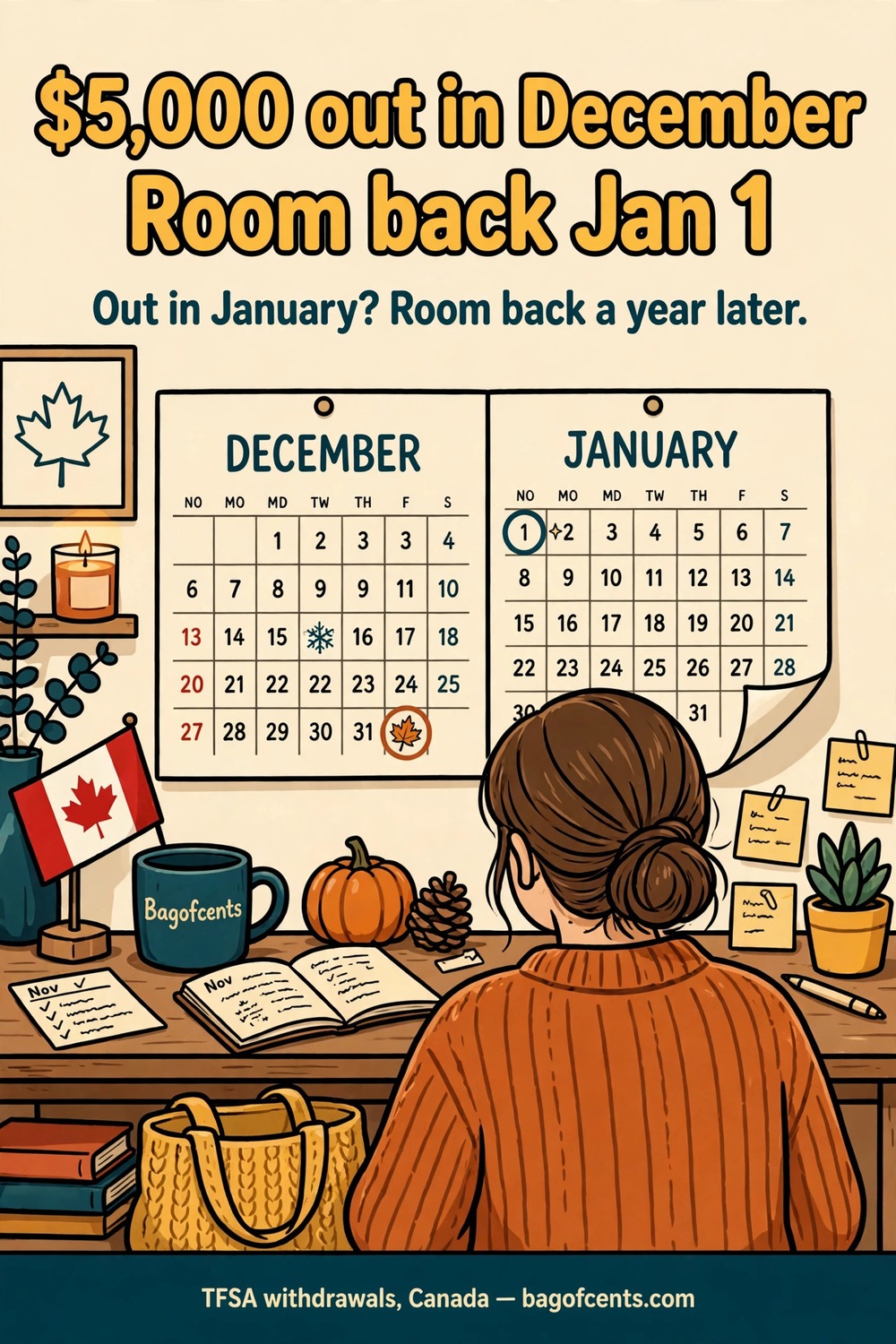
Take $5,000 out of a TFSA in December 2026, and the room to put it back returns on January 1, 2027 — weeks later. Take the same $5,000 out in January 2027 instead, and that room does not come back until January 1, 2028. Same account. Same money. Same need. One month of timing moves the door by an entire year.
This article explains the January 1 rule in plain English, walks through Maya’s December-versus-January choice side by side, and covers the trap that catches people who try to put the money back too soon.
The January 1 Rule, In Plain English
A TFSA withdrawal feels like it should free up space straight away. You took money out, so surely you can put the same amount back in. That is how a lot of people assume it works — and it is not how it works.
Here is the actual rule, straight from how the CRA runs the program:
When you withdraw money from a TFSA, the amount is added back to your contribution room on January 1 of the following calendar year. Not the next day. Not the next month. January 1, next year.
So every withdrawal carries a date stamp that decides when its room returns:
- Withdraw in 2026 → the room returns January 1, 2027.
- Withdraw in 2027 → the room returns January 1, 2028.
It does not matter whether you withdraw on January 2 or December 30 of that year. The calendar year of the withdrawal is the only thing that counts. Which means the last few weeks of December are the most valuable withdrawal window of the whole year: a December withdrawal gets its room back almost immediately, while a January withdrawal — days later — waits a full year.
One more piece of the rule, because it is where the trouble starts: a withdrawal does not stop you from contributing if you have other unused room. If you have never maxed out your TFSA and you have $10,000 of room sitting unused, you can take money out and put money in during the same year without any problem, as long as your total contributions stay within that unused room. The January 1 rule only bites when the withdrawal itself is the thing you are counting on to make space.
Maya’s Choice: December vs. January
Maya is our recurring example — a $4,000-a-month paycheque, saving $390 a month since she fixed her budget in the fall. She has built up her TFSA over the last couple of years, and she knows the car bill is coming. She can take the $5,000 out now, in December 2026, or wait and take it out when the bill actually lands, likely January 2027. She intends to rebuild the $5,000 over the course of 2027 either way.
Here is what each choice does to her room:
| Withdraw December 2026 | Withdraw January 2027 | |
|---|---|---|
| $5,000 room returns | January 1, 2027 | January 1, 2028 |
| Can she re-contribute the $5,000 during 2027? | Yes — the room is back | Not from this withdrawal — only if she has other unused room |
| New annual limit added Jan 1, 2027 | Yes (the 2027 amount, whatever it is set at) | Yes — same |
| Earliest the withdrawn $5,000 itself can go back | January 2027 | January 2028 |
Read the second row twice, because it is the whole article. If Maya waits until January to withdraw, then tries to rebuild the $5,000 through 2027 the way she planned, the room from that withdrawal is not there. Her rebuild would have to fit inside her other unused room plus the new annual amount added on January 1, 2027. If it does not fit, part of her rebuild becomes an over-contribution — even though she is only putting back money she took out.
By withdrawing in December instead, she loses nothing. The car bill is paid either way. The $5,000 sits in her regular account for a few extra weeks. And on January 1, her room quietly tops itself back up, ready for the rebuild she planned all along.
That is the entire trick: if you know you will need TFSA money early in the new year, and you plan to put it back, take it out before December 31.
The Same-Year Trap: Putting It Back Too Soon
Now the mistake that turns this rule from a quirk into a bill.
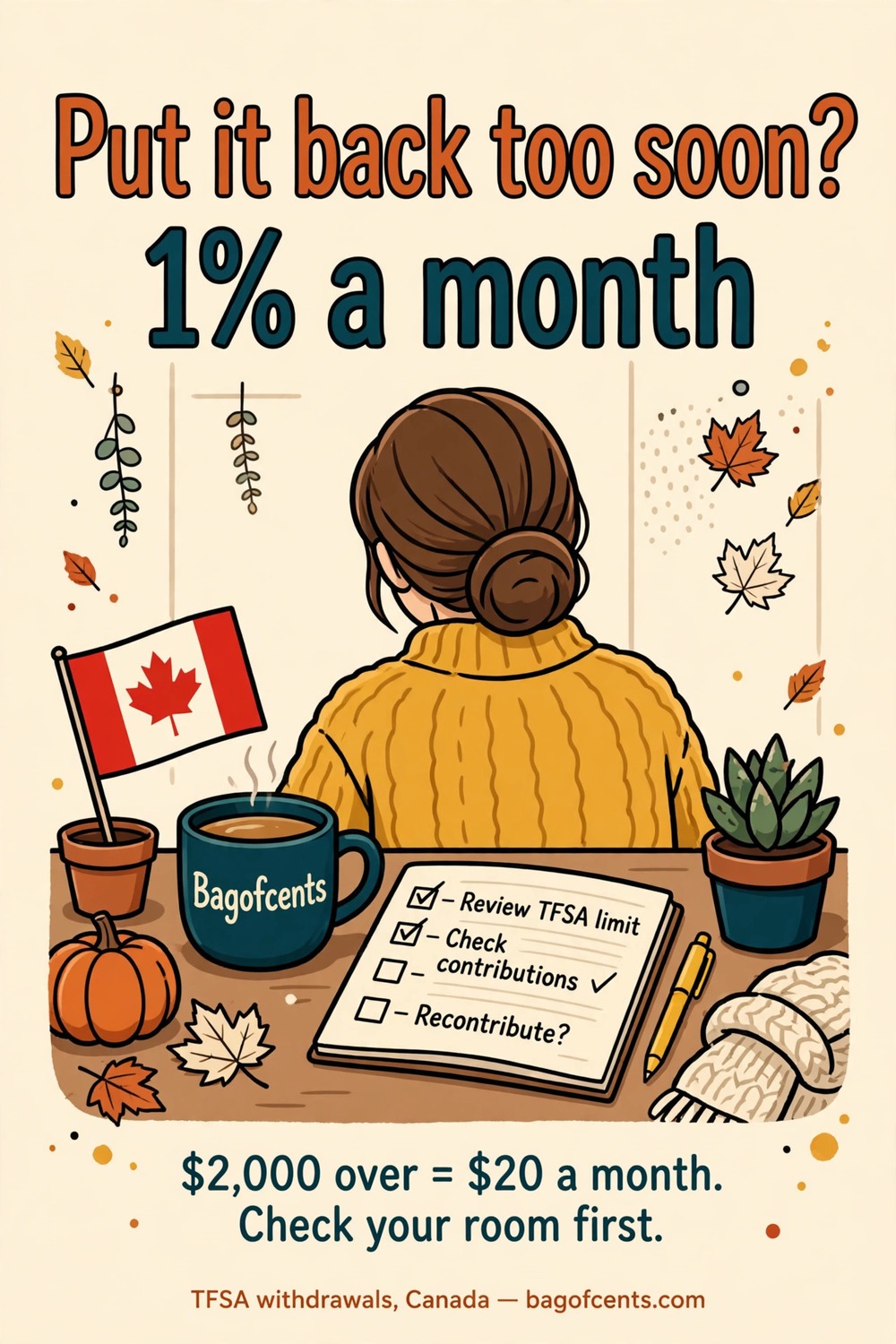
Say someone withdraws $5,000 in March, spends it, gets a bonus in June, and puts the $5,000 straight back — without having other unused room to cover it. It feels responsible. It is also an over-contribution, because the room from the March withdrawal does not exist again until next January 1.
The CRA charges a tax of 1% per month on the highest excess amount in the account for each month the excess stays there. On a $2,000 excess, that is $20 a month — $240 over a full year — until the excess comes out. On Maya’s $5,000, a full year of excess would run $50 a month. The tax keeps ticking for as long as the extra money sits in the account, and it does not stop just because the withdrawal and the re-contribution were the same dollars.
The fix, if it has already happened, is the same one from the TFSA Room article: withdraw the excess amount as soon as you spot it, and do not put it back until you genuinely have room for it. If you are not sure whether you are over, check CRA My Account and call the CRA before moving more money in.
And one warning about that CRA number: the room figure in CRA My Account is your room as of January 1, updated after financial institutions report the previous year’s transactions. It can lag your bank’s records by months. In December especially, do your own subtraction — take the CRA figure, subtract everything you have contributed since January 1, and remember that this year’s withdrawals do not add anything back until next January 1.
When December Does NOT Beat January
This rule is useful, but it is not a command to empty your TFSA every December. A planned December withdrawal makes sense when two things are both true: you know you will need the money early in the new year, and you plan to put it back. If either one is missing, the timing barely matters.
You are not planning to re-contribute. If the money is leaving the TFSA for good — a house deposit, a career break, a big planned expense — the return date of the room is a footnote. It comes back next January 1 whenever you withdraw, and it will be waiting if your plans change years from now.
The money is for the long term. If the $5,000 is part of savings you will not need for many years, there is no early-new-year expense driving the decision. Leave it where it is.
The need is not actually certain. December withdrawals work when the bill is real and dated. Taking money out “just in case” and then rushing it back in the spring, without checking your other room first, is how the same-year trap gets set. A maybe-expense does not need a December move.
You would have to guess at your room. If you do not know your unused room and cannot check it, do not improvise a withdrawal-and-rebuild plan in the last week of December. Check CRA My Account first, in November, while there is time to think.
A Simple December Checklist
If the December move does fit your situation, it takes about fifteen minutes:
Step 1: Confirm the need is real and early. The expense should be landing in the first part of the new year, and you should genuinely plan to re-contribute.
Step 2: Check your room before you touch anything. Log in to CRA My Account at canada.ca, note the figure and remember it is as of January 1. Subtract this year’s contributions yourself.
Step 3: Withdraw before December 31. The withdrawal has to happen in 2026 for the room to return on January 1, 2027. Do not leave it to the last afternoon of the year — processing times are not your friend in late December.
Step 4: Park the money somewhere boring. It is spoken for. A regular savings account for a few weeks is fine; this is bill money, not an investment decision.
Step 5: Write one line down. Amount withdrawn, date, and “room returns Jan 1, 2027.” That one note is what stops next year’s rebuild from accidentally becoming an over-contribution.
FAQ
If I withdraw from my TFSA in December, when exactly can I put the money back? January 1 of the next year. A withdrawal made any time in 2026 is added back to your contribution room on January 1, 2027, on top of the new annual amount for 2027. You do not have to wait a full twelve months — the calendar does the work.
What if I withdraw in January and want to put it back the same year? Only if you have other unused room to cover it. The room from a January 2027 withdrawal does not return until January 1, 2028. Putting it back without other room makes the re-contributed amount an over-contribution.
How much does an over-contribution actually cost? The CRA charges 1% per month on the highest excess amount in the account for each month it stays there. A $2,000 excess costs $20 a month — $240 over a year. Withdraw the excess as soon as you spot it to stop the clock.
Does withdrawing from a TFSA get taxed? No. TFSA withdrawals are tax-free, and the amount you withdraw is added back to your room the following January 1. What gets taxed is contributing more than your room — not taking money out.
I have lots of unused room. Does any of this matter to me? Much less. If your contributions have never come close to your total room, you can withdraw and re-contribute in the same year and the unused room absorbs it. This rule matters most for people whose TFSA is near their limit or who are rebuilding a specific amount on a schedule, like Maya.
Can I trust the room figure in CRA My Account in December? Trust it as a starting point, not the final number. It is your room as of January 1 and can lag your bank’s reporting by months. Subtract everything you have contributed since January 1 yourself, and do not count this year’s withdrawals as room — they are not, until next January 1.
Final Thought
The TFSA is the most flexible savings account most Canadians have, and this is the one place where it is quietly rigid: withdrawals only turn back into room on January 1. Once you know that, the calendar becomes a tool instead of a trap. Money you will need in January and plan to replace belongs out in December. Money you are taking out for good can move whenever it likes.
So before December 31, do Maya’s fifteen minutes: check your room in CRA My Account, look at what the first months of 2027 will actually ask of you, and if a withdrawal is coming anyway, let the calendar work in your favour. Same money, same plan — just a date that gives you your room back a full year sooner.
For general education only, not financial advice. TFSA limits and rules are set by the CRA and can change; check canada.ca or CRA My Account for your own number before making a large contribution or withdrawal.
Leave a Reply