
Most budgets fail for the same reason: they ask you to track twenty categories and feel guilty about every coffee. Nobody keeps that up for a month, never mind a year.
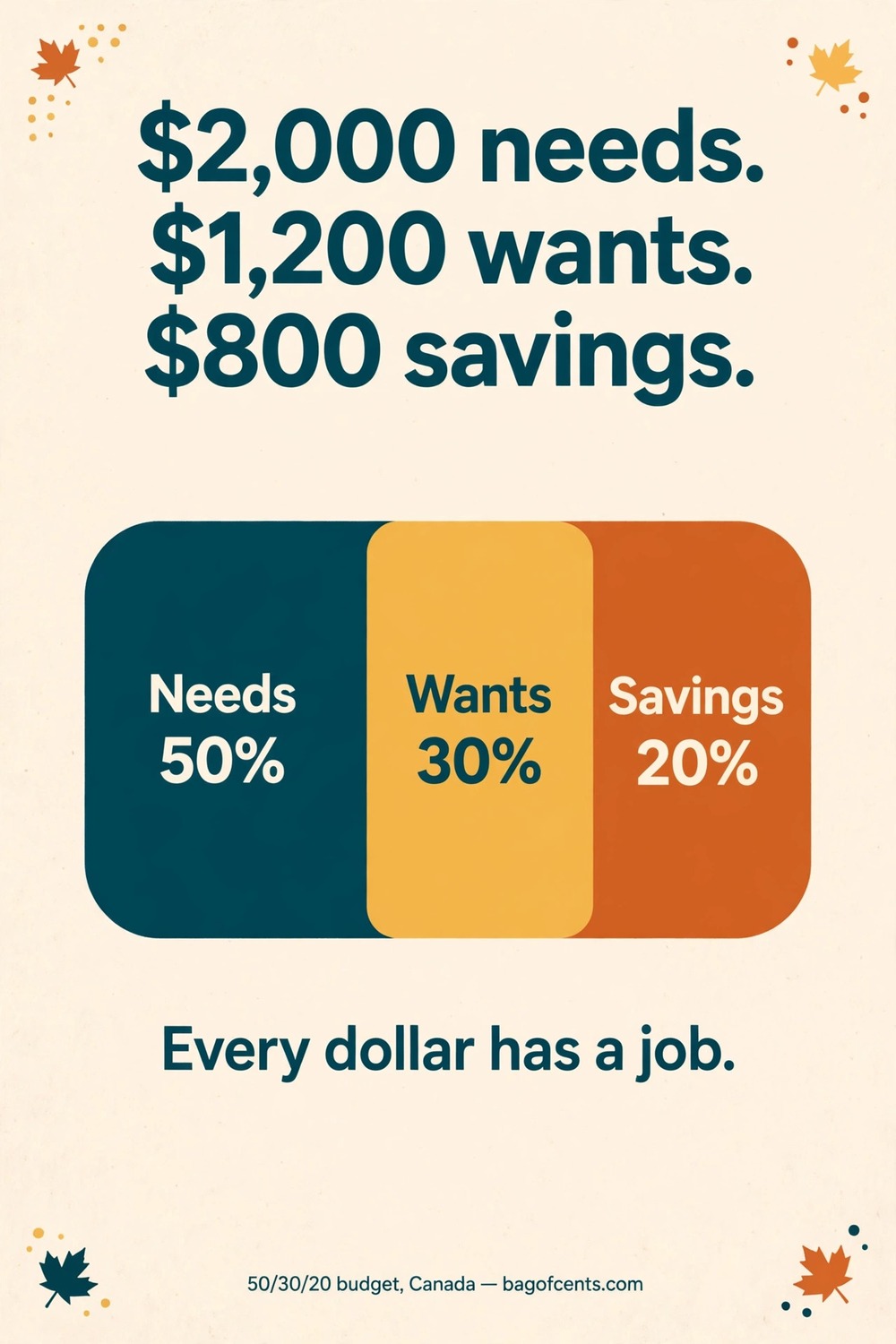
The 50/30/20 budget is the opposite. It has three buckets, and that is the whole system. Half your take-home pay goes to needs, 30% to wants, and 20% to savings and extra debt payments. No twenty categories. No guilt about a single purchase. Just three numbers to check at the end of the month.
It is not a magic formula, and it will not fit every household exactly — rent in Toronto is not rent in a small town, and a single parent’s numbers look different from a couple with no kids. But as a starting point, it is the clearest way I know to answer the only question a budget really has to answer: is my money going where I want it to go?
Here is how it works, with a real paycheque split dollar by dollar.
What Each Bucket Actually Covers
Needs — 50%. The things you cannot skip without real consequences: rent or mortgage, groceries, utilities, transit or car costs to get to work, basic phone and internet, minimum debt payments, and insurance. If you stopped paying it, your life would get worse fast. That is a need.
Wants — 30%. Everything that makes life good but is not survival: eating out, streaming, concerts, holidays, new clothes you do not strictly need, the nicer groceries, gifts. Wants are not waste. A budget with no wants in it is a budget you will quit. The point is to choose your wants on purpose, not to discover them on your bank statement.
Savings and extra debt — 20%. Emergency fund, RRSP and TFSA contributions, and any debt payments above the minimum. This is the bucket that moves your future. Paying only the minimum on a credit card keeps you in the needs bucket. Paying extra — even $50 more — belongs here, because it is buying your freedom back.
One honest warning before the numbers: in Canada, with today’s rents, many people will find needs take more than 50%. That does not mean the system failed. It means your starting point is different, and the fix is in the steps below, not in throwing the whole idea away.
The Worked Example: $4,000 a Month After Tax
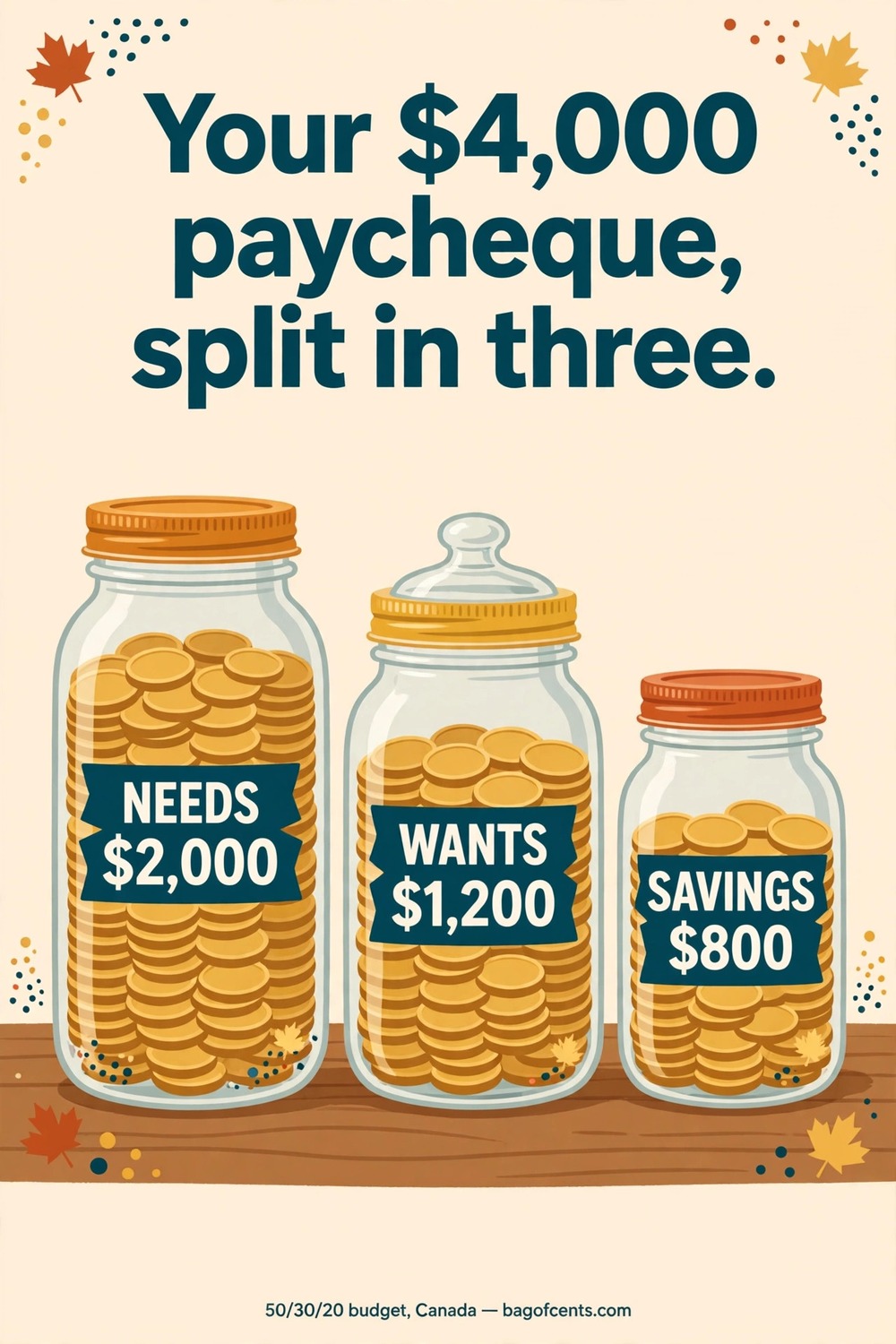
Take a household bringing home $4,000 a month after tax and deductions. Here is the split, exactly as the rule says:
- Needs — 50% = $2,000. Rent $1,300, groceries $450, utilities and phone $150, transit $100. Total: $2,000.
- Wants — 30% = $1,200. Eating out and takeout $300, streaming and fun $200, clothes and personal $200, holidays fund $300, gifts and extras $200. Total: $1,200.
- Savings and extra debt — 20% = $800. Emergency fund $400, TFSA $250, extra debt payment $150. Total: $800.
Check the math: $2,000 + $1,200 + $800 = $4,000. Every dollar has a job, and nothing is left unassigned.
Now the useful part: what if your numbers do not match? Say your rent alone is $1,800 and your needs come to $2,600 — that is 65% of $4,000, not 50%. You have three honest moves, and only three: earn more, cut a need (a cheaper place, a roommate, a smaller car payment), or accept a temporary split like 65/20/15 and rebuild the savings bucket as your situation changes. What does not work is pretending the 20% is there when it is not. A budget that lies to you is worse than no budget at all.
Step 1: Start With Take-Home Pay, Not Salary
Use the money that actually lands in your account. If your salary is $5,000 a month but $1,000 disappears to tax, CPP, EI and your pension, your budget starts at $4,000. Budgeting on gross pay is the most common reason the numbers never add up at the end of the month.
If your income changes month to month, use your lowest recent month as the base. Budget on the low month, and treat a good month as a bonus that goes straight to savings — not as permission to raise your wants.
Step 2: Sort Last Month, Honestly
Before you set targets, look at what actually happened last month. Pull up your bank and credit card statements and sort every expense into needs, wants, or savings. Do not guess from memory. Memory is generous to wants and forgetful about needs.
Most people find the same surprise: wants are 40% or more, and savings are close to zero. That is not a failure. It is the whole reason to do this — you cannot fix a split you have never seen.
Step 3: Set Your Three Numbers
Write down your three targets, in dollars, not percentages. Percentages are for explaining the idea. Dollars are for living it.
On $4,000 take-home, the targets are $2,000 / $1,200 / $800. On $3,000 take-home, they are $1,500 / $900 / $600. On $5,500, they are $2,750 / $1,650 / $1,100. Pick your income, do the same simple multiplication, and write the three numbers where you will see them — on the fridge, in your phone, in the spreadsheet.
If needs are over 50%, set your real numbers anyway: needs at what they actually cost, wants at what is left after a smaller savings number, and savings at whatever you can honestly protect — even $100 a month. A 65/25/10 split you actually follow beats a perfect 50/30/20 you abandon in week two.
Step 4: Automate the 20% First
This is the step that makes the whole thing work. On payday, before anything else, move the savings amount out of your spending account — into a separate savings account, a TFSA, or an extra debt payment. Pay yourself first is not a slogan. It is the only way the savings bucket survives contact with real life.
If $800 a month feels impossible, start with $200 and raise it by $50 every month until you reach your target. In a year, that ramp takes you from $200 to $800 a month, and you never feel the jump all at once.
Step 5: Check In Once a Month, for Ten Minutes
At the end of the month, add up the three buckets and compare them with your targets. That is the whole review. Ten minutes, once a month.
If wants ran over, do not punish yourself — move the difference out of next month’s wants and keep going. If needs ran over because of a car repair, that is what the emergency fund is for. The monthly check is not a test you pass or fail. It is how a rough split slowly becomes an accurate one.
5 Mistakes That Break the 50/30/20 Budget
1. Counting gross pay instead of take-home pay. Covered above, and still the most common mistake. Budget the money that lands, not the money on the job posting.
2. Putting minimum debt payments in the savings bucket. The minimum is a need — you have to pay it. Only the extra payment above the minimum counts as savings and debt payoff. Mixing them up makes your savings look bigger than it is.
3. Calling everything a need. Streaming, the gym, and the daily takeout coffee are wants. That does not make them bad. It makes them choices. When everything is a need, nothing can ever be cut, and the budget has no room to move.
4. Setting wants to zero. A budget with no fun in it lasts about two weeks. Keep the wants bucket, keep it honest, and spend it without guilt. That is what it is for.
5. Quitting after one bad month. One month over budget proves nothing except that life happened. The system works over six months, not one. Give it six.
FAQ
Does 50/30/20 work on a low income?
The percentages get harder when income is low, because needs eat a bigger share — that is real, not a personal failure. The method still works: use your real needs number, protect even a small savings amount, and revisit the split when your income changes. A $100 savings habit on a tight income matters more than a perfect ratio.
Does 50/30/20 work for couples?
Yes, if you run it on the household’s combined take-home pay. Add both incomes, split the combined number, and agree on the wants bucket together. The most common couple mistake is running two separate budgets and double-counting the same bills.
What counts as a need versus a want?
Ask one question: what happens if I stop paying for this? If the answer is real harm — eviction, no food, no way to get to work — it is a need. Everything else is a want, even the wants that feel essential. The line is yours to draw, but draw it honestly.
Should debt payoff go in needs or savings?
Minimum payments are needs. Extra payments above the minimum go in the 20% bucket, alongside savings. If you are carrying high-interest credit card debt, many people put most of the 20% toward the extra payment first, then rebuild savings once the card is clear.
How is this different from the 50/30/20 template in the Money Systems Pack?
It is the same rule. The template just does the sorting and the math for you: you plug in your income and spending, and the built-in formulas show your split and whether it balances. The article is the explanation; the spreadsheet is the tool that keeps it updated month after month.
If you want the template that does this split for you, it is in The Money Systems Pack: the 50/30/20 Budget Template, plus a Debt Payoff Calculator and a Net Worth Tracker. $19 USD, instant download, 14-day money-back guarantee. https://bagofcents.com/my-budget
Final Thought
A budget does not have to be complicated to work. It has to be honest, and it has to survive a normal month. Three buckets, three numbers, ten minutes a month — that is a system you can still be using next November.
Start tonight: take last month’s statements, sort them into needs, wants, and savings, and see where you actually stand. Whatever the split says, you now know the number to work on. And that is the whole point.
For general education only, not financial advice. Your numbers will differ based on your income, rent, and family situation — use the split as a starting point, not a rule you have to follow exactly.
Leave a Reply