
Yesterday’s article answered the first TFSA question: how much room do you have? For someone eligible since 2009 who never contributed, it is $109,000. For someone who turned 18 in 2020, it is $45,500.
Today’s question is the one people actually get stuck on: what do you put inside it?
Here is the part nobody explains clearly enough. A TFSA is not an investment. It is an account — a shell, a container. The money inside it has to sit in something. Cash in a savings account, a GIC, or an investment fund are the three usual choices, and they do very different jobs. Picking the wrong one for your timeline is how a good account ends up doing very little for you.
First, the Shell: a TFSA Is Not the Investment
Think of it like a lunchbox. The lunchbox is the TFSA. The sandwich inside is what you actually hold. The tax-free part is the lunchbox: growth inside it is not taxed while it stays there, and withdrawals come out tax-free.
That means two decisions, not one. First, open the TFSA. Second, choose what goes inside it. Opening the account and leaving the money as plain cash is a real choice — it is just the slowest one. And buying something you will need to sell next month is a real choice too — just a risky one.
The right choice depends on one question above all: when will you need this money?
The Three Usual Choices, in Plain English
1. A high-interest savings account (HISA) inside the TFSA. Your money sits as cash, earns interest, and you can take it out whenever you need it. Nothing to sell, nothing that can fall in value. This is the choice for money you might need within a year or two — an emergency fund top-up, a trip, a car repair. The trade-off is the return: it is modest, and it moves up and down with interest rates. Check the current rate before you open one; do not trust a rate you saw in an article months ago.
2. A GIC inside the TFSA. You lock the money away for a set term — often one to five years — and in exchange you get a fixed rate for that whole term. Your original amount is protected, and you know exactly what you will get at the end. This is the choice for money with a known date: a down payment in two years, a replacement car in three. The trade-off is access: take it out early and you usually lose the interest, or cannot take it out at all until the term ends. Do not put money you might need next month into a GIC.
3. An ETF or mutual fund inside the TFSA. Your money buys a basket of investments — for example, a broad fund that holds many companies at once — and its value goes up and down with the market. Over many years, this is the choice that has historically grown the most. It is also the only one of the three that can fall in value in a bad year. This is the choice for money you will not need for five years or more. The trade-off is patience: you have to be able to leave it alone when it drops, because selling in a dip locks the loss in.
None of these is “the best” on its own. The best one is the one that matches when you need the money.
The Worked Example: $100 a Week
Take the Save With Me pace: $100 a week, $5,200 a year. Maya, from Monday’s 50/30/20 article, now saves $390 a month — $4,680 a year — after fixing her $200-a-month leak. Both are well inside the $7,000 added to TFSA room this year, and well inside the $109,000 total room for someone eligible since 2009.
What changes is where that $100 a week goes:
- If it is next year’s Christmas and car repairs: a HISA inside the TFSA. You need it soon, you need all of it, and a market dip right before Christmas would be the worst timing.
- If it is a down payment in three years: a GIC ladder — for example, a new one-year GIC each year — so some money frees up every year and you are not locked in all at once.
- If it is retirement in twenty years: a broad, low-cost fund inside the TFSA, bought automatically every week, left alone. The weekly habit matters more than picking the perfect fund, and the tax-free growth matters more the longer it stays in.
Same $100 a week. Three different jobs. The timeline decides.
How to Decide in Five Minutes
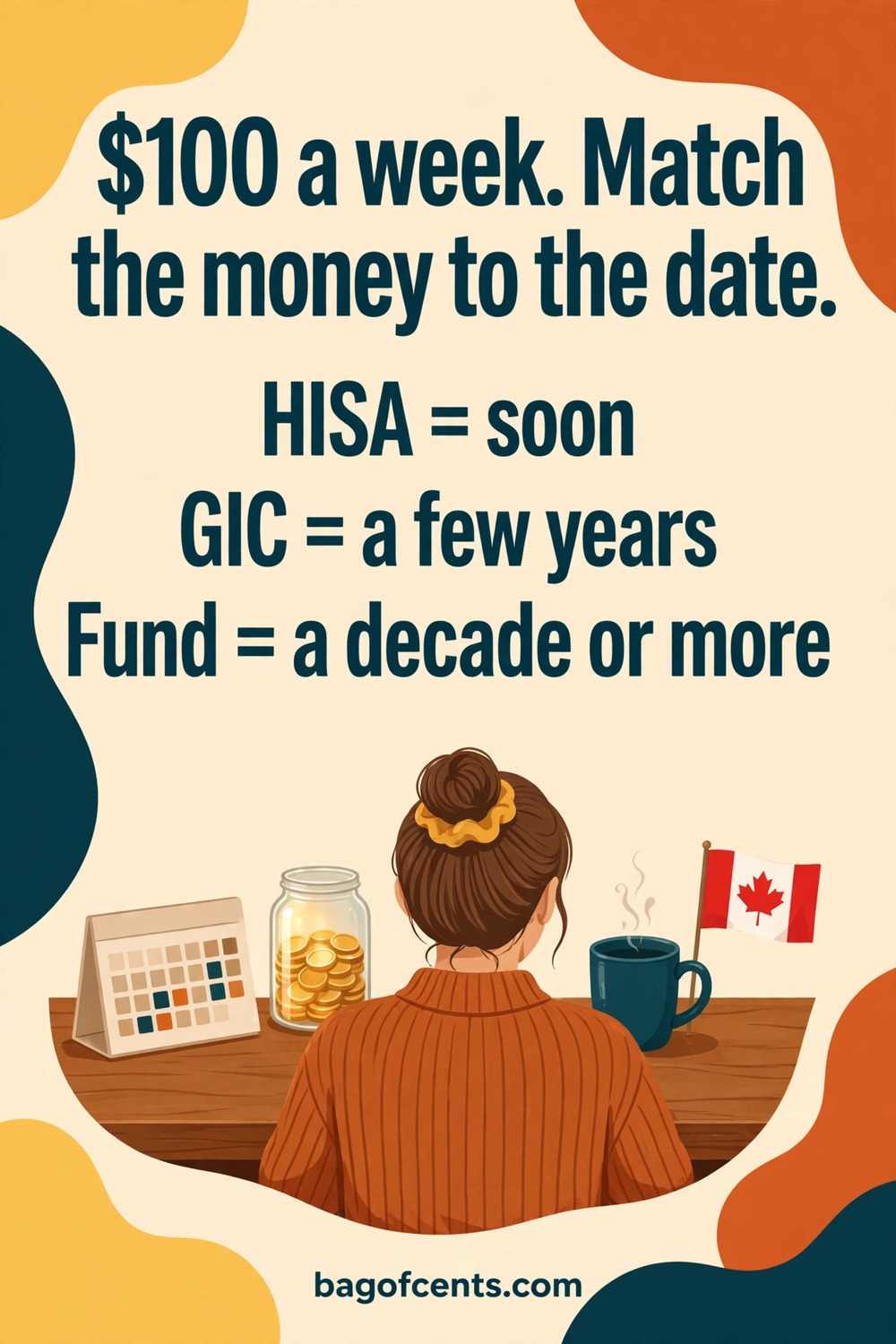
Step 1: Write down when you need it. A date, not a feeling. “Sometime soon” means a HISA. “In about three years” means a GIC. “Not for a decade or more” means you can consider a fund.
Step 2: Ask what happens if it drops 20% next month. If the answer is “I would have to sell it anyway,” it does not belong in a fund. If the answer is “Nothing — I would not touch it for years,” a fund is on the table.
Step 3: Check what you already hold. Two TFSAs at two banks share one room — $7,000 this year is across all of them, not per account. Add up what you have already contributed this year before you put more in.
Step 4: Automate the boring part. $100 a week, moved the day the paycheque lands, beats a bigger amount you mean to move later. The automation is the system; the choice of HISA, GIC or fund is just where the automated money lands.
Step 5: Revisit once a year, not once a week. Timelines change — a house purchase moves closer, a job changes. Once a year, check whether the money is still in the right place for its new date. Checking every day just invites selling at the worst moment.
5 Mistakes That Waste the TFSA
1. Leaving it as plain cash for twenty years. Cash is safe, but over decades it barely grows. Money you will not need for a long time deserves a job that can grow.
2. Putting next month’s rent money in a fund. A market dip does not care about your rent date. Short-term money needs a short-term home.
3. Locking everything in a five-year GIC. Certainty is nice until life changes. Keep the money you might need soon somewhere you can reach it.
4. Buying something you do not understand because someone online did. If you cannot explain what it holds in one sentence, do not buy it yet. A broad fund you understand beats a clever product you do not.
5. Forgetting the room rules. Room is across all your TFSAs, and money you withdraw this year does not come back as room until January 1 next year. Check CRA My Account before a large contribution — the full steps are in yesterday’s TFSA Room article.
FAQ
Do I need a TFSA to buy a GIC or an ETF? No. You can hold all three outside a TFSA too. Inside the TFSA, the growth is tax-free; outside it, interest and gains are taxed. The TFSA is the wrapper — the HISA, GIC or fund is what is inside it.
Can I hold more than one thing inside one TFSA? Yes. One TFSA can hold cash, GICs and funds at the same time, and you can move between them inside the account without using up more room. Moving money inside the account is not a contribution.
What if I pick the wrong one? You can usually switch. Cash can move to a GIC, a GIC matures and can move to a fund, a fund can be sold. The cost of switching is time and, for a GIC, sometimes lost interest — not a permanent mistake. The expensive mistake is leaving the decision unmade for years.
Is a TFSA better than an RRSP for this money? They do different jobs. The TFSA is flexible — withdrawals are tax-free and do not affect benefits. The RRSP gives a tax deduction now and is taxed on withdrawal. Friday’s RRSP vs TFSA article covers which one first when you cannot max both.
How much do I need to start? Most accounts let you start with $100 or less, and many funds accept regular $25 or $50 contributions. The $100-a-week habit in this article is a pace, not a minimum.
I already have a TFSA with cash in it. Is it too late? No. Cash sitting in a TFSA is still inside the tax-free wrapper. Moving it to a GIC or a fund when your timeline is clear is a normal next step, not a redo.
Final Thought
The TFSA rewards the person who matches the money to the date. Money you need soon stays safe and reachable. Money you need in a few years gets a fixed rate and a fixed date. Money you will not need for a long time gets the chance to grow — and the patience to ride out the years when it does not.
Tonight, take five minutes: write down one date for your TFSA money. Not a product, not a rate — a date. That one date tells you whether it belongs in a savings account, a GIC, or a fund. Everything else follows from it.
For general education only, not financial advice. TFSA limits and rules are set by the CRA and can change; rates on savings accounts and GICs change too — check the current rate and the terms before opening anything, and check canada.ca or CRA My Account for your own room before making a large contribution.
Leave a Reply