
It is 11 p.m. on a Tuesday, and your car makes a sound it has never made before. The mechanic’s estimate the next morning: $850. Or the furnace quits in February. Or your hours get cut and the next paycheque comes up $600 short.
Here is the question that decides what happens next: do you have $1,000 you can reach without borrowing? For a huge number of Canadians, the honest answer is no — and that single missing thousand is the reason a car repair becomes credit card debt, which becomes minimum payments, which becomes a balance that lingers for years.
The fix is not a six-month emergency fund. Not yet. That goal is so big it paralyzes people into doing nothing. The fix is a $1,000 starter emergency fund: small enough to build in weeks or a few months, big enough to absorb the most common surprises without new debt. This is general information, not personal advice — but the mechanics below work for any Canadian household starting from zero.
What Is a Starter Emergency Fund?
A starter emergency fund is a small, dedicated cash cushion — $1,000 is the classic target — kept in a separate savings account and touched only for true surprises. It is not your full emergency fund (that is 3–6 months of essential expenses, a later project). It is the first layer: the money that stands between you and the credit card when life happens.
Why $1,000 specifically? Two reasons. First, it covers the most common financial shocks: the typical car repair, a vet emergency, a broken appliance, a short gap between paycheques. Second, it is psychologically reachable. Telling someone with $43 in savings to build a six-month fund is telling them to climb a mountain. Telling them to save $1,000 is telling them to climb a hill they can see the top of. People finish hills.
Think of it as financial shock absorption. Without it, every surprise is financed at the worst possible price: 20%+ credit card interest, exactly when your budget is already stressed. With it, a surprise is just an inconvenience — annoying, but not the first domino in a debt spiral. The $1,000 does not make the car repair cheaper. It stops the car repair from becoming $1,600 of revolving debt.
And one important boundary: this fund is for unpredictable expenses, not predictable ones. The annual car insurance bill, holiday gifts, back-to-school costs — those are foreseeable, and they belong in sinking funds, a separate system. The starter emergency fund is for the things you genuinely could not see coming.
How to Build Your $1,000 Starter Fund
Step 1: Open a separate home for it — today
Before you save a single dollar, decide where it lives. The money needs its own account, separate from your chequing and your bill money. A high-interest savings account (HISA) at an online bank is the standard choice for Canadians: no fees, no minimum balance, and it earns a few percent while it waits instead of nothing.
Why separate? Because money in your chequing account is already spent in your mind. A separate account creates a small wall of friction: you have to log in, transfer, and wait a day or two. That friction is the entire point. Out of sight, out of reach, out of temptation.
Name the account something boring and clear, like “Emergency Fund.” Every time you see it, you get a tiny reminder of what it is for. Do not invest this money, do not lock it in a GIC, and do not keep it as “available credit” on a card — a credit limit is not savings, it is pre-approved debt.
Step 2: Pick your timeline and your number per paycheque
$1,000 divided by your timeline is your target per paycheque. The math is simple, and seeing the small number is motivating:
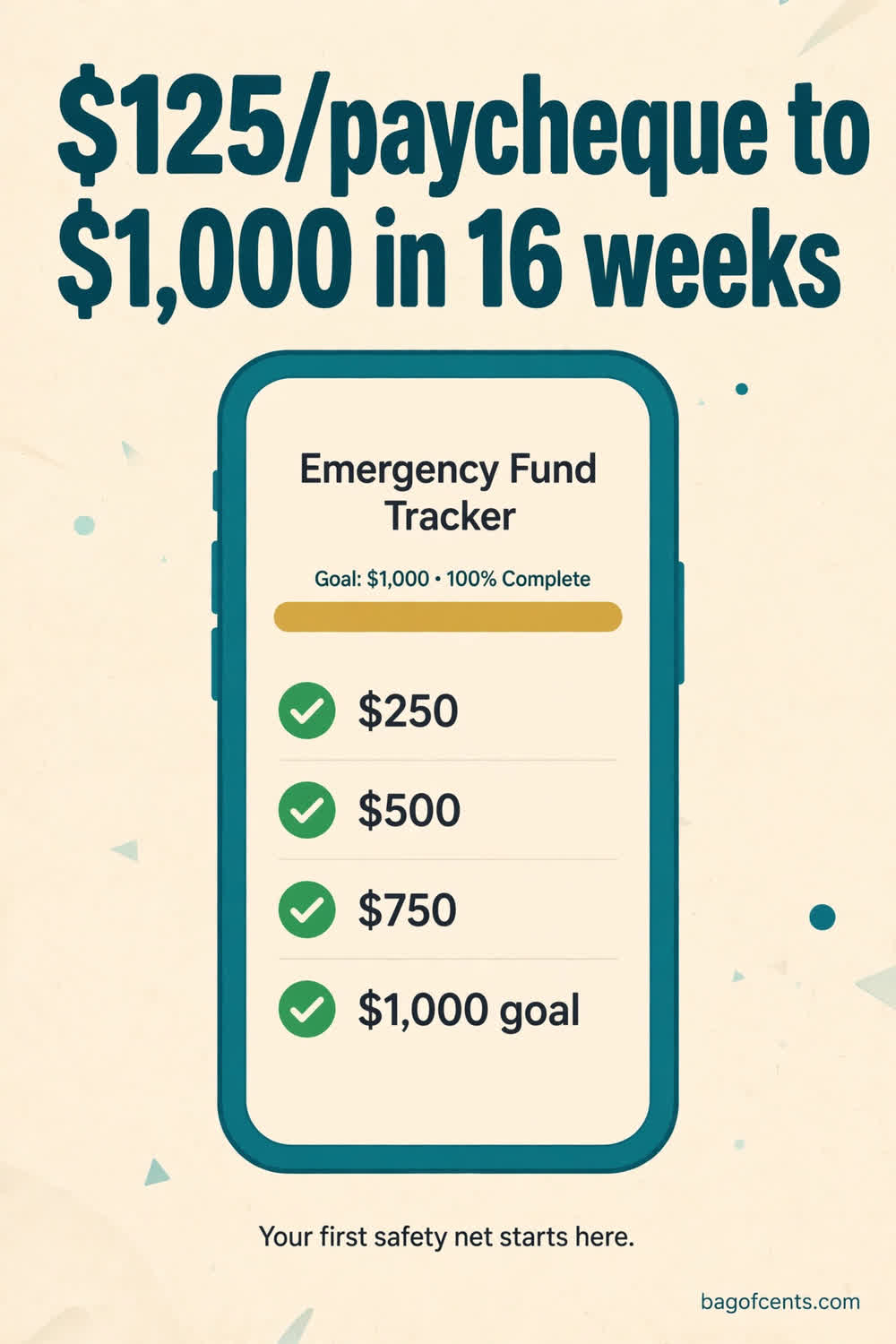
- Paid biweekly, 16-week target: $125 per paycheque × 8 paycheques = $1,000
- Paid biweekly, aggressive 10-week sprint: $200 per paycheque × 5 paycheques = $1,000
- Paid monthly, 4-month target: $250 per month × 4 months = $1,000
- Slow and steady: $50 per week × 20 weeks = $1,000
Pick the fastest timeline you can sustain without missing bill payments. Speed matters here — not because of interest, but because of exposure. Every week without the fund is a week a surprise can still become debt. This is a sprint, not a lifestyle.
Step 3: Find the money (the 90-day funding sprint)
You do not need a raise to find $1,000 in 90 days. You need a short, focused hunt. Here is what a realistic 90-day funding sprint looks like for a Canadian household:
- Subscription audit: ~$60/month. List every recurring charge and cancel what you have not used in 30 days. Two or three forgotten subscriptions at $10–$20 each is typical.
- Two no-spend days a week: ~$120/month. Two days with zero discretionary spending breaks the daily leak of coffees, snacks, and impulse stops.
- Pause dining out and delivery for 90 days: ~$150/month. The average household’s restaurant and delivery spending is the single biggest flexible expense. Three months of cooking is temporary.
- Sell what you do not use: $200–$400 one-time. The exercise bike, the old phone in a drawer, the tools, the barely-worn clothes. One weekend of listings.
Add it up: $330/month freed × 3 months = $990, plus a few hundred from selling — the fund is built in one quarter with room to spare. Not every line will fit your life; the point is that $1,000 is almost always findable in 90 days when you hunt for it deliberately. (For the full leak-plugging playbook, see our 10 saving money hacks.)
Step 4: Automate the transfer on payday
Set up an automatic transfer from chequing to the emergency account for the day after each payday. Payday, not month-end: if you wait until the end of the month to save “what is left,” there will never be anything left.
Automation is doing two jobs here. First, it removes the monthly decision — and monthly decisions are where savings plans go to die. Second, it trains you to live on what remains in chequing, which is quietly the most valuable financial skill there is. After two or three pay cycles, you stop noticing the transfer. That is when you know the system is working.
Step 5: Write your “this counts” rules — and your rebuild rule
Before the fund is full, write down what qualifies as an emergency. True emergencies: job loss or hours cut, a car repair you need to get to work, an urgent medical or vet bill, a home emergency like a burst pipe. Not emergencies: sales, vacations, concert tickets, Christmas gifts, “I had a hard week.”
Then write the rebuild rule: if the fund gets used, rebuilding it becomes your #1 financial priority until it is back to $1,000. Pause extra debt payments, pause other savings — refill the safety net first. A half-empty emergency fund is a plan waiting to fail the second time.
The Real Numbers: Three Paths to $1,000
Time to make it concrete. Here are three realistic paths a Canadian household can take, with exact numbers:
Path A: The steady paycheque plan. $125 automatically transferred every biweekly payday. After 8 paycheques — about 16 weeks — the fund hits $1,000. Total effort: one 15-minute setup. This is the path for people with stable income who just need a system.
Path B: The 90-day sprint. $250/month freed up ($60 subscriptions + $120 no-spend days + $70 less dining out, for example) plus $250 from selling unused items in month one. Month 1: $500. Month 2: $750. Month 3: $1,000. Total time: 90 days. This is the path for people who want it done fast and can tolerate three focused months.
Path C: The tight-budget path. $50/week, automated every Friday. Twenty weeks to $1,000 — about five months. Slower, but it works on the tightest budget, and $50 a week is findable for almost anyone (it is one skipped takeout dinner). The only requirement: start this week, not “when things settle.” Things never settle.
And what does the $1,000 earn while it waits? In a HISA earning around 4%, it generates roughly $40 a year — not life-changing, but the fund’s job is not growth, it is availability. (One Canadian tax note: interest earned in a regular savings account is taxable income, so keep the paperwork at tax time. Some Canadians hold emergency cash in a TFSA to shelter the interest — that works, but only if you have the contribution room and the discipline not to treat it as a spending account.)
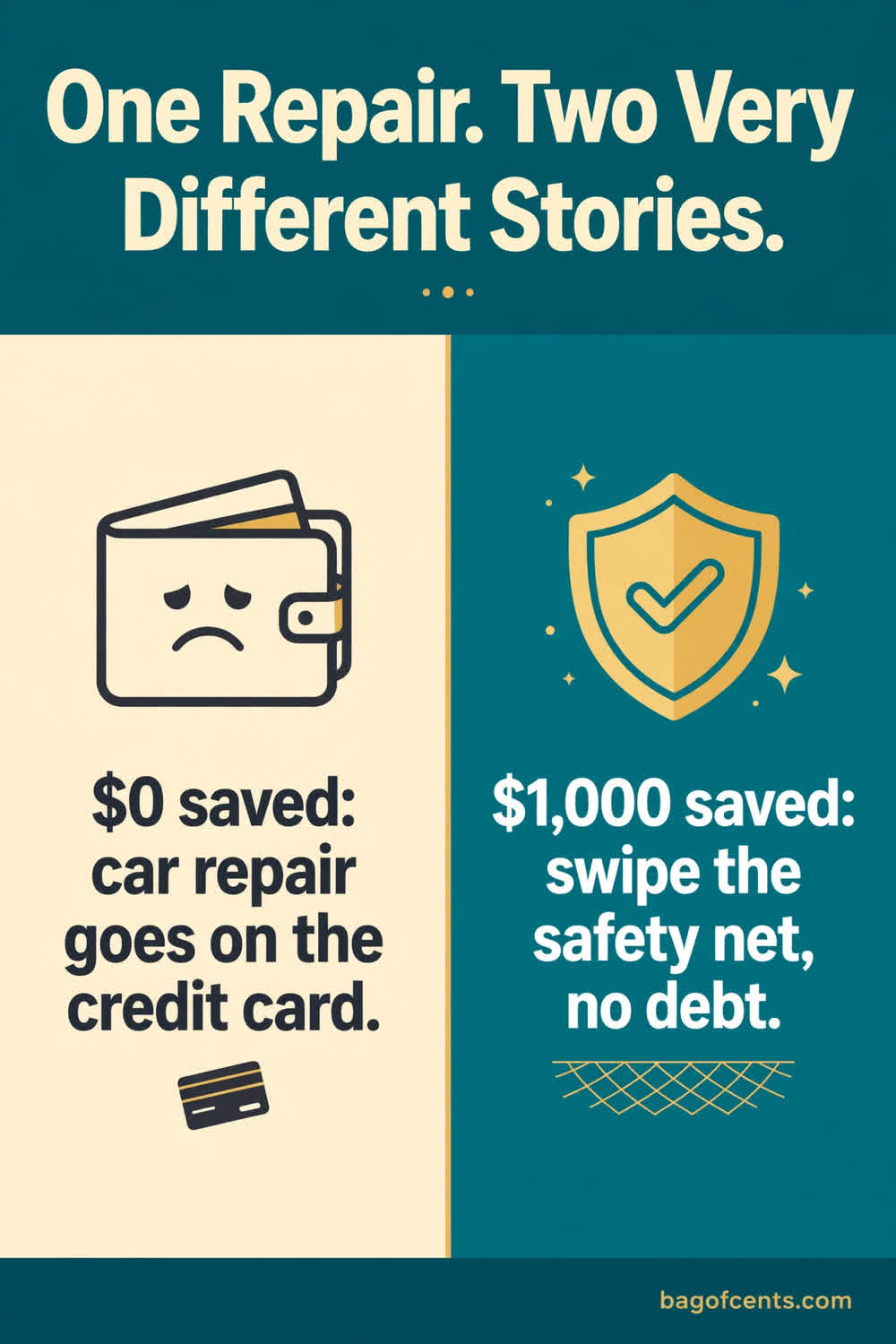
Now compare the paths to the alternative: no fund, and the $850 car repair goes on a credit card at 20.99%. Making minimum payments, that repair takes years to clear and costs well over $1,200 with interest. Every path above costs $1,000, once, and then the money is still yours. The fund is not an expense. It is the cheapest insurance you will ever buy.
5 Mistakes That Keep the Fund at Zero
Mistake 1: Keeping it in your chequing account. “I will just mentally earmark $1,000 in chequing” does not work. Mental accounting collapses the first time you are tired, stressed, or standing in front of something shiny. The fund needs its own account with its own login screen. Separation is the system.
Mistake 2: Investing it. The emergency fund is not an investment — it is insurance. Money you might need next Tuesday cannot be in anything that can drop 20% or lock you out for a term. A HISA is boring on purpose. Boring is available; exciting is not.
Mistake 3: Counting your credit limit as your emergency fund. Available credit is not a safety net — it is pre-approved debt. Every emergency financed at 20.99% costs roughly double by the time minimum payments finish with it.
Mistake 4: Raiding it for non-emergencies. The fund dies by a thousand small “emergencies”: the sale, the weekend trip, the gift you overspent on. Every withdrawal needs to pass the written “this counts” test from Step 5. If it does not pass, it waits. Protect the fund like it protects you.
Mistake 5: Waiting for the “right time” to start. “I will start after the holidays / after the car is paid off / when I get a raise.” There is never a calm stretch ahead — that is precisely why the fund exists. The best time to build it was before the last surprise; the second-best time is this payday. $50 this week beats $500 “someday” every time.
Starter Emergency Fund FAQs
Should I build this before paying off debt? Yes — build the $1,000 first (or at least alongside), then attack the debt. Without the buffer, every surprise during your debt payoff lands back on a credit card, and you rebuild debt as fast as you kill it. The $1,000 fund is what makes a debt payoff plan survivable. Once the fund exists, aim everything else at the high-interest debt.
Is $1,000 really enough? It is enough to start — that is why it is called a starter fund. It handles the most common surprises without new debt. After it is built, the next tiers are: one month of essential expenses, then three months, then six. Each tier is its own project. Do not let the size of tier three stop you from finishing tier one.
What exactly counts as an emergency? The test: is it unexpected, urgent, and necessary? Job loss, essential car repairs, urgent medical or vet bills, a burst pipe — yes. Sales, vacations, gifts, predictable bills you forgot to plan for — no. When in doubt, apply the 24-hour rule: if it can wait a day while you think, it is probably not an emergency.
What if I have to use it — did I fail? No — you used it exactly as designed. That is a success story, not a failure. The only failure is not rebuilding it. The moment the emergency passes, refilling the fund becomes priority one until it is back to $1,000. A used-and-rebuilt fund is proof the system works.
Should my partner and I each have $1,000, or share one? One shared $1,000 fund is fine for a household — emergencies hit the household, not the individual. What matters is that it is separate, both of you know the “this counts” rules, and neither of you raids it quietly. Shared fund, shared rules, shared accountability.
Where should Canadians keep it — regular HISA or TFSA? For most people starting out, a separate regular high-interest savings account is simplest: no contribution-room math, no withdrawal rules to think about. A TFSA can shelter the interest from tax, which is a nice bonus later — but simple and separate beats clever and confusing for your first $1,000.
Final Thought
The $1,000 starter emergency fund will never make a best-investments list. It earns a few dollars a year, it sits there doing nothing, and nobody brags about it. But ask anyone who has lived through a surprise with one and without one, and they will tell you it is the highest-return $1,000 in their financial life.
Without it, an $850 car repair becomes $1,200 of credit card debt and two years of minimum payments. With it, the same repair is a bad week and a refill plan. Same surprise, completely different life.
So here is the move: open the separate account today — it takes fifteen minutes. Set the automatic transfer for the day after your next payday. Pick your number: $125, $250, $50. Sixteen weeks, ninety days, twenty weeks — whichever path fits, the destination is the same. A year from now, you will either have a $1,000 safety net or you will not. Start this payday, and make it the former.
Liked this? Take it further.
Grab our free 52-Week Savings Challenge Tracker and save $1,378 in a year — one small deposit a week, a printable tracker that keeps you honest, and weekly money tips to keep the momentum going.
Join the Bagofcents weekly money tips email. Unsubscribe anytime.
Happy Budgeting!
Stanley
Keep Reading
- 52-Week Savings Challenge: Save $1,378 This Year — turn your new saving habit into a year-long game.
- The 30-Day No-Spend Challenge: Reset Your Spending in One Month — the fastest way to find your first $1,000.
- Sinking Funds: The Simple Budget Trick That Ends Surprise Bills — the companion system for predictable expenses.
- The 50/30/20 Budget Rule Explained — give every dollar a job, including your emergency fund.
Leave a Reply