
Your paycheque lands tomorrow morning. You check your bank account tonight and it’s nearly empty — again. Not because you went wild. You paid your rent, your bills, your groceries. The math just… didn’t stretch.
Here’s the thing nobody tells you: a monthly budget doesn’t match how most Canadians actually get paid. If you earn a paycheque every two weeks, you’re living on a paycheque rhythm, not a monthly one. And trying to plan a whole month with money that arrives in two uneven chunks is like trying to fill a swimming pool with a teacup. The bi-weekly budget fixes that — you budget each paycheque as its own little life.
What a Bi-Weekly Budget Actually Is
A bi-weekly budget is exactly what it sounds like: instead of writing one big plan for the month, you write a small, complete plan for each paycheque. Every two weeks, the money arrives, and that paycheque already knows what it’s for — which bills it pays, how much goes to groceries, how much goes to savings. Nothing is left to vibes.
Why does this matter? Because “bi-weekly” doesn’t mean “twice a month.” Twice a month is 24 paycheques a year. Bi-weekly is every two weeks — 26 paycheques a year. That means two months every year you get three paycheques instead of two. Most monthly budgets quietly pretend this doesn’t exist, averaging everything into neat monthly numbers that never match your actual deposits.
And here’s the quiet killer: bills are due monthly, but money arrives bi-weekly. Rent is due on the 1st, but your paycheque lands on the 3rd and the 17th. A monthly budget says “everything balances by month’s end,” but your bank account lives paycheque to paycheque — and that’s where overdraft fees and end-of-cycle anxiety are born.
How to Build Your Bi-Weekly Budget: 5 Steps
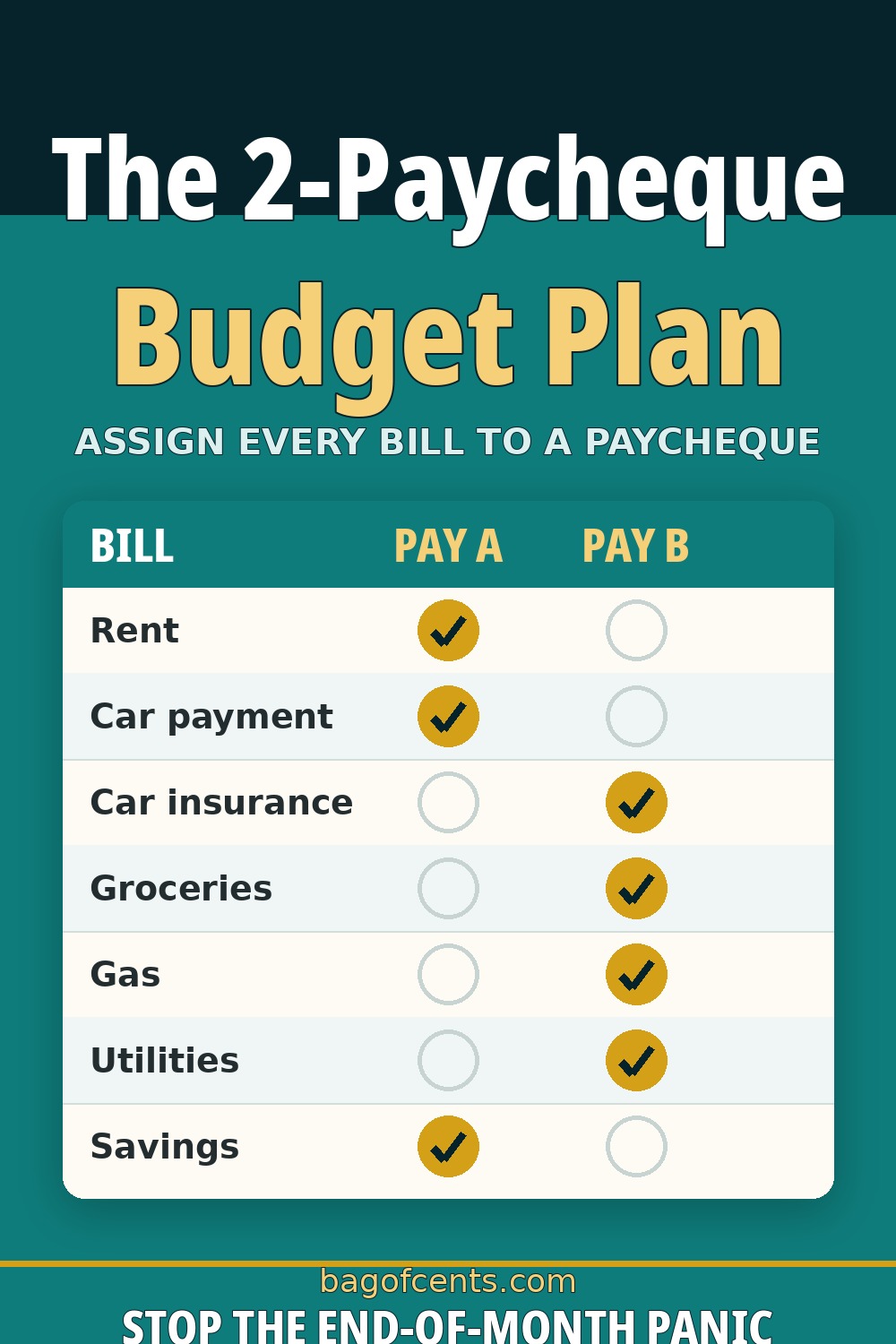
Step 1: List Every Bill by Due Date, Then Assign Each to Paycheque A or Paycheque B
Open your bank statements or grab a pen. Write down every recurring bill, its amount, and its due date. Then split the month’s paycheques into two camps:
- Paycheque A: the first pay of the month (the one that has to cover the big 1st-of-the-month bills — rent or mortgage, car insurance, any subscriptions renewing early in the month)
- Paycheque B: the second pay of the month (utilities, phone, internet, the bills due mid-to-late month)
The rule is simple: a bill belongs to the paycheque that arrives before it’s due. Rent due on the 1st goes to Paycheque A even if that pay landed in the previous month — what matters is the money is there before the bill is.
Work through every bill. If one paycheque is carrying far more than the other, shuffle a few flexible bills (streaming subscriptions, savings contributions) to the lighter side.
Step 2: Give Every Paycheque Its Own Job (The “Zero-Based Paycheque”)
This is the heart of the system. Each paycheque gets its own mini-budget where every dollar has a job before the paycheque even arrives — bills, groceries, gas, a little fun money, and a savings line, all planned so the total equals the paycheque. If Paycheque A is $2,100 and the plan adds up to $2,100, there’s nothing left to “accidentally” spend. You never have to remember a 30-day plan — only the plan for this paycheque, a two-week commitment your brain can actually hold.
Step 3: The 2-Bill Buffer Rule
Life doesn’t respect your spreadsheet. Some months your paycheque lands the day after a big bill is due, or two large bills hit in the same pay cycle. The 2-bill buffer is your shock absorber: always keep enough in your chequing account to cover your two largest bills, no matter where you are in the pay cycle.
The buffer is the first thing you build — before any other savings goal. It sits in your chequing account, untouched, like a financial airbag. Once it’s in place, a payday that’s three days late or a bill that comes out two days early becomes a non-event.
Step 4: The Two 3-Paycheque Months Are Sacred
Twice a year, you’ll have a month with three paycheques. This is the bi-weekly budgeter’s secret weapon — and its biggest temptation. That third paycheque is roughly a full extra paycheque of pure opportunity: two extra pay periods a year that your bills never counted on.
The rule, decided now: every third paycheque goes straight to savings, debt payoff, or both. Decide the split in advance — half to emergency savings and half to your highest-interest debt, say — and the month it arrives, the money moves on day one and the decision is already made.
Step 5: The 15-Minute Payday Routine
The night before every payday, take 15 minutes and run this checklist:
- Look at the plan for the paycheque arriving tomorrow. Which bills, how much for groceries, what’s the savings move?
- Check for anything unusual — a bill that changed amounts, a due date that shifted, a subscription you meant to cancel.
- Move the money the moment it lands. Savings transfers, bill payments, sinking fund contributions — same day. The longer money sits, the more likely it is to “disappear.”
- Glance at the next paycheque’s plan so there are no surprises two weeks out.
Fifteen minutes, twice a month, and you never start a pay cycle blind again.
A Real-Numbers Example: $2,100 Every Two Weeks
Let’s make this concrete. Imagine your net pay is $2,100 every two weeks. Here’s what a full month looks like.
Paycheque A (arrives early in the month — covers the big bills):
| Category | Amount |
|---|---|
| Rent | $1,400 |
| Car insurance | $160 |
| Groceries (2 weeks) | $200 |
| Gas/transit (2 weeks) | $80 |
| Savings | $150 |
| Phone bill | $110 |
| Total | $2,100 |
Paycheque B (arrives mid-month — lighter bills, more breathing room):
| Category | Amount |
|---|---|
| Utilities (hydro + water) | $180 |
| Internet | $90 |
| Phone bill | $110 |
| Groceries (2 weeks) | $200 |
| Gas/transit (2 weeks) | $80 |
| Savings | $1,200 |
| Fun money | $120 |
| Household/miscellaneous | $120 |
| Total | $2,100 |
Notice the balance: because rent eats most of Paycheque A, Paycheque B carries the heavier savings line ($1,200 vs $150). Every dollar of both $2,100 paycheques is assigned — that’s the whole game.
Now the fun part. In a 3-paycheque month, the math changes completely:
- Paycheque 1: $2,100 (bills as usual)
- Paycheque 2: $2,100 (bills as usual)
- Paycheque 3: $2,100 (the bonus round)
That’s a $6,300 month — and because your bills were already covered by the first two paycheques, the entire third one is free. Send it all to savings and debt: two of these months a year means $4,200 of pure progress annually, on top of your regular savings.
5 Mistakes That Break a Bi-Weekly Budget
1. Budgeting monthly averages instead of per-paycheque.
“I spend $600 a month on groceries” doesn’t tell you whether Paycheque A’s two weeks need $400 or $200. Average-based budgets create weeks where the money runs out before the week does. Plan the two weeks in front of you, not the month on the calendar.
2. Treating the third-paycheque month as a bonus to spend.
That extra $2,100 feels like found money, which makes it the most expensive spending decision of your year. Decide its fate in January, not in May or October when it actually shows up.
3. Assigning bills to the wrong paycheque.
If your car insurance comes out on the 12th and you assigned it to the paycheque arriving on the 15th, you’re paying overdraft fees — every time. Remember: a bill belongs to the paycheque that arrives before it’s due, with a day or two of breathing room.
4. Skipping the buffer.
“I’ll build the buffer once I’m caught up.” Backwards: the buffer is how you get caught up. Without it, every mis-timed bill cascades into the next pay cycle, and suddenly you’re permanently behind. Build it first.
5. Forgetting the irregular bills.
Car insurance renewals, annual subscriptions, back-to-school costs — these don’t follow a bi-weekly rhythm, so they ambush you. List each irregular bill, divide it by the paycheques until it hits, and tuck that amount into each paycheque’s savings line. When the renewal arrives, the money is already waiting.
Your Questions, Answered
Q: I get paid semi-monthly (twice a month), not bi-weekly. Does this still work?
Absolutely — it’s simpler. Semi-monthly means 24 paycheques on fixed dates (like the 15th and the last day), so bill assignment is even cleaner. You just don’t get the bonus months — make the regular savings lines work harder.
Q: My partner gets paid on a different cycle than me. How do we budget together?
Run one shared bill calendar, then assign each bill to whichever partner’s paycheque arrives before it’s due — a household with four paycheques a month instead of two. Every dollar still gets a job, and you run the 15-minute check before each payday, whoever’s it is.
Q: It’s the middle of the month. Do I have to wait for the 1st to start?
Start with the very next paycheque. Build a plan for the two weeks ahead with the money you have right now, assign the upcoming bills, and run your first 15-minute routine the night before it lands. Starting imperfectly mid-month beats starting perfectly never.
Q: My income varies — shifts, overtime, tips. Can I still do this?
Yes — budget each paycheque on the lowest amount you can reasonably expect, and send anything above that to savings or debt the day it arrives. A monthly budget based on your “average” month can leave you short in a slow one; per-paycheque planning protects you.
Q: What about months where a paycheque lands right after the 1st — does rent still go on Paycheque A?
If rent is due on the 1st and your paycheque lands on the 3rd, you have a timing problem, not a planning problem. Two fixes: build your 2-bill buffer so rent is covered regardless, or ask your landlord about shifting the due date a few days. Many landlords are flexible — a monthly late fee costs them nothing to fix.
Final Thought
Nobody’s financial life actually runs on months. Rent is due on a date, groceries happen weekly, paycheques arrive every two weeks. The bi-weekly budget stops fighting that reality — one paycheque, one plan, every two weeks. Run the 15-minute routine, protect the buffer, and when those two golden 3-paycheque months arrive, an entire paycheque glides straight into savings while normal life hums along untouched. That’s not luck. That’s a system.
Liked this? Take it further.
If mapping every paycheque got your planning brain going, the free 52-Week Savings Challenge Tracker will give you a week-by-week savings plan for the whole year — follow it all the way through and you’ll have $1,378 saved by year end. Grab it below and start this week.
Join the Bagofcents weekly money tips email. Unsubscribe anytime.
Happy Budgeting!
Stanley
Leave a Reply