
Most people never ask for a raise. They hope their boss notices the extra work, the late nights, the problems they quietly solved — and rewards them with a pay bump out of thin air. That day almost never comes.
Here’s the truth: raises are rarely given. They are requested. Managers have budgets, payroll systems, and dozens of competing priorities. Your compensation is one line on a spreadsheet they will not touch unless you give them a reason to.
The good news is that asking is a skill, and it’s a simple one. You don’t need to threaten to quit, cry in the meeting, or write a five-page manifesto about your worth. You need three sentences, said with calm confidence, after a short stretch of good preparation.
This article walks you through the prep, the timing, the exact three-sentence script, what never to say, and what to do after the meeting — whether the answer is yes or not yet.
Why Asking Works (Even When It Feels Awkward)
Asking for a raise feels awkward because most of us were raised to believe talking about money is rude. But in a workplace, your salary is a business negotiation, not a personal favour. Your employer bought your time and skill at a price. If the value you deliver has grown, the price should be renegotiated.
The numbers back this up. People who change jobs frequently get bigger jumps, but that doesn’t mean loyal employees are stuck. Research on salary negotiation consistently finds that employees who ask receive raises far more often than those who wait — often in the range of a few thousand dollars a year. A single 5-minute conversation can be worth $3,000, $5,000, or more every year you stay, compounding with every future raise calculated as a percentage of your new base.
Think of it this way: a $4,000 raise is $333 a month. That’s a car payment, a serious chunk of rent, or a much healthier savings rate. And because most raises compound — a 3% increase next year is calculated on your new, higher salary — the lifetime value of one successful ask can easily reach tens of thousands of dollars.
Before You Ask: The 4-Part Prep Checklist
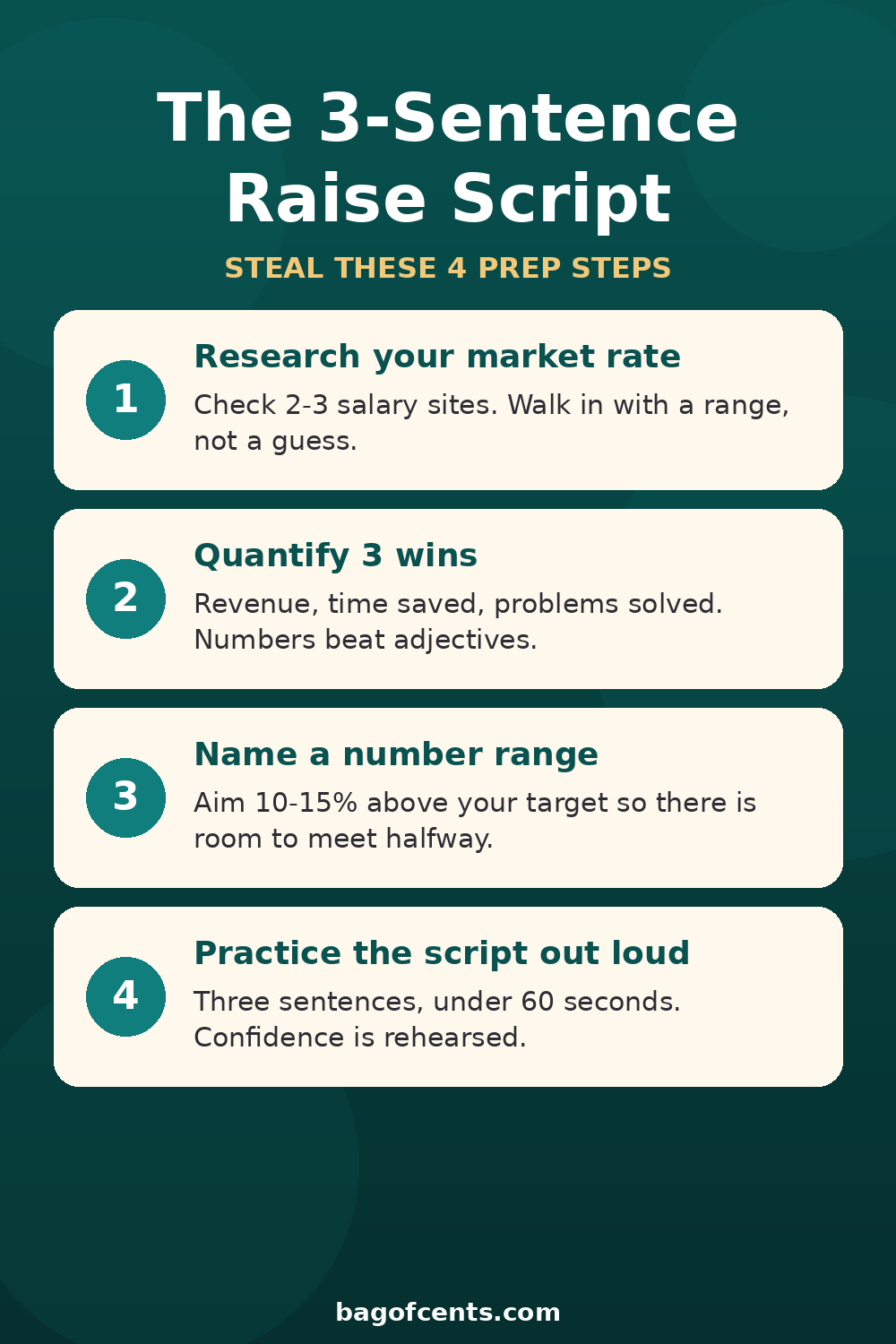
The script only works if the groundwork is solid. Spend a week or two on these four things before you book the meeting.
1. Document Your Wins
Managers forget. It’s not malicious — they have their own deadlines. So build a short list of your contributions over the past 6–12 months:
- Projects you led or rescued
- Revenue you generated or costs you cut (numbers beat adjectives)
- Problems you solved that nobody else could
- Praise from clients, customers, or other teams
- New responsibilities you took on beyond your job description
You don’t need twenty items. Five to eight strong, specific bullet points is plenty. Write them in a document you can reference — you likely won’t read it in the meeting, but having it makes you sound concrete instead of vague.
2. Research Your Market Rate
You can’t argue you’re underpaid if you don’t know what “paid” means. Look up your role on Canadian salary resources — Glassdoor, Payscale, Robert Half’s Canadian salary guides, or job postings for the same title in your city. Find a range, not a single number, and note the median.
If you earn $58,000 and the market range for your role in Toronto is $65,000–$75,000, you have a factual foundation. You’re not asking for a favour — you’re asking to be brought closer to the going rate.
3. Name Your Number (and a Range)
Walk in knowing exactly what you want. A specific number signals preparation. If you’re currently at $60,000 and the market says $68,000, asking for $66,000 is reasonable and defensible. Aim for a 5–10% increase in most cases — that’s ambitious enough to matter and realistic enough to survive a budget review.
Have a walk-away floor in mind too, the number below which you’d start looking elsewhere. You don’t need to state it. Just know it.
4. Time It Right
Timing won’t rescue a weak case, but it can sink a strong one. The best windows:
- After a visible win (a successful launch, a landed client, a great review)
- During performance review season, when compensation is already on the table
- When the company is doing well — never ask the week after layoffs
- After you’ve taken on meaningful new responsibility
Avoid asking during a personal crisis moment of your boss, during a hiring freeze announcement, or right after you made a mistake. Common sense, but common sense is exactly what nerves make people forget.
The 3-Sentence Script
Here it is. Memorize the structure, then put it in your own words so it sounds like you:
Sentence 1 — The anchor (state your contribution):
“Over the past year, I’ve taken on [specific responsibility], delivered [specific result], and consistently [specific strength].”
Sentence 2 — The market fact (state the gap):
“Based on my research, the market range for this role in our city is [$X–$Y], and I’d like to be brought closer to that.”
Sentence 3 — The ask (state the number):
“I’m asking for an increase to [$Z]. Can we make that happen?”
That’s it. Then stop talking. The silence after your ask is not your enemy — it’s where the manager processes. Filling it with apologies (“I know it’s a lot,” “totally fine if not”) undercuts everything you just said. Ask, then breathe, then listen.
A concrete example: “Over the past year, I’ve taken over the client reporting that used to eat up our director’s Fridays, brought our quarterly reports in three days early, and consistently kept our biggest account happy. Based on my research, the market range for this role in Toronto is $68,000 to $76,000, and I’d like to be brought closer to that. I’m asking for an increase to $70,000. Can we make that happen?”
Calm. Specific. Factual. Respectful. No threats, no drama.
What Never to Say
A few lines torpedo even well-prepared asks. Avoid these:
- “I need more money because my rent went up.” Your expenses are not your employer’s problem. Raises are about value delivered, not bills owed.
- “My coworker makes more than me.” This makes you look petty and puts your manager on the defensive. Keep the focus on you and the market.
- “I’ll have to start looking elsewhere.” Threats might win the round and lose the relationship. If you have another offer, that’s a different conversation — and it usually means you’re already halfway out the door.
- “I haven’t had a raise in two years.” True, but backward-looking. Reframe it: “My responsibilities have grown significantly over two years,” which is forward-looking and factual.
- Anything apologetic about your worth. “I know this is a lot to ask” tells them to say no. You’re not asking for a favour; you’re renegotiating a price.
After the Meeting: The Follow-Up Playbook
If the answer is yes: Say thank you, ask for the effective date and the new amount in writing, and ask what expectations come with the new pay level. Then deliver. Nothing strengthens your position for next time like proving the raise was a good investment.
If the answer is “not now”: Don’t sulk. Ask the two most valuable questions in any negotiation: “What would need to be true for me to earn this in six months?” and “Can we put a timeline on revisiting this?” Get specifics — a title, a project, a metric. Write them down, send a short thank-you email summarizing what was agreed, and start working toward those targets. A deferred raise with a clear path is still a win.
If the answer is a hard no with no path: That’s information too. Some companies simply won’t pay market rate for your role. Now you know — and knowing is what lets you make a calm, strategic decision about your next move instead of stewing in resentment.
Always follow up in writing. A short email the same day — “Thanks for the conversation today, here’s what I understood” — creates a paper trail and shows professionalism. If your manager agreed to revisit in six months, that email is what makes it real.
Real Numbers: What a Successful Ask Is Worth
Let’s make this concrete. Imagine you’re earning $60,000 and you negotiate a $5,000 raise to $65,000. That’s a pay bump of about 8.3%.
- Annual salary: $60,000 → $65,000
- Monthly (before tax): $5,000 → $5,417
- Extra per month: $417
That $417 a month could fully fund a $5,000 emergency fund in a year, wipe out a credit card balance, or supercharge your TFSA. And it compounds: if you get a 3% raise next year, that’s 3% of $65,000 ($1,950) instead of 3% of $60,000 ($1,800). The gap widens every year.
Over ten years, that single $5,000 raise — assuming modest 3% annual increases on the new base — is worth roughly $57,000 in extra earnings compared to staying at $60,000. One conversation. Five minutes. That’s the highest hourly rate you’ll ever earn.
Common Mistakes That Cost People Raises
- Waiting to be noticed. The default is no raise. Managers are not tracking your market rate for you.
- Asking without a number. “I’d like more money” is a wish, not a negotiation. Specificity is credibility.
- Leading with personal finances. Your landlord raised the rent. Your manager’s budget doesn’t care. Lead with value.
- Doing it by email. Big asks deserve a face-to-face (or video) conversation. Email is for the written follow-up, not the ask itself.
- Accepting the first “no” as final. A no without a timeline is just a “not yet” waiting to happen — ask for the path and the date.
- Not documenting anything. If you can’t name three wins, you look like everyone else. The prep document is the whole game.
FAQ: Asking for a Raise
How often should I ask for a raise?
Once a year is the standard rhythm, usually around your performance review. If your role changes dramatically mid-year — a promotion in everything but title — that’s a fair reason to ask sooner.
What if my company says there’s a pay freeze?
A freeze is real, but it’s not always total. Ask about alternatives: a title change (which unlocks a new pay band), extra vacation days, a one-time bonus, professional development funding, or a written commitment to revisit when the freeze lifts. And ask when the freeze is expected to end.
Should I mention a competing job offer?
Only if you’re genuinely prepared to take it. A bluff that gets called destroys your credibility; a real offer used calmly is the strongest leverage that exists. But know that many employers respond to offers with a counter — and counter-offer statistics are grim. If you’ve decided to leave, leave.
What if I’m new to the job?
If you’re within your first 6–9 months, focus on delivering and documenting rather than asking — unless the role you were hired for has materially changed. After a year of strong performance, you’re in the normal window.
Is it different for remote workers?
The script is the same, but the prep is more important: remote contributions are easier to forget, so your wins document needs to be airtight. Book a video call — don’t do it over Slack.

Final Thought
The worst outcome of asking is a no. The worst outcome of not asking is years of being paid less than you’re worth, compounded annually, funding someone else’s bottom line instead of your own goals.
You don’t need permission to start the conversation. You need ten minutes of prep, three sentences, and the willingness to sit through five seconds of silence. Your future self — the one with the bigger emergency fund, the healthier savings rate, and the salary that actually matches the work — will thank you for it.
Liked this? Take it further.
Earning more is only half the battle — keeping more is where the real wealth builds. Grab our free 52-Week Savings Challenge Tracker and put every dollar of your next raise to work automatically, one week at a time.
Join the Bagofcents weekly money tips email. Unsubscribe anytime.
Happy Budgeting!
Stanley
Leave a Reply