
The Headline Is Never the Paycheque
“Make $600 a month delivering food.” “Freelancers earn $30 an hour.” “I flipped thrift finds into $500 a month.”
You’ve seen the headlines. Maybe you’ve tried one of these hustles and wondered why your bank account didn’t get the memo. Here’s the uncomfortable part nobody puts in the thumbnail: the headline number is the gross. What lands in your pocket — after platform cuts, costs, gas, and taxes — is often a fraction of it.
That’s the $200 truth: a side hustle advertised at $600 a month very often nets closer to $200. Not because anyone lied to you exactly, but because four quiet costs each take a bite before you see a dollar: fees, expenses, taxes, and your own hours. Once you see the math, though, you can pick a hustle that genuinely pays — and drop one that doesn’t before it costs you another month.
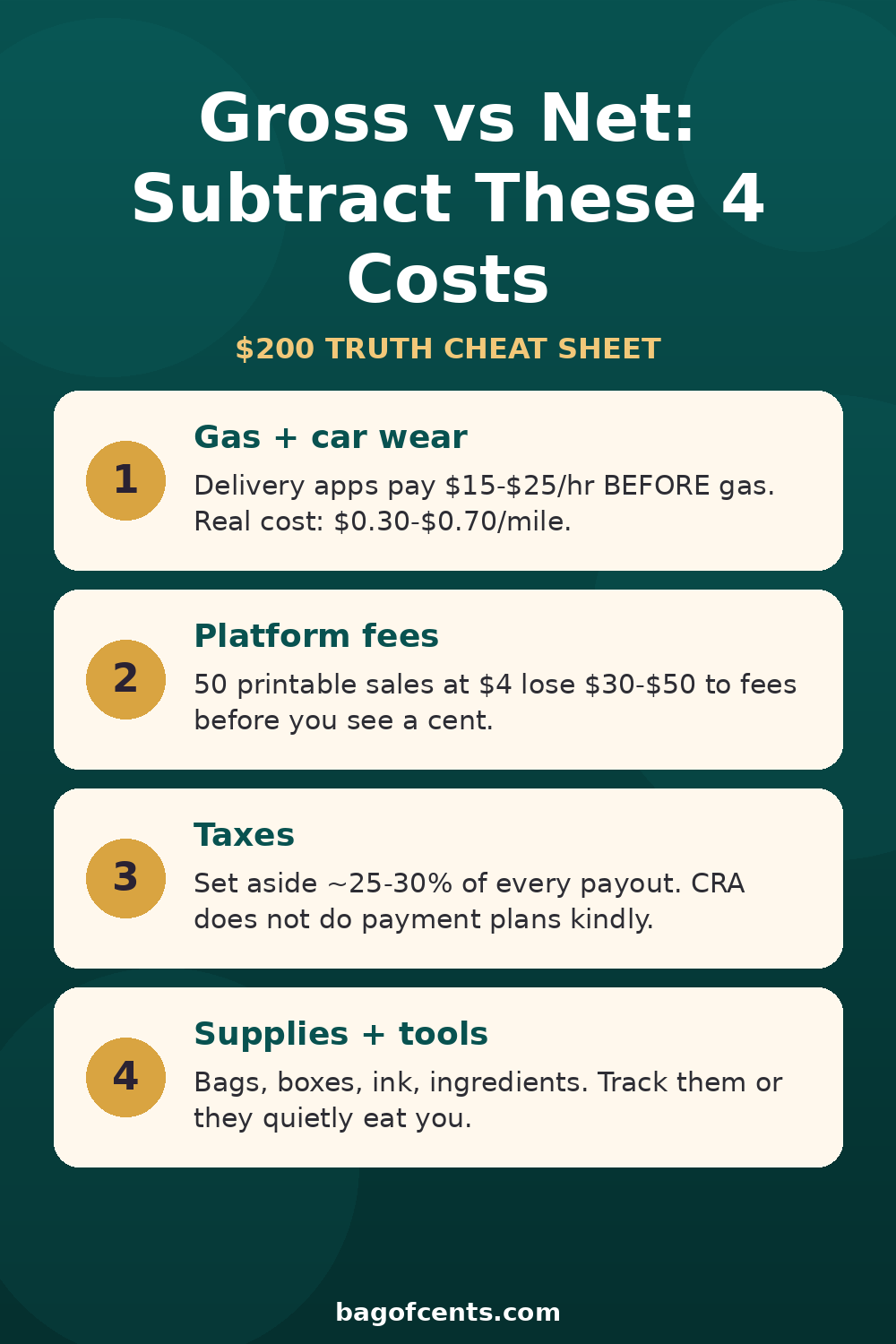
Gross vs. Net: The Four Bites
Every side hustle dollar passes through up to four filters before it becomes spendable money:
- Platform cuts. Marketplaces and gig apps take their share off the top — typically 10% to 25%. A freelance platform might take 10% of every invoice. A resale marketplace can take 13–15% once you add listing, transaction, and payment-processing fees. Delivery apps build their cut into the per-order pay, so the “cut” hides inside lower rates.
- Real expenses. Gas, mileage, shipping supplies, software subscriptions, inventory, packaging, extra data on your phone plan. These aren’t optional; they’re the cost of doing the work. For driving gigs, the CRA’s automobile allowance rate (about $0.72 per kilometre for the first 5,000 km) hints at what a car actually costs to run — far more than the gas receipt alone.
- Taxes. Side income in Canada is self-employment income. It gets reported on a T2125 with your tax return, it’s taxed at your marginal rate, and you also owe both halves of CPP contributions — roughly 11.9% of earnings above the basic exemption. Nobody withholds this for you. If you don’t set it aside as you earn, April delivers the surprise.
- Your hours. The number nobody divides by. “$500 a month” means nothing until you know whether it took 15 hours or 45. Your real hourly rate is the only number that lets you compare a hustle to, say, overtime at your day job or simply resting so you perform better at work.
A hustle is only worth it if the number after all four bites clears your personal bar. Let’s work that out properly.
Your Real Hourly Rate in Four Steps
This is the single most useful exercise in this article. Do it before you commit to any hustle — and redo it monthly once you’re earning.
Step 1: Write down the gross. What you were actually paid last month (or expect to be paid), before anything is deducted.
Step 2: Subtract every cost of earning it. Platform fees, gas, mileage at a realistic per-km cost, shipping, supplies, inventory, software, the portion of your phone bill the hustle uses. Be honest. If you drove 800 km, that cost you real money whether or not you wrote it down.
Step 3: Set aside the tax bite. A practical rule of thumb in Canada: put 20–25% of your profit (gross minus expenses) into a separate savings account the moment it arrives. Your exact number depends on your marginal tax bracket plus CPP, but 20–25% keeps most people safe. If your total self-employment revenue ever approaches $30,000 over four consecutive quarters, you also need to register for GST/HST — but for most side hustlers, the income-tax set-aside is the part that matters.
Step 4: Divide by your honest hours. Include the unglamorous ones: driving to the thrift store, photographing items, waiting between delivery orders, revising a client’s draft for the third time. That final number — net dollars per hour — is your hustle’s true wage. Compare it to your floor: the minimum that makes the time worth it to you.
Three Hustles, Honest Numbers
Let’s run the formula on three common hustles so you can see how the headline shrinks.
Hustle A: Food delivery — “$600 a month”
| Line | Amount |
|---|---|
| Gross payouts | $600 |
| Gas and vehicle costs (800 km) | −$230 |
| Net before tax | $370 |
| Tax set-aside (20%) | −$74 |
| True take-home | $296 |
| Hours worked | 24 |
| Real hourly rate | $12.33/hr |
Half the headline vanished. The delivery pay already had the platform’s cut baked in, the car ate $230, and the tax set-aside took the rest. At $12.33 an hour, this hustle is paying less than most part-time jobs — and it’s wearing out your car to do it.
Hustle B: Freelance writing/design — “$800 a month”
| Line | Amount |
|---|---|
| Gross invoices | $800 |
| Platform fee (10%) | −$80 |
| Software/tools | −$30 |
| Net before tax | $690 |
| Tax set-aside (20%) | −$138 |
| True take-home | $552 |
| Hours worked | 26 |
| Real hourly rate | $21.23/hr |
Advertised as “$30 an hour,” reality is $21.23. Still respectable — above many part-time wages, with no commute and no vehicle costs. This is what a healthy hustle looks like: the costs are visible, the tax bite is planned for, and the hourly rate clears a reasonable bar.
Hustle C: Reselling thrift finds — “$500 a month in sales”
| Line | Amount |
|---|---|
| Gross sales | $500 |
| Cost of goods | −$150 |
| Shipping and supplies | −$55 |
| Marketplace fees (~13%) | −$65 |
| Net before tax | $230 |
| Tax set-aside (20%) | −$46 |
| True take-home | $184 |
| Hours worked (sourcing, photos, listings, post office) | 20 |
| Real hourly rate | $9.20/hr |
This is the $200 truth in its purest form: $500 in sales became $184 in the pocket, at $9.20 an hour. It’s not a scam — it’s just a business with thin margins and heavy time costs. Fine as a hobby that pays for itself; brutal as an income strategy.
The pattern: the hustles with the catchiest headlines (driving, flipping) carry the heaviest hidden costs. The boring ones (freelancing a skill you already have) usually pay better per hour.
Picking a Hustle That Fits Your Actual Schedule
The math only works if the hours exist. A hustle that needs 20 hours a week is a fantasy if your calendar has six. Run this filter before you start:
- Audit a real week. Track where your hours actually go for seven days — not where you think they go. Most people find 5–10 genuinely free hours, not the 20 they imagined.
- Set your floor rate. Decide the minimum real hourly rate that makes it worth your evenings. A starting point: your day job’s after-tax hourly rate. If your job pays you $22/hr after tax, a hustle paying $12/hr is a pay cut on your free time.
- Favour recurring over one-off. A retainer client, a weekly cleaning route, or a regular tutoring slot beats chasing one-time gigs. One-off work has unpaid selling time baked into every dollar.
- Count the startup cost. If the hustle needs $400 of equipment, courses, or inventory before dollar one, that’s months of profit in many cases. Prefer hustles that start with skills and tools you already own.
- Run a 30-day test. Commit to one month, track every dollar and hour with the four-step formula, then decide with data — not hope.
Mistakes That Turn Hustles Into Money Losers
- Spending the gross. Treating the full payout as spendable money, then discovering the tax bill in April. The 20–25% set-aside isn’t optional; it’s the difference between a hustle and a debt.
- Buying the gear before the income. Courses, cameras, bulk inventory, a “pro” setup — purchased on the promise of future earnings. Earn first with what you have; upgrade from profit, not from savings.
- Ignoring vehicle costs. Delivery and rideshare drivers who count only gas are missing depreciation, maintenance, tires, and extra insurance. The per-km math is unforgiving.
- Taking every gig at any rate. Low-rate work drags down your average and eats the hours your best-paying work needs. A floor rate protects you from yourself.
- Letting the hustle hurt the day job. Exhaustion that costs you a promotion, a bonus, or the job itself is the most expensive hustle cost of all. Your primary income is almost always your best hourly rate — protect it.
- Never quitting a loser. Sunk cost keeps bad hustles alive for months. The 30-day test exists so the data — not your pride — makes the call.
- Forgetting the $30,000 GST/HST line. Cross $30,000 in self-employment revenue over four consecutive quarters and you must register for GST/HST and start charging it. It rarely applies to casual hustles, but fast-growing ones can trip over it.
FAQ
How much should I set aside for taxes on side income?
For most Canadians, 20–25% of profit (income minus expenses) kept in a separate account covers income tax at typical marginal rates plus CPP contributions. If you’re already in a high bracket at your day job, lean toward 30%. A quick chat with an accountant in your first profitable year is money well spent.
Do I need to register a business or charge GST/HST?
Not for casual earnings. You report the income on a T2125 as a sole proprietor — no formal registration needed. GST/HST registration becomes mandatory once your taxable revenue exceeds $30,000 over four consecutive quarters.
Can I put side-hustle income in my TFSA?
Your TFSA has annual contribution room you can use for any savings, including money earned from a hustle. But the business income itself must still be reported and taxed in the year you earn it — a TFSA doesn’t shelter self-employment income from tax. Keep business cash in a separate account so the bookkeeping stays clean.
Is food delivery worth it after expenses?
Sometimes, in the right market at peak hours, with a fuel-efficient car. But run your own per-hour math with honest mileage costs before deciding — the national average story is far less rosy than the recruiting ads.
How do I know when to quit a side hustle?
Give it 90 days of honest tracking. If the real hourly rate stays below your floor for three straight months and there’s no realistic path to raise it (better clients, higher prices, lower costs), the hustle is a hobby. Hobbies are fine — just stop calling them income.
Should I tell my employer?
Check your employment contract for moonlighting or conflict-of-interest clauses first. Many employers don’t care; some do, especially if the hustle competes with them or uses company resources.
Final Thought
Nobody is coming to hand you the honest version of a side hustle’s pay — the platforms advertise the gross, the gurus advertise the dream, and the tax bill arrives whether you planned for it or not. But once you run the four-step math, the fog clears: some hustles genuinely pay $20+ an hour with costs you can see, and some turn $500 of effort into $184. A $200 truth you can plan around beats a $600 fantasy every time. Pick the hustle whose real numbers clear your bar, track it for 30 days, and let the data — not the headline — decide.
Liked this? Take it further.
Now that you can see your side hustle’s true take-home, put those dollars to work: grab the free 52-Week Savings Challenge Tracker and turn your extra income into a growing savings balance, one week at a time.
Enter your email to get the free 52-Week Savings Challenge Tracker, plus practical money tips from Bagofcents. Unsubscribe anytime.
Happy Budgeting!
Stanley
Keep Reading
- 12 Side Hustles That Actually Pay: Make $500/Month — idea-first companion to this article: which hustles are worth running the numbers on.
- Zero-Based Budgeting: Give Every Dollar a Job — put your hustle’s true take-home to work with a budget that assigns every dollar.
- The Minimum Payment Trap: How $8,000 Becomes $25,000 — if your hustle earnings are headed toward debt, make sure they land where they hurt the balance most.
Leave a Reply