
How to Budget on an Irregular Income: The Buffer Method
You made $5,200 in March. You made $1,900 in April. May brought $3,600, and June was a blur of "I'll just put groceries on the card and sort it out later."
If your income arrives in waves — freelance gigs, gig-worker earnings, seasonal work, commission, contracts that land whenever they land — traditional budgeting advice has been quietly failing you for years. Every standard budget assumes the same paycheque lands on the same day, twice a month, forever. Yours doesn't. So you end up budgeting off your best month (fun, brief), panicking in your worst month (familiar, miserable), and calling the whole thing a budgeting problem when it's really a timing problem.
It's not a discipline problem. Studies of gig and freelance income consistently show the same pattern: earnings that swing 30 to 60 percent month to month, even when the annual total is perfectly respectable. A freelancer averaging $48,000 a year might see $2,300 one month and $6,100 the next. The money exists. The calendar just refuses to cooperate.
That's exactly what the Buffer Method fixes. It doesn't ask you to earn more, spend less in a vacuum, or predict the unpredictable. It changes the game you're playing: instead of budgeting the money you hope to earn, you budget the money you already know is the floor — and you pay yourself like a salaried employee on the 1st of every month, good months and bad.
What the Buffer Method Actually Is
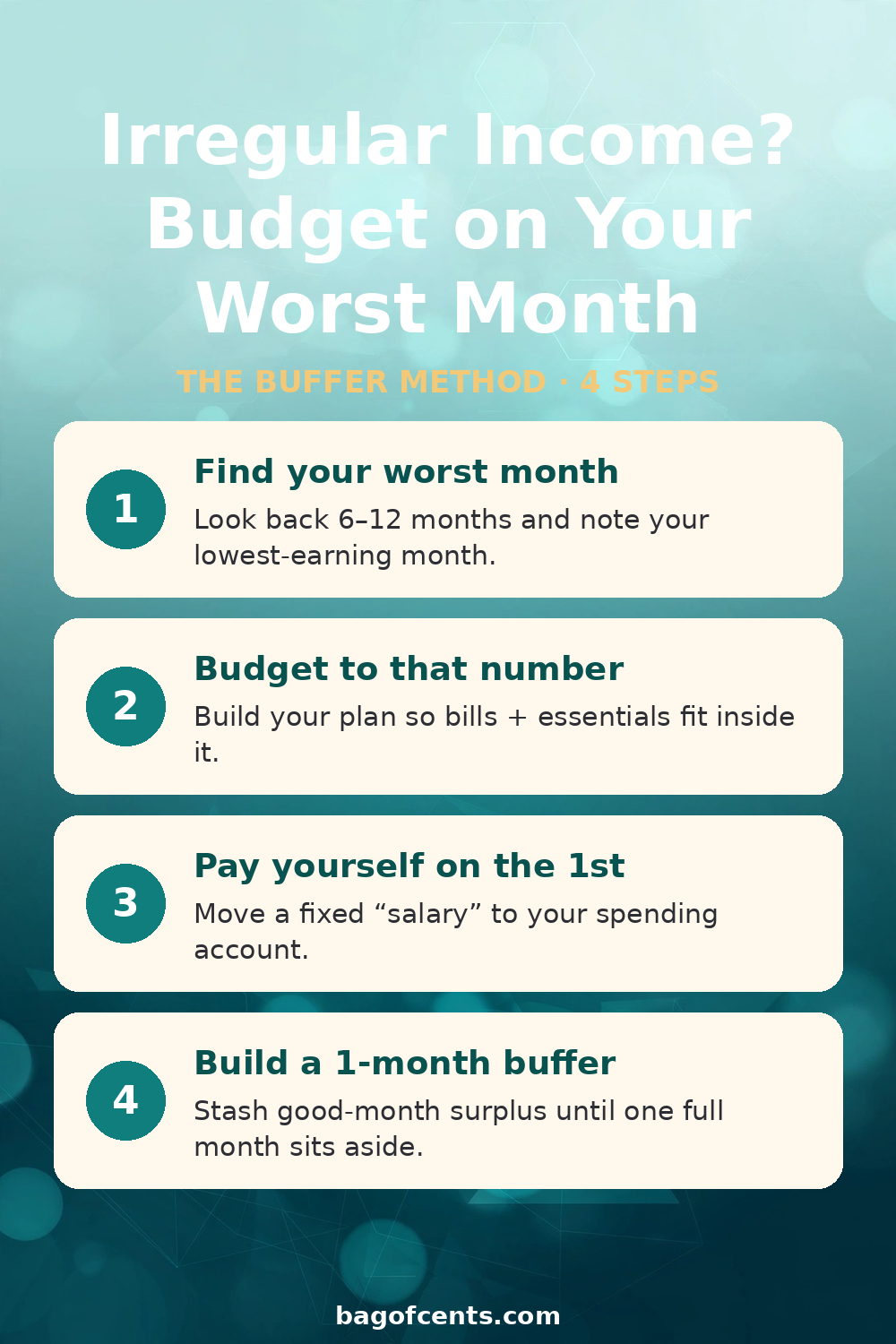
The Buffer Method is a cash-flow system for irregular income built on one principle: your spending budget should be based on your worst recent month, not your average month, and definitely not your best month.
Here's the whole thing in four moves:
- Find your base. Look at your last three to six months of take-home income. Your base budget is either your worst month, or your three-month average minus 15 percent — whichever feels safer.
- Pay yourself on the 1st. On the first of each month, transfer your base amount into your spending account. That transfer is your "salary." Everything else stays in a holding account.
- Feed the buffer. Every dollar that lands above your base goes into a buffer account until the buffer holds one full month of base expenses.
- Split the overflow. Once the buffer is full, surplus dollars split between savings and debt — your goals, funded by the good months.
The buffer is what stands between a thin month and a credit card, and because it's built from surplus in good months, you're never budgeting money you don't have.
Step 1: Find Your Base Number (This Is the Whole Game)
Open your bank app and pull your take-home income for the last six months — the actual deposits, after tax. Not what you invoiced, not what you're owed, what landed.
Let's say the six months look like this:
- May: $4,200
- June: $2,600
- July: $5,800
- August: $3,100
- September: $4,900
- October: $2,900
Your worst month is June at $2,600. Your three-month average (August–October) is about $3,633; minus 15 percent, that's roughly $3,090.
Two legitimate base options:
- Conservative: use your worst month — $2,600. Safest, and the right pick if your swing is wild or you're carrying debt.
- Middle path: use your three-month average minus 15 percent — call it $3,000 for round numbers. Slightly more room, still conservative.
Most people in this system land somewhere between those two. For this walkthrough, we'll use a $3,000 base — a life you can genuinely fund on your bad months.
Why not the average? Because averaging lies to irregular earners. If your average is $4,100 but two months a year come in under $3,000, an average-based budget fails in exactly those months — the ones that matter most. The base is designed for the month that ruins budgets. Everything above it is gravy.
Step 2: Pay Yourself on the 1st Like a Salary
Here's where the magic happens. Set up two accounts — your regular chequing account can be the spending account; a no-fee savings account (or a second chequing account) is your holding account. All income lands in the holding account first. On the 1st, you transfer exactly your base ($3,000) to spending.
This one ritual fixes the two biggest behavioural traps of irregular income:
Trap one: spending the peak. In a $5,800 month, your brain registers "$5,800 of spendable money" and calibrates your lifestyle upward — nicer groceries, the weekend trip, the "I deserve it" dinner. Three weeks later, the bill for that calibration arrives in a $2,600 month. The transfer wall stops the peak from ever reaching your spending brain.
Trap two: panic-mode austerity. In a $2,600 month, you slash everything — groceries to the bone, cancelled subscriptions, stress about every tank of gas. That kind of whiplash is exhausting, and exhausting systems get abandoned. With the 1st-of-the-month salary, a $2,600 income month can still be a perfectly normal $3,000 spending month. The buffer absorbs the dip, and you never feel it.
Salary-paying yourself also makes the rest of personal finance possible: automated savings, bill schedules, debt plans — all of them assume predictable cash flow, which the Buffer Method manufactures out of chaos.
Step 3: Feed the Buffer Until It Holds One Full Month
The buffer lives in your holding account (or a separate buffer account — whatever you'll actually leave alone). Every time income lands, the rule is simple: your base stays funded, and everything above it flows to the buffer.
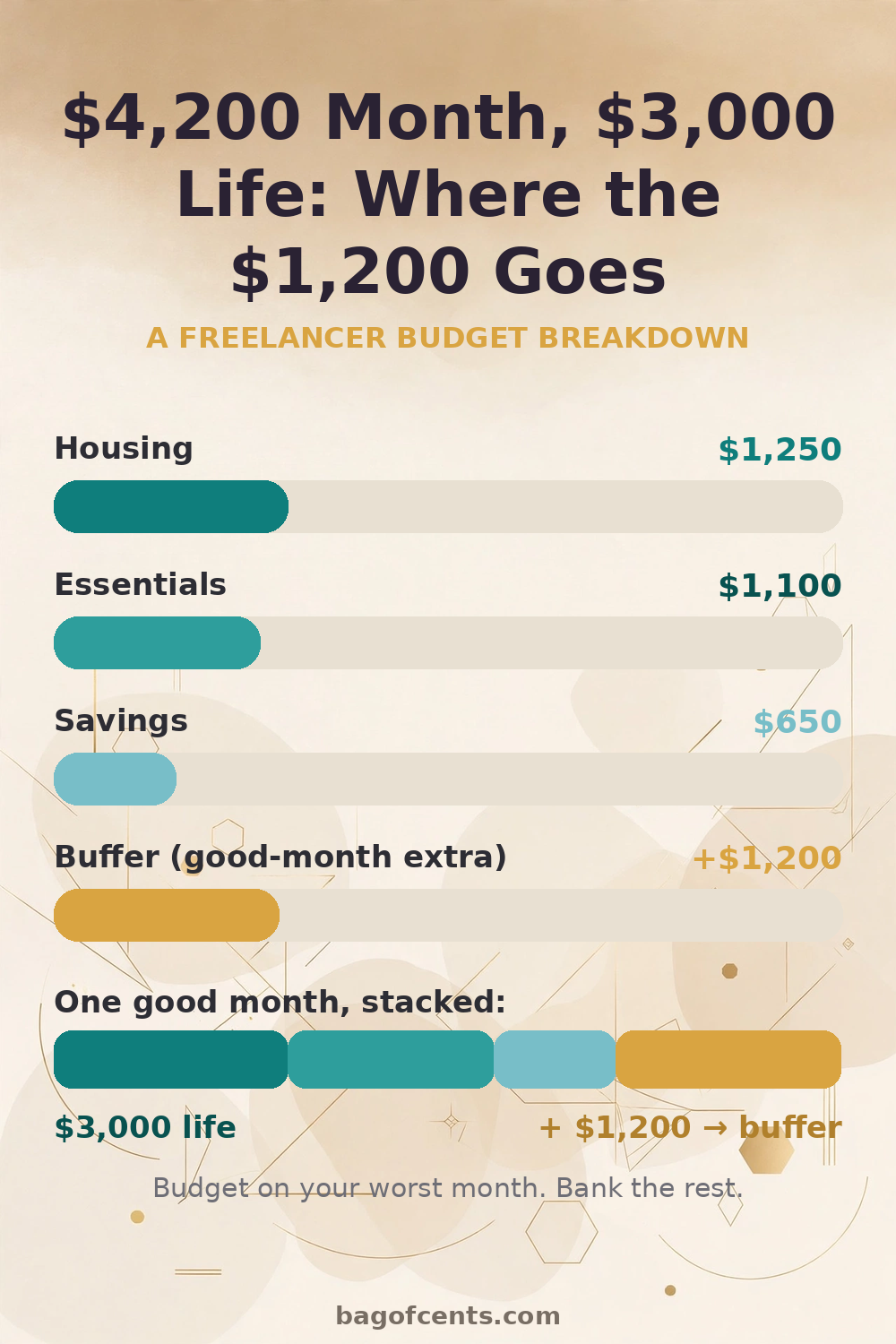
Working the example numbers: a $4,200 month funds your $3,000 base life, and $1,200 flows straight to the buffer. A $5,800 month sends $2,800. A $2,600 month sends nothing — and that's fine, because that month you spend from the base, which is fully funded.
Your target: one full month of base expenses in the buffer — $3,000 in our example. That's not an emergency fund; it's a cash-flow shock absorber. Its only job is letting a bad month (or two) feel like a normal month. You'll hit the target faster than you think: three above-base months averaging $1,200 in surplus get you there.
Practical rules for the buffer:
- It's not savings. Don't raid it for a vacation or count it toward your down payment. Its job is timing, not goals.
- Rebuild automatically. If a thin month draws it down to $2,200, the next good month's surplus refills it first, before anything splits toward goals.
- Keep it boring. A no-fee savings account is ideal. It should be slightly inconvenient to touch — separate from your spending money, not staring at you in your main chequing account.
Once the buffer holds a full month, the system shifts into its steady state, which is where the real payoff lives.
Step 4: Split the Overflow Between Savings and Debt
With a full buffer, surplus months stop being about survival and start being about progress. A $4,200 month still funds the $3,000 base — but now the $1,200 in surplus splits toward your goals. A common split:
- 50 percent to debt (highest-interest balance first)
- 30 percent to long-term savings (TFSA, emergency fund top-up)
- 20 percent to fun (yes, really — good months should feel good)
The new pattern is deliberately spending 20 percent of the peak and enjoying it — which keeps the system sustainable for years instead of weeks.
Adjust the split to your season. Heavy debt? Go 70/20/10 until the high-interest balances are gone. Buffer still building? Then it's 100 percent buffer until the target is hit — survival infrastructure comes before optimization.
The Worked Example: A $4,200 Month Funding a $3,000 Base Life
Let's put the whole month on paper. Meet the freelancer: base budget $3,000, buffer currently at $1,800 (building toward $3,000), October income $4,200.
October 1st: $3,000 transfers to the spending account. This is the salary. Rent, groceries, transit, bills, the fun slice — all budgeted from this $3,000, exactly like a salaried person's paycheque.
Income lands through October: $4,200 total hits the holding account. The base is already funded, so the entire $1,200 surplus flows to the buffer. Buffer: $1,800 → $3,000. Target reached.
November 1st: Another $3,000 salary transfers. The system is now fully armed: a full buffer behind you, a clean base in front of you.
November income: $2,600 (a thin month). Nothing flows to the buffer — and nothing needs to. November 1st's transfer already funded the month at $3,000 — a normal month on a $2,600 income, with no card debt and no panic cuts.
December income: $5,800 (a peak month). Base funded, buffer full — the $2,800 surplus splits: $1,400 to the credit card, $840 to the TFSA, $560 to guilt-free fun money. The peak month did what peak months are supposed to do: fund the future.
Three months, three wildly different incomes, one steady life.
5 Mistakes That Break the Buffer
1. Basing the budget on your best month. The most common failure. Your $5,800 month is not your life; it's a visitor. Budget it and the $2,600 month will always destroy you. When in doubt, round the base down.
2. Skipping the separate holding account. If all income lands in your spending account, the transfer wall is imaginary — and imaginary walls don't stop spending. The physical separation is the system. Two accounts minimum.
3. Treating the buffer as a savings account. The buffer is plumbing, not a pool. The moment you "borrow" from it for a trip or a purchase, it's no longer a buffer — it's a slush fund, and the next thin month will prove it.
4. Rebuilding nothing after a drawdown. Two rough months pull the buffer to $1,200. Then a $5,000 month arrives and every dollar goes to debt and fun because the buffer "felt fine before." Rebuild first. Always rebuild first.
5. Not adjusting the base as life changes. Got a raise in your rates? Base can rise — after three months of proof. Moved to a pricier city? Recalculate. The base is a living number, reviewed quarterly, not carved in stone.
Buffer Method FAQ
How is this different from zero-based budgeting?
Zero-based budgeting assigns every dollar a job — and it's excellent, but it assumes you know how many dollars you have. The Buffer Method is the layer underneath zero-based budgeting for irregular earners: it stabilizes your monthly income first, so you can then zero-base budget your $3,000 salary like anyone else. They stack beautifully.
What if I have a terrible quarter and the buffer empties?
Then the buffer did exactly what it was built for — it absorbed the shock instead of your credit card. Rebuild it with the next surplus, and use the experience to check whether your base was set too high. One bad quarter is data, not failure.
Does this work for seasonal workers with months of zero income?
Yes, with a bigger buffer target. If you earn nothing for two months a year, your buffer target should be two to three months of base expenses, not one. Same mechanics, larger shock absorber.
Should the buffer replace my emergency fund?
No. The buffer handles timing — income arriving late or light. The emergency fund handles events — the car repair, the vet bill, the furnace. Different problems, different accounts. (If you don't have an emergency fund yet, build the buffer first — cash-flow stability is the foundation everything else stands on.)
What about taxes? I'm self-employed in Canada.
Set aside your estimated tax in the holding account before calculating surplus. A common approach: move 20 to 25 percent of each payment into a separate tax sub-account immediately, then run the Buffer Method on what's left. The CRA doesn't accept "my buffer was full" as a payment plan.
Final Thought
Irregular income isn't a character flaw, and it isn't a budgeting failure — it's a cash-flow shape, and shapes can be managed. The Buffer Method works because it stops fighting the shape and starts routing around it: base from the floor, salary on the 1st, surplus to the buffer, overflow to your goals.
Start this month. Pull your last six months of deposits, circle the worst one, and set up the two accounts. Your first "salary" transfer happens on the 1st — and the first thin month that feels like a normal month is the moment this stops being a system and starts being your life.
Want the free budget tracker? The spreadsheet that makes the base budget and the monthly salary transfer dead simple is waiting — comment BUDGET and it'll land in your DMs.
Liked this? Take it further.
If irregular income makes saving feel impossible, the free 52-Week Savings Challenge Tracker gives you one small, fixed weekly target — a simple plan that builds your savings to $1,378 by year end, one checked box at a time.
Join the Bagofcents weekly money tips email. Unsubscribe anytime.
Happy Budgeting!
Stanley
Leave a Reply