
Same Payment, $400 Less Interest
Imagine two people with the exact same debts and the exact same monthly budget for killing them. One pays off every debt in 28 months and $3,305 of interest. The other takes the same 28 months — but pays $3,707 in interest. The only difference? The order they attacked the debts in.
That’s not a trick. It’s just how interest works: every dollar of debt accrues interest at its own rate, every single month. A dollar sitting on a 19.99% credit card costs you more than three times what a dollar on a 6.49% car loan costs. So which balance your extra payment hits first changes the total interest you pay — even when the monthly amount never changes.
This article is the sequencing math: how to order your debts so the same money does the most damage, with a full worked example. (If you want the psychology-first approaches, our guides to the Debt Snowball vs Avalanche debate and the Debt Hybrid Method cover those — here we’re purely after the cheapest order.)
Why Order Matters: Interest Is Rent on Every Dollar
Think of interest as rent you pay each month for every dollar you still owe — and each lender charges a different rent. Your credit card charges about 1.67% per month (19.99% ÷ 12). Your car loan charges about 0.54% per month (6.49% ÷ 12). Every month a $1,000 balance sits on the card, it costs you roughly $16.67 in rent. The same $1,000 on the car loan costs about $5.41.
When you make an extra payment, you’re choosing which rent to stop paying first. Send it to the 19.99% balance and you cancel $16.67-a-month rent per thousand. Send it to the 6.49% balance and you cancel $5.41. The payment is identical; the savings aren’t. Multiply that choice across every month of a multi-year payoff, and you get the $400 gap from the opening example.
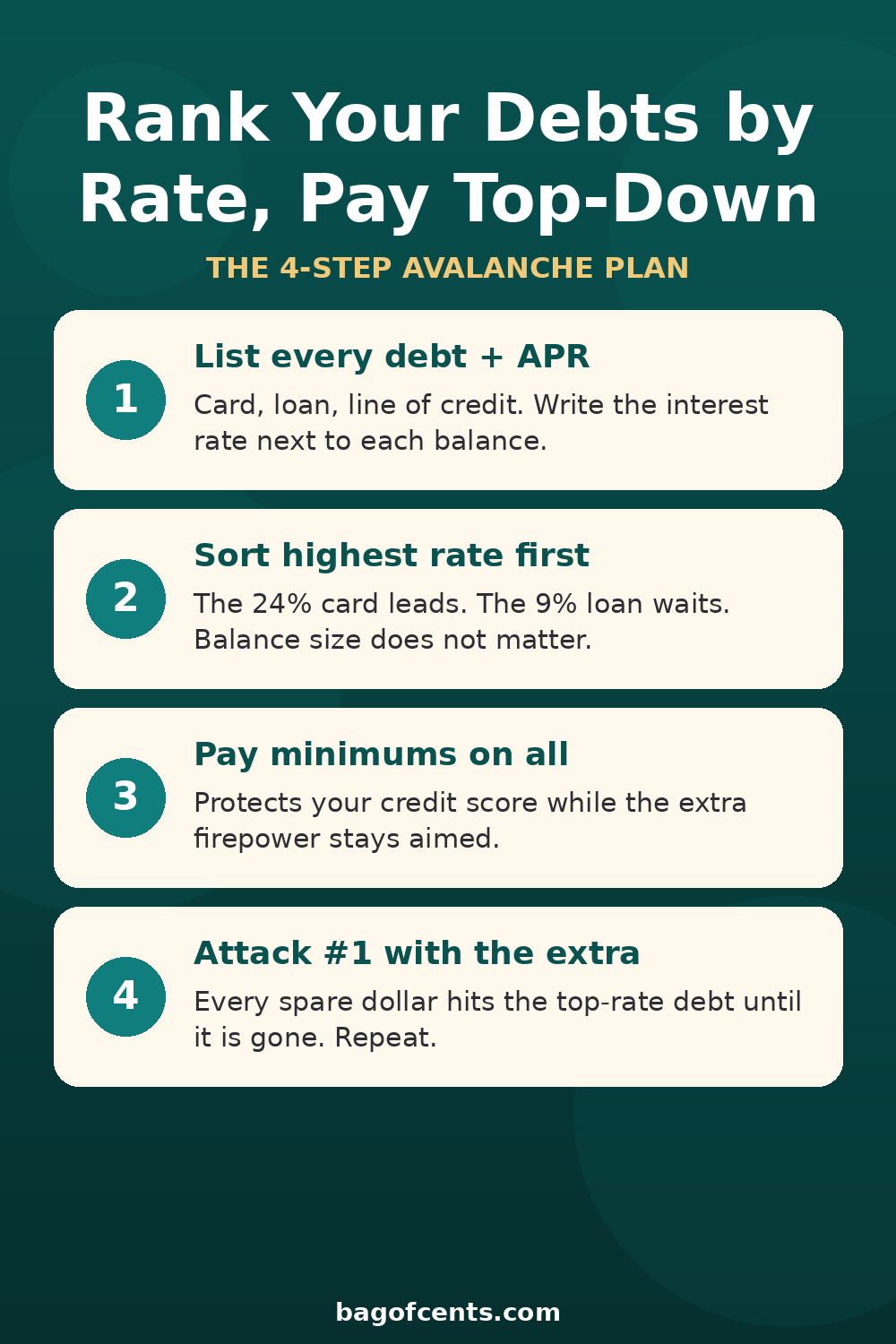
The rule, then, is simple to state: rank your debts by interest rate, highest first, and point every spare dollar at the top of the list. Minimum payments go to everything (always — missed minimums mean fees and credit damage), and the entire extra amount goes to the highest-rate debt until it’s gone. Then the freed-up minimum rolls into the next-highest rate. That’s the whole method. Now let’s watch it work.
The 3-Step Rate-Ranked Method
Step 1: List every debt with its rate, balance, and minimum. Not the balance order — the rate order. Pull the actual APR from your statements, not the “as low as” number from the ad. Include credit cards, lines of credit, personal loans, car loans, and any buy-now-pay-later balances still accruing interest.
Step 2: Pay minimums on all, extra on the highest rate. Add up your minimums, decide on a fixed extra amount you can sustain every month, and send 100% of the extra to the highest-APR debt. Automate the minimums so nothing is ever late; automate the extra so it happens without willpower.
Step 3: Roll the freed payment downhill. When the top debt hits zero, take its entire old minimum plus your extra and aim it at the next-highest rate. Your total monthly debt payment never changes — but the amount attacking principal grows every time a debt dies. This “rollover” is where the acceleration comes from.
Worked Example: Three Debts, Two Orders
Meet a realistic household carrying three debts:
| Debt | Balance | APR | Minimum |
|---|---|---|---|
| Credit card | $8,000 | 19.99% | $240 |
| Personal loan | $12,000 | 8.99% | $275 |
| Car loan | $4,200 | 6.49% | $190 |
| Totals | $24,200 | — | $705 |
They can put $1,000 a month toward debt: $705 in minimums plus a $295 extra payment. Let’s run both orderings to the finish line.
Order A: Rate-ranked (highest APR first)
Extra $295 goes to the 19.99% credit card — $535 a month against that balance. The card is gone first, roughly a year and a half in. Its $240 minimum plus the $295 extra — $535 total — now joins the personal loan’s $275 minimum, so $810 a month attacks the 8.99% loan. When the loan falls, the full $1,000 a month finishes the 6.49% car loan.
Result: debt-free in 28 months, total interest paid $3,305.
Order B: Balance-first (smallest balance first)
The $295 extra goes to the $4,200 car loan — $485 a month. The car loan dies fast (a satisfying early win), and its $190 minimum rolls into the credit card: $240 + $190 + $295 = $725 a month against the 19.99% balance. Meanwhile, that 19.99% balance has been sitting nearly untouched, compounding at ~$130+ a month in interest while the cheap car loan got the extra. Eventually the card falls, and the full $1,000 finishes the personal loan.
Result: debt-free in 28 months, total interest paid $3,707.
Same debts. Same $1,000 a month. Same 28-month timeline. But the balance-first order costs $402 more in interest — pure sequencing loss. The car loan felt productive to kill early (and psychologically it is — more on that below), but every month the extra payment sat on 6.49% debt instead of 19.99% debt, the household paid about $14 more in interest per $1,000 of misdirected extra. Over two-plus years, that compounds into real money.
The takeaway isn’t that balance-first is “wrong” — it’s that it has a price. Now you know the price, you can decide whether the early win is worth $402 to you.
When to Break the Rate Order
The rate-ranked order is the mathematically cheapest path — with a few honest exceptions where deviating pays:
1. A 0% promo window is about to close. This is the big one. Say you moved $3,500 to a 0% balance-transfer card with a 12-month promo, paying $120 minimums. After a year, roughly $2,060 remains — and then the rate jumps to ~22%. That’s about $38 a month in new interest, on a debt that cost nothing yesterday. Strict rate-ranking says “0% is the lowest rate, attack it last” — but the promo expiry changes the math. Kill (or nearly kill) promo balances before the clock runs out, even if it means pausing the rate order for a few months. Mark every promo expiry date on a calendar the day you open the transfer.
2. The quick-win exception. If your smallest balance is tiny and cheap to clear — say $400 on a store card — the interest cost of clearing it first instead of the top-rate debt might be $10–20 total. That’s a fair price for momentum if you’re the kind of person who needs an early win to stay motivated.
3. A minimum payment is straining your cash flow. If one debt’s minimum is the reason your budget has no breathing room, clearing that specific debt first buys monthly cash flow — which protects you from new debt. The cheapest order on paper isn’t cheapest if it leads to another balance.
4. Debts involving other people. A co-signed loan or money owed to family carries relationship interest that doesn’t show up in APR. Clearing those first is often the right call regardless of the math.
In every other case, trust the ranking.
Common Mistakes That Quietly Cost Interest
- Sprinkling the extra across all debts. An extra $100 on three debts feels balanced; it’s actually the worst of both worlds. Concentrated fire on the top rate always wins — that’s the entire $402 lesson above.
- Forgetting promo expiry dates. The 0% balance transfer that becomes a 22% card is the most expensive “forgotten date” in personal finance. Set reminders at 90, 60, and 30 days out.
- Chasing the small balance without pricing it. Balance-first feels great and costs $402 in our example. Sometimes worth it — but know the price before you pay it.
- Pausing one debt’s minimum to hammer another. Minimums are non-negotiable. A missed payment means late fees, penalty rates, and credit-score damage that dwarf any sequencing gains.
- Closing cards the moment they’re paid. An old card with zero balance helps your credit utilization and history length. Cut it up if you must — but think twice before closing the account itself.
- Never re-ranking. Rates change — variable-rate lines of credit move, promos expire, and balances shift. Re-rank your list every few months, not once.
- Raiding the emergency fund to pay debt faster. Then the car breaks down, the money goes back on the card at 19.99%, and you’ve paid interest twice on the same problem. Keep a small buffer while you pay down debt.
FAQ
Should I build an emergency fund before attacking debt?
Most financial educators suggest a small starter buffer — often around $1,000 — before aggressive payoff, then building a fuller emergency fund after high-interest debt is gone. The logic: without any buffer, every surprise becomes new high-interest debt, undoing your progress.
What if two debts have the same interest rate?
Attack the smaller balance first. The rates are tied, so the tiebreaker goes to the quicker win — fewer open accounts, sooner.
Does this method work if I include my mortgage?
Keep the mortgage on a separate track. It’s usually your lowest rate, it’s secured against your home, and the balance is large enough to distort the whole ranking. Run the rate-ranked method on your consumer debts; handle the mortgage with its own prepayment strategy.
Are 0% balance transfers worth the transfer fee?
Do the specific math: a 3% fee on $5,000 is $150. If it lets you dodge 19.99% interest for 12 months while you pay it down, the fee usually pays for itself many times over — if you clear the balance before the promo ends. If you won’t, the fee plus the post-promo rate can leave you worse off.
How often should I re-check my debt order?
Whenever a rate changes, a promo nears expiry, or a debt is paid off — plus a quick review every three to six months. Five minutes with your statements keeps the ranking honest.
What if I can only afford minimums right now?
Then minimums it is — on everything, on time, every month. The sequencing method needs an “extra” to sequence; without one, your job is damage control: stop new borrowing, protect your credit, and revisit the ranking the moment you free up even $50 extra.
Final Thought
Nobody hands you a prize for paying debts in a clever order — the reward is invisible, a few hundred dollars of interest you simply never pay. But invisible is still real: in our example, one household kept $402 that the other handed to lenders, for doing nothing except pointing the same $295 at a different account number each month. List your debts by rate, automate the minimums, aim every spare dollar at the top of the list, and let the rollover do the compounding in your favour for once. The math has been on the lenders’ side long enough.
Liked this? Take it further.
Now that you know the cheapest order to attack your debts, put the interest you’re no longer paying to work: grab the free 52-Week Savings Challenge Tracker and turn those saved dollars into a growing savings balance, one week at a time.
Enter your email to get the free 52-Week Savings Challenge Tracker, plus practical money tips from Bagofcents. Unsubscribe anytime.
Happy Budgeting!
Stanley
Keep Reading
- Debt Snowball vs Avalanche: Which Wins? — the full head-to-head on the two classic payoff strategies behind the sequencing math.
- The Debt Hybrid Method: One Quick Win, Then Avalanche — when you want the psychological quick win and the cheapest order after it.
- The Minimum Payment Trap: How $8,000 Becomes $25,000 — why minimums alone are the slowest, most expensive way out.
- Pay Off Your Car Loan Early: 4 Moves That Save Thousands — specific tactics for the auto-loan leg of your payoff order.
Leave a Reply