
Somewhere in your wallet is a credit card charging you 20%, 22%, maybe 25% interest on every dollar you carry. And here’s the thing almost nobody tells you: that rate is negotiable. Not in theory — in practice, on a regular Tuesday afternoon, with a regular customer-service rep, using a script that fits on an index card. Surveys of cardholders who ask for a lower rate have found that a majority who ask successfully get one — often a cut of 5 percentage points or more.
Let that sit for a second. A ten-minute phone call — the kind of call you keep meaning to make while you scroll your phone — can shave hundreds of dollars a year off your interest costs. Not by refinancing. Not by balance-transfer juggling. By asking. This is general information, not financial advice, and outcomes vary by issuer and profile — but the mechanics below are real, and the script is one people have used successfully for years.
What This Phone Call Actually Is
Credit card interest rates are not set in stone. The rate printed on your statement is the rack rate — like the sticker price on a car. Banks set it high by default, and most customers never question it, which is exactly why they set it high by default. But behind that number sits a retention department whose entire job is keeping profitable customers from leaving. When you call and politely suggest you’re considering your options, you trigger a process the bank built on purpose: they would rather cut your rate a few points than lose your balance — and your future interest payments — entirely.
This works because of a simple asymmetry. Acquiring a new customer costs a bank far more than keeping one. Your account, especially if you’ve been paying for a while, is a revenue stream. The rep you speak to has discretion — often a pre-approved range of rate reductions they can offer without asking a supervisor. Many cardholders report that the first ask, made calmly, produced a cut on the spot. Some even report being offered it before they asked, the moment they mentioned switching cards.
To be clear about what this is and isn’t: this is not debt relief, not a hardship program, and not a credit-counseling service. It’s a negotiation between a customer and a company. You’re not begging. You’re a customer asking for better terms, the way you’d ask your phone company about a cheaper plan. Banks do it. Phone companies do it. Insurance companies do it. The only reason cardholders don’t is that nobody told them they could.
The Math: Why a 5-Point Cut Is Worth Hundreds
Percentages feel abstract, so let’s make this concrete. Take a hypothetical balance of $8,000 — not unusual for a household carrying debt — paid down at $250 a month.
| APR | Months to Pay Off | Total Interest Paid |
|---|---|---|
| 22% | ~48 months | ~$4,100 |
| 17% | ~43 months | ~$2,900 |
| 14% | ~40 months | ~$2,300 |
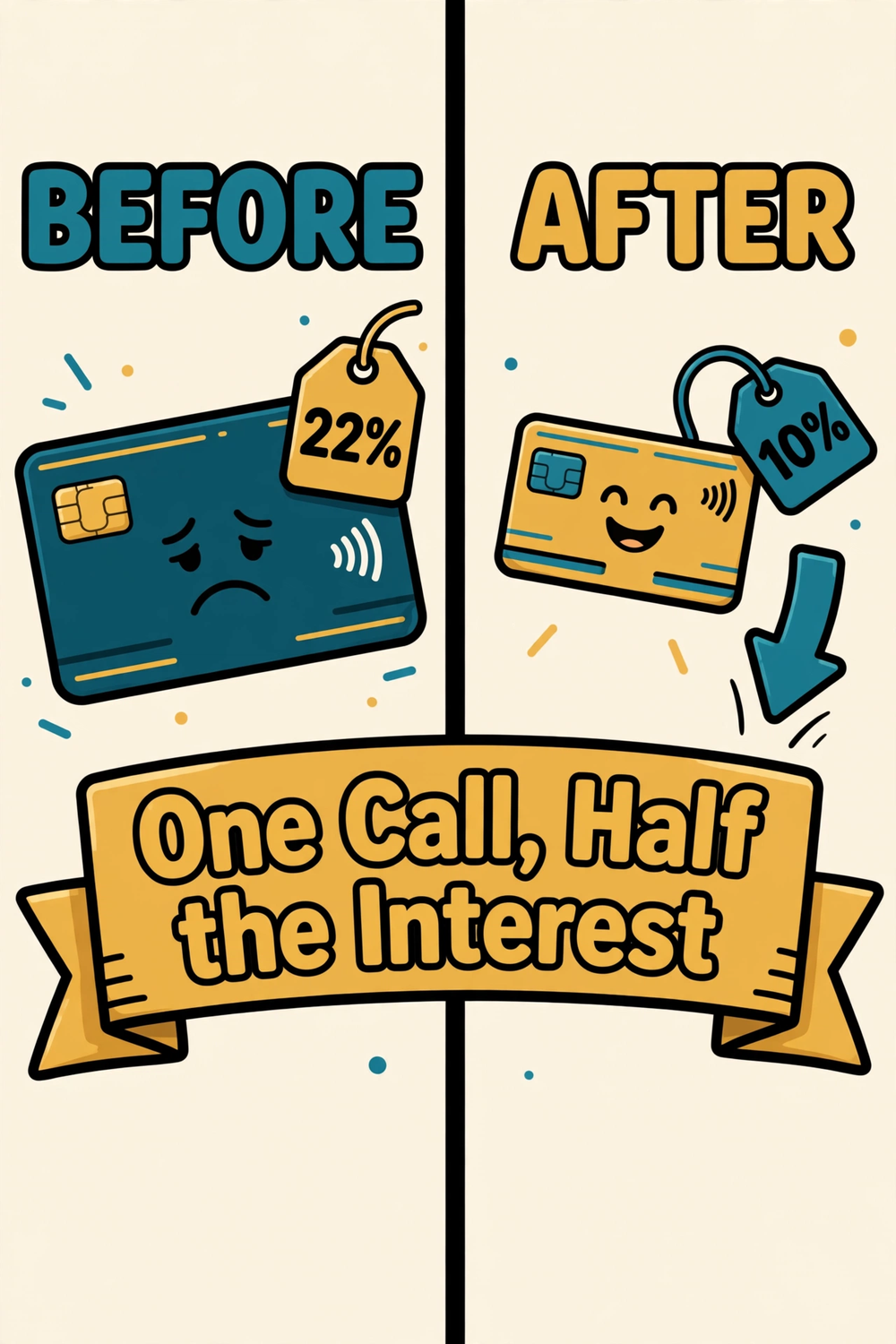
Read that again. Dropping from 22% to 17% — the kind of cut people routinely get from one call — saves roughly $1,200 in interest and gets you debt-free about five months sooner. A cut to 14% saves roughly $1,800. And your monthly payment never changed. The only thing that changed was the price of the debt itself. There are very few ten-minute tasks in life with a $1,200 payout.
(Quick note: these figures assume minimum-plus payments with no new charges — your real numbers depend on your balance, payment, and habits. A free debt payoff calculator will run your exact scenario in seconds.)
The 6-Step Call (Your Exact Game Plan)
Set aside 10–15 minutes. Call the number on the back of your card. Then follow these steps.
Step 1: Call Prepared (2 minutes of prep)
Before you dial, know three numbers: your current APR (on your statement or in the app), your account history (how long you’ve been a customer, roughly how often you pay on time), and one competing offer. That last one is your leverage. Google the current promotional APRs of one or two competing cards — balance-transfer offers of 0% for 6–12 months are common. You don’t need to have applied for anything. You just need to know the offers exist.
Step 2: Be Polite, Be Specific (the opener)
When the rep answers, be warm and direct. Something like: “Hi, I’ve been a customer for [X] years, and I’d like to see if you can lower the interest rate on my account. My current rate is [X]%, and I’ve seen other cards offering much lower rates.” That’s the whole opener. Polite, specific, and it signals you know your numbers. Reps respond to customers who sound informed — it tells them you’re serious, not venting.
Step 3: State Your Case (30 seconds)
Give them the reason to say yes: “I’ve made my payments on time for [X months/years], I carry a balance, and I’d like to keep my business with you — a lower rate would help me do that.” Loyalty, payment history, and a balance that earns them interest: that’s the trio. You’re not threatening. You’re presenting facts that make a rate cut the logical move for them.
Step 4: Name a Number (the anchor)
Don’t ask “can you do anything?” — that’s an invitation to offer nothing. Name a specific target. A good anchor is 5–8 points below your current rate, or the competing offer you found: “Is there any way to get this down to around [X]%?” Anchoring works in negotiations because it sets the frame. The rep may counter with a smaller cut — and a smaller cut is still a cut. A 3-point reduction on an $8,000 balance still saves roughly $700 in interest over the payoff. Take the win.
Step 5: If They Say No, Ask for the Next Thing
Sometimes the first rep can’t help. Stay pleasant and ask: “I understand. Is there a supervisor or retention specialist I could speak with about this?” Retention teams have more discretion — that’s literally their function. If the answer is still no, ask what would qualify you for a lower rate in the future (some issuers review rates automatically after 6–12 months of on-time payments), and set a calendar reminder to call back. A “no” today is often a “yes” in six months.
Step 6: Confirm It in Writing
Before you hang up: “Can you confirm the new rate and when it takes effect?” Ask whether it applies to your existing balance or only new purchases — this distinction matters enormously, because a cut that only covers new charges barely helps you. Then watch for the confirmation on your next statement. If it’s not there, call back and reference the date of the call.
5 Mistakes That Sink the Call
Mistake 1: Calling angry. The rep didn’t set your rate, and anger makes people rigid — including you. Calm, friendly customers get further. Every time.
Mistake 2: Threatening to cancel without meaning it. “I’ll close my account!” as a bluff is transparent, and actually closing a card can hurt your credit utilization ratio. The leverage is the competing offer, not the threat. Keep it professional.
Mistake 3: Not knowing your current rate. Calling without your numbers is like negotiating a salary without knowing the market. The rep can tell. Two minutes of prep changes the dynamic completely.
Mistake 4: Accepting a “no” from the first person. Front-line reps have limited authority. Supervisors and retention specialists have more. One polite escalation is standard practice, not rudeness.
Mistake 5: Forgetting the existing-balance question. Some rate reductions apply only to new purchases. If your goal is paying down an existing balance faster, confirm the cut covers it — otherwise the call was mostly theater.
What If It Doesn’t Work? Your Backup Moves
Sometimes the answer is no, even done perfectly. You’re not out of options:
Balance-transfer cards: A 0%-intro-APR card for 6–12 months can pause interest entirely while you attack the principal — just watch the transfer fee (typically 1–3%) and have a payoff plan before the promo ends, because the post-promo rate is often steep.
Call again in 6 months: Issuers periodically review accounts. Six more months of on-time payments is new evidence. Put it on your calendar.
Focus on the payoff order: While the rate is what it is, direct every extra dollar at the highest-rate balance first (the avalanche method) — or pair it with a hybrid approach: one quick win for momentum, then the math. A lower rate accelerates any strategy; a good strategy works even at the current rate.
Questions People Ask
Will asking hurt my credit score? No. Requesting a lower rate is not a credit application — there’s no hard inquiry, no new account, nothing reported. It’s a conversation with your existing lender.
How often can I ask? There’s no formal limit, but once or twice a year is the practical rhythm. Asking every month looks erratic and won’t produce new results. Mark your calendar for the next attempt.
Does this work on all cards? It works best on major bank cards where you have some history. Store cards and some subprime cards have less flexibility. But the call costs ten minutes and the worst outcome is “no” — the expected value is overwhelmingly positive.
What if I’m behind on payments? Be honest with yourself first: if you’re struggling, a hardship program (temporary lower rate or paused payments) may fit better than a negotiation. Call and ask about hardship options directly — different department, different conversation, and no shame in it.
Final Thought
Your credit card company is counting on one thing: that you’ll never ask. The rate stays high because silence is profitable. One ten-minute call flips that — and on an $8,000 balance, it can be worth $1,200 in interest you never pay. The script is above. The number is on the back of your card. The only thing between you and a lower rate is the call itself. Make it this week.
Liked this? Take it further. Run your exact numbers through the free Debt Payoff Calculator — see exactly how many months and dollars a lower rate saves on your balance.
Join the Bagofcents weekly money tips email. Unsubscribe anytime.
Happy Budgeting!
Stanley
Leave a Reply