
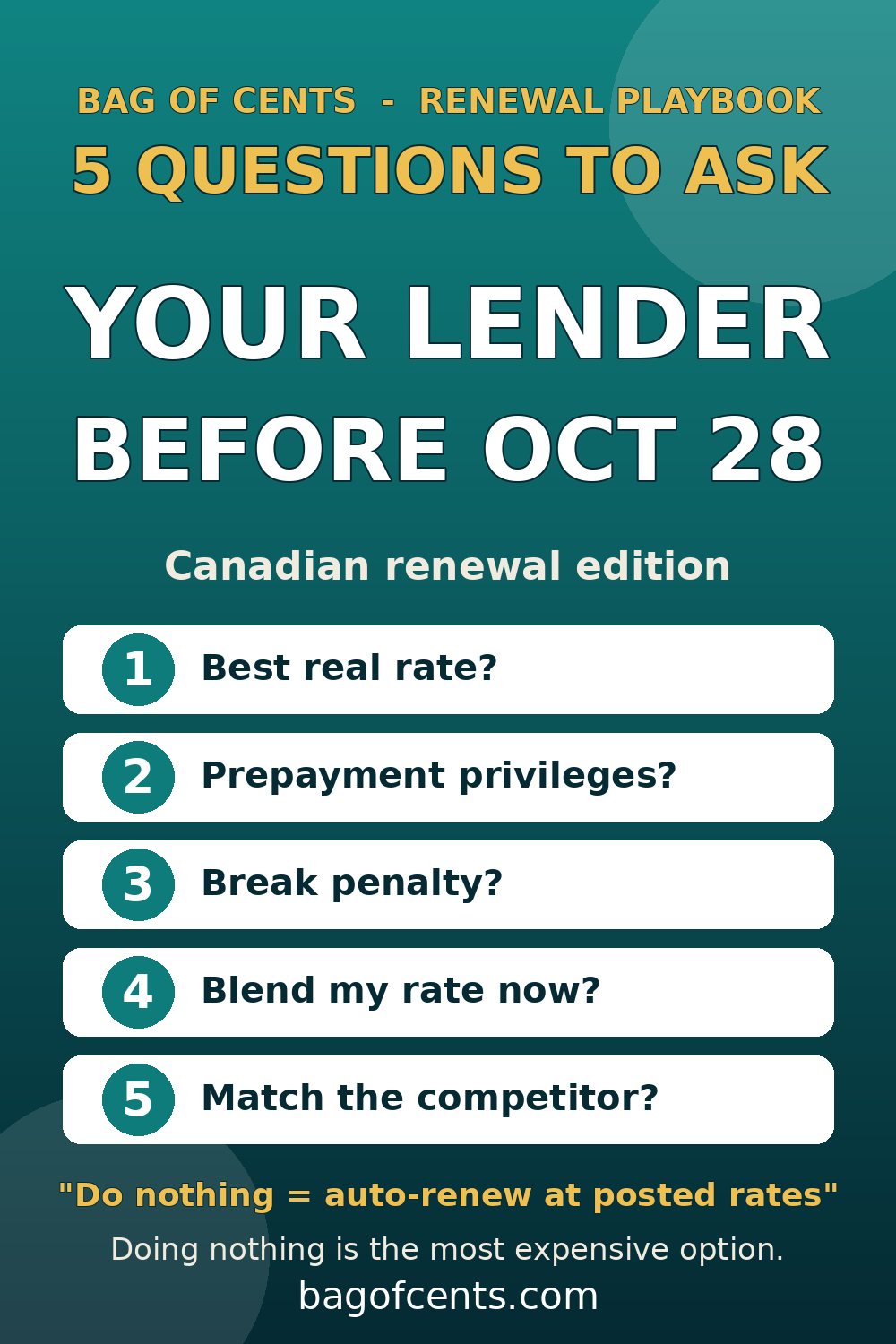
5 Questions to Ask Your Lender Before Oct 28
September inflation came in at 3.1% this morning — StatsCan released the numbers at 8:30 AM ET, gasoline up 27.8% from a year ago. Nine days from now, on October 28, the Bank of Canada (9:45 AM ET) and the U.S. Federal Reserve (2:00 PM ET) announce rate decisions on the same day. Two central banks, one day — millions of Canadian mortgages watching.
Your renewal doesn’t have to be October 28 for this to matter. Rate decisions move what lenders offer within days, and lenders can hold a rate 90 to 120 days before your term ends. The window to ask sharp questions and negotiate from strength is open now — before the announcements, not after.
If your mortgage renews in the next few months, these five questions turn you from a passive renewal-signer into an informed negotiator. One call or one branch visit — and answers that could change what you pay every month for the next five years.
What’s Actually Happening on October 28
Two separate decisions, both relevant to a Canadian mortgage:
The Bank of Canada decides at 9:45 AM ET. The policy rate sits at 2.25%, and the Bank’s job is keeping inflation near its 2% target. This morning’s 3.1% CPI reading, driven by energy prices, is the freshest data they’ll weigh. The policy rate drives prime, and prime drives every variable mortgage in Canada — if the Bank moves, variable rates move quickly.
The U.S. Federal Reserve decides at 2:00 PM ET. U.S. rates influence Canadian bond yields, and Government of Canada bond yields are what fixed mortgage rates are priced off. A Fed surprise can nudge the 5-year yield, and lenders adjust fixed rates within days.
A renewal in November, December, or next spring is still affected by October 28. Rate holds exist for exactly this: a lender can lock in today’s offer for 90 to 120 days while you shop. Nobody knows which way rates will go — but these questions work in any direction.
Question 1: “Is this your best rate — and what’s the same term costing elsewhere?”
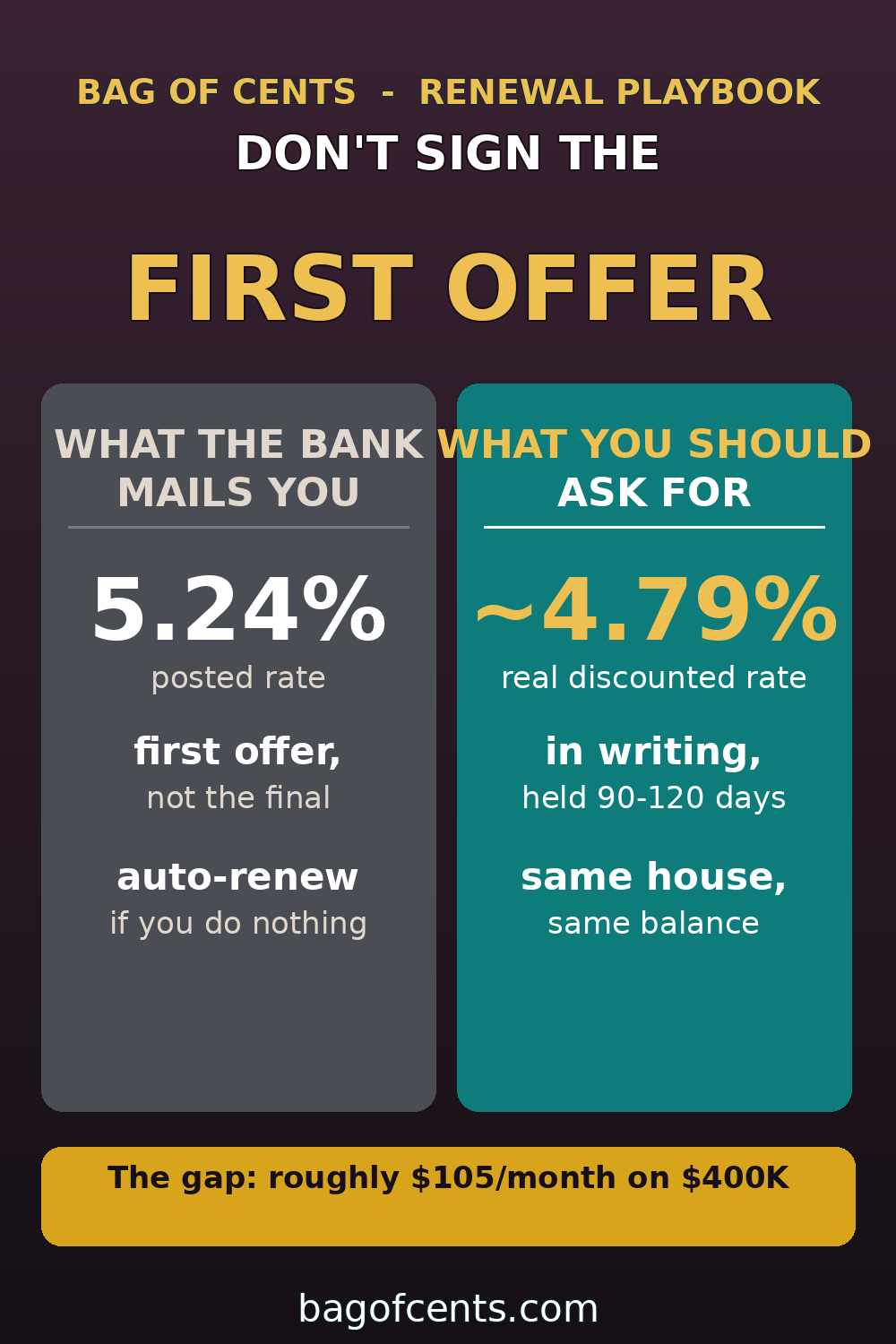
Why it matters: The rate on your renewal letter is rarely the lowest your lender can offer. Lenders advertise “posted” rates, but most borrowers get a discounted rate — and the discount is negotiable. Rule of thumb: the first offer is a starting point, not a final answer.
What a good answer sounds like: A specific discounted rate for the exact term, in writing, plus an honest sense of what competing lenders are advertising for it. “Our posted 5-year fixed is 5.59%, and we can do 4.99% for you” is a real answer. “That’s the best we can do, take it or leave it” is not — and it’s a sign to shop the file elsewhere.
Your follow-up: “Put that rate in writing, and tell me how long you’ll hold it.” A 90- to 120-day hold is standard — get the expiry date in writing, because verbal holds have a way of evaporating.
Question 2: “Fixed or variable — and exactly what happens to my payment if rates move?”
Why it matters: This is the core fork in every renewal, and the right framing isn’t which one wins — it’s which one fits your life. Fixed rates give payment certainty; variable rates usually start lower but your payment can change. Since your last renewal, your situation has changed: your income, your balance, your plans.
What a good answer sounds like: For a variable offer: the discount to prime in plain numbers (“prime minus 0.85%”), whether your payment stays fixed or floats, and what happens at the extremes — the “trigger point” where your payment stops covering interest, and whether the lender raises your payment or extends amortization. For a fixed offer: the exact rate, term, and early-break penalty. Vague answers are a red flag.
Your follow-up: “What does the penalty look like on each option if I have to break two years in?” Which leads directly to the next question.
Question 3: “What are my prepayment privileges — and what does breaking early actually cost?”
Why it matters: Prepayment privileges decide how much flexibility you have: most Canadian lenders let you put down an extra 15% to 20% of the original balance per year, plus increase your regular payment by a similar amount, penalty-free. Expecting a bonus, inheritance, or property sale? These numbers matter more than a tenth of a point on the rate — as does the penalty formula if life forces an early break.
What a good answer sounds like: Exact prepayment numbers for your term (“20% lump sum per year, 20% payment increase”), whether the mortgage is portable, and the penalty formula in plain English. On fixed rates it’s usually the greater of three months’ interest or the interest rate differential (IRD) — and IRD penalties at the big banks can run into the tens of thousands. Ask to see the formula, not just the label.
Your follow-up: “Show me the penalty calculation in writing for a hypothetical break two years in.” If they can’t or won’t, that’s information too.
Question 4: “What are ALL the costs — switching, staying, and everything in between?”
Why it matters: The rate is only part of the math. Switching lenders can mean a discharge fee, appraisal, legal fees, and registration — often $1,000 to $2,000 all-in, though many lenders cover some or all of it to win your business. Staying put has its own cost: inertia. Renewing at your current lender’s first offer without comparing is how people pay above-market rates for five years.
What a good answer sounds like: A line-by-line breakdown: discharge fee, legal/registration, appraisal (and who pays), and any cashback or fee coverage — netted to what you actually pay at signing. The lender should also flag the stress test: switching lenders usually means re-qualifying at the benchmark rate; a straight renewal with your current lender typically doesn’t.
Your follow-up: “Net of every fee and credit, what do I pay out of pocket on signing day?” Get the number, not the narrative.
Question 5: “When will my renewal offer arrive — and what happens if I do nothing?”
Why it matters: This is the trap question, and it’s the one most borrowers never ask. If you do nothing, your lender renews you automatically — often at or near the posted rate, a full point or more above the discounted rate you’d get by asking. On a $400,000 balance, that gap is thousands of dollars over a term. Doing nothing is the most expensive option on the menu, and lenders count on it.
What a good answer sounds like: The date your renewal offer will be issued (lenders must send it at least 21 days before maturity, but ask for it much earlier), confirmation that nothing auto-renews at posted rates without your signature, and a clear response deadline. The best answer includes starting the conversation 120 days out.
Your follow-up: “Can I get my renewal offer 90 days before maturity instead of 21?” Early paperwork is leverage. Late paperwork is pressure.
The Real-Numbers Illustration
The dollars are real. Here’s an illustration — not a prediction, just the math — on a $400,000 balance, 25-year amortization, 5-year term, at 5.25% versus 4.75%:
At 5.25%: monthly payment $2,383.67. Over the 5-year term, about $98,426 in interest; remaining balance at renewal roughly $355,406.
At 4.75%: monthly payment $2,269.82. Over the 5-year term, about $88,813 in interest; remaining balance at renewal roughly $352,623.
The difference: $113.85 a month, or about $1,366 a year — and roughly $9,613 less interest paid over the term, with about $2,783 more principal paid down. Same house, same balance, same term. The only difference is half a percentage point — the kind of gap that separates a negotiated renewal from a signed-first-offer one.
That’s why Question 1 comes first. On mortgage-scale balances, the rate you accept is the single biggest lever you have, and it’s the one most borrowers spend the least time on.
5 Mistakes That Cost Renewers the Most
1. Signing the first renewal letter without shopping. The letter arrives, the rate looks fine, you sign — and most borrowers do exactly this, which is why the first offer is rarely the best one. The fix: one phone call and two or three competing offers.
2. Choosing on monthly payment alone. A lower payment from re-stretching amortization back to 25 years can cost far more in total interest than a slightly higher payment on your remaining amortization. Compare the term’s total interest, not just the monthly number.
3. Ignoring the penalty fine print. A rock-bottom rate with a brutal IRD penalty is a bad deal if you might move, refinance, or sell mid-term. Rate-chasers in 2021 learned this the expensive way when life changed in 2023.
4. Overlooking prepayment privileges. If you plan to throw bonuses or lump sums at the mortgage, 20/20 privileges beat 10/10 — even at a slightly higher rate. Match the privileges to your actual plans.
5. Starting too late. Shopping two weeks before maturity means no rate hold, no leverage, and no time to switch lenders. Rule of thumb: start 120 days out. Your future self will thank you.
Frequently Asked Questions
How far before my renewal should I start asking these questions?
About 120 days — four months — is the rule of thumb, because that’s how far out lenders will hold a rate. Starting early costs nothing and buys you the one thing negotiations need: time to walk away.
Will shopping my mortgage around hurt my credit score?
A mortgage application triggers a hard inquiry, but Canada’s bureaus generally treat multiple mortgage inquiries within a short window — usually 14 to 45 days — as a single inquiry. Keep your shopping inside a tight window and the impact is usually small and temporary.
Fixed or variable — which is better right now?
No article can answer that — be skeptical of anyone who claims they can. Match the choice to your situation: fixed for payment certainty, variable if you can absorb payment changes. Ask your lender to show both options’ payments and penalties side by side, then decide on your risk tolerance, not a prediction.
My renewal isn’t until next spring. Do these questions still apply?
Yes. A spring renewal means you can watch the October 28 decisions, the December Bank of Canada decision, and early-2026 data before locking in — with a rate hold protecting you meanwhile. The questions don’t expire; the answers just get fresher.
Do I need a broker — and what if my lender won’t budge?
No — these five questions work in a branch, on the phone, or through a broker, whose value is submitting your file to multiple lenders at once (including monolines your bank won’t mention). And a lender that won’t move on rate, put offers in writing, or explain penalties has told you how the next five years of service will feel — take your file to a competitor.
Final Thought
October 28 is nine days away: the Bank of Canada in the morning, the Fed in the afternoon, this morning’s 3.1% inflation print setting the tone. None of it decides your mortgage. What decides it is whether you walk in as a price-taker or a negotiator — and the difference is five questions, asked before the decisions land instead of after.
Pull out your renewal letter (or your last mortgage statement) tonight. Write down your current rate, maturity date, and remaining balance. Then call your lender and ask Question 1. You’ll know more after that call than most borrowers know at signing — and knowing is the whole game.
Liked this? Take it further.
If these questions got you thinking about how much small rate differences really cost, the free 52-Week Savings Challenge Tracker is a great next step — a simple week-by-week plan that builds your savings to $1,378 by year end, one small deposit at a time.
Join the Bagofcents weekly money tips email. Unsubscribe anytime.
Happy Budgeting!
Stanley
Leave a Reply