
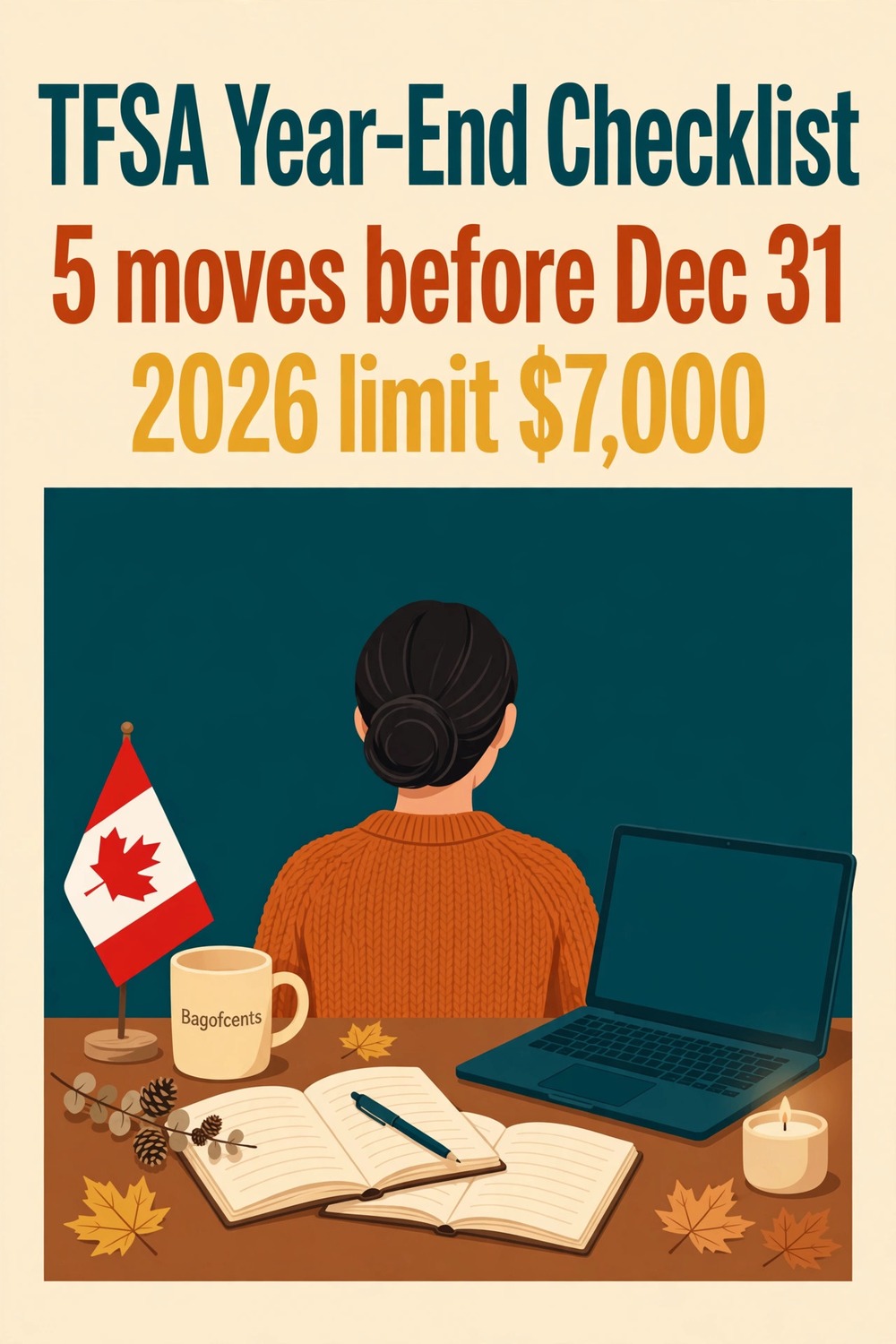
December is the one month when TFSA timing actually matters. For most of the year, the TFSA is forgiving: room you do not use carries forward, and a contribution made in March counts the same as one made in October. But three of the TFSA’s rules run on the calendar — and December 31 is where they all land at once.
This checklist pulls together the five moves from this month’s TFSA series into one page. None of them take long. All of them are worth more done in December than done in January — and one of them cannot be done in January at all.
Move 1 — Taking Money Out? Do It in December, Not January
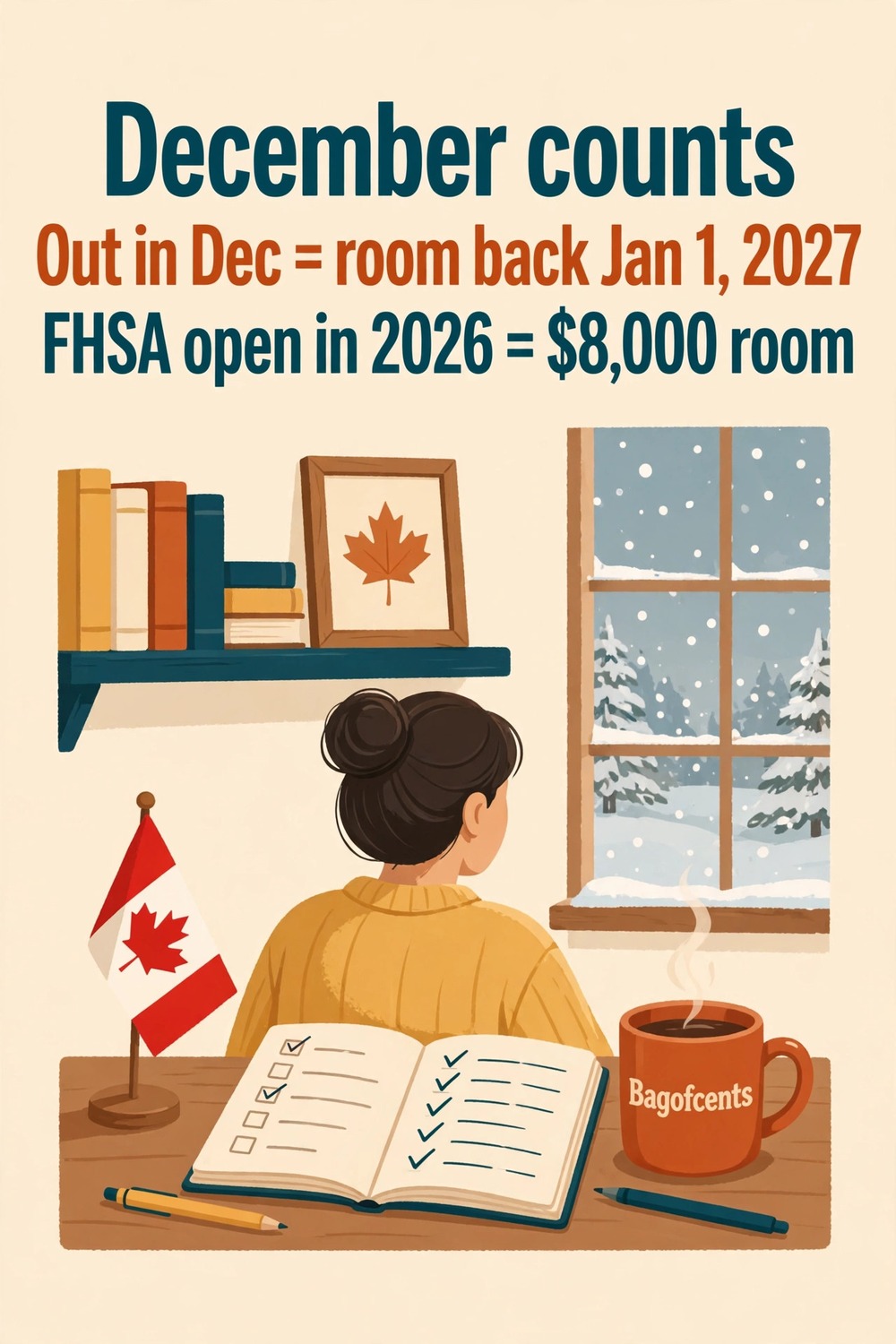
A TFSA withdrawal does not come back as contribution room until January 1 of the next year. That one rule makes December and January very different months:
- $5,000 out in December 2026 → the room returns January 1, 2027. You wait weeks.
- The same $5,000 out in January 2027 → the room returns January 1, 2028. You wait a year.
If you already know you will need TFSA money early in the new year — a bill, a purchase, a planned expense — and you expect to put it back, taking it out before December 31 brings the room back a full year sooner. Sunday’s article covered this rule in full; the short version is that December counts and January costs.
Move 2 — Check for an Excess Now, While Stopping It Is Cheap
An over-contribution is taxed at 1% per month on the highest excess amount in the account that month, for every month the excess stays there. There is no grace amount — the tax starts at the first $1.
December is the cheapest month to discover one. Work out your real room (Move 4), compare it with what you actually contributed this year, and if you are over, withdraw the full excess before the month ends. An excess created in October and removed in December costs three months of tax; the same excess found in the spring costs six or seven. Monday’s article has the full fix, including Form RC243 (due June 30, 2027 for a 2026 excess) and how to ask the CRA for a waiver when the excess came from a reasonable error.
Move 3 — Open the FHSA Before December 31, Even With $0
This is the one move with no January substitute. FHSA room only starts in the year you open your first account — $8,000 a year, up to $40,000 over your lifetime — and it cannot be backdated. Open a first FHSA in 2026, even with nothing to put in it, and 2026’s $8,000 of room exists. Wait until January and that year of room is simply gone.
If a first home is anywhere in your future, this is a ten-minute errand with a permanent payoff. Friday’s article covers the account in full, and Saturday’s shows how its $40,000 stacks with the Home Buyers’ Plan’s $60,000 for $100,000 of down payment room per buyer.
Move 4 — Write Down Your Real Room Before January Resets It
The contribution room figure in CRA My Account is calculated as of January 1 and lags what your banks have reported since. Early in the year especially, it can overstate the room you truly have — which is exactly how Move 2’s excesses happen.
Before the year turns, do the boring math once, on paper or in a note you will keep:
- Your total room at January 1, 2026.
- Minus every contribution you made in 2026, at every bank and app.
- Plus nothing for 2026 withdrawals — those return January 1, 2027, not before.
That number is your real room. When new room arrives on January 1, you will know exactly what it adds to — instead of guessing from a figure that has not caught up with your own deposits yet.
Move 5 — Decide What the Money Inside Actually Does
Room is only half the account. Money sitting in a TFSA as plain cash is sheltered from tax on growth it is not having. Thursday’s article walked through the plain-English choices — a HISA for money you will need soon, a GIC for a known date, an ETF for years-away goals — and December is a natural moment to check that what your TFSA holds still matches when you will actually need it. No changes are urgent; the point is to look once, on purpose, instead of never.
Maya’s December, On One Page
Maya — $4,000 a month, the same paycheque all through this series — runs the list in one evening:
| Move | Maya’s version | Cost of waiting |
|---|---|---|
| Withdraw in December | $5,000 out Dec 2026 for a planned January expense | Room back 2027 instead of 2028 |
| Check for an excess | Finds $0 excess — her October re-contribution fit | Would have been $20/month per $2,000 |
| Open the FHSA | Opens with $0, starts 2026’s $8,000 room | That year of room gone for good |
| Write down real room | One note: room, 2026 deposits, real total | Guessing from a stale CRA figure |
| Check what it holds | Emergency money in a HISA, long-term in an ETF | Cash earning nothing, still “invested” on paper |
Five moves, one evening, and she starts January knowing her TFSA is clean, her FHSA clock is running, and her room figure is hers — not a website’s estimate of it.
FAQ
Does unused TFSA room expire on December 31? No. Unused room carries forward indefinitely. What expires is timing: a December withdrawal’s room returns a year sooner than a January one’s, and an unopened FHSA’s 2026 room never exists at all.
I am taking money out in January no matter what. Is that a problem? Not a problem — just slower. The withdrawal itself is tax-free either way; only the room’s return date changes, from January 1, 2027 to January 1, 2028.
How do I know if I am over-contributed? Add up every 2026 contribution across every TFSA you hold and compare it with your real room (Move 4). If contributions exceed room, the difference is the excess — withdraw it and see Monday’s fix.
Can I open an FHSA and a TFSA in the same month? Yes. They are separate accounts with separate room, and opening one does not affect the other.
What if I do none of this until January? Your TFSA keeps working and your unused room carries forward. You lose the FHSA’s 2026 room year and a year of room-return timing on any early-2027 withdrawal — real costs, but not catastrophes. The checklist is about not paying them for want of one evening.
Is there a deadline to contribute to my TFSA for 2026? No. Unlike an RRSP, a TFSA has no contribution deadline — a contribution counts when you make it, and room carries forward. The December deadlines on this page are about withdrawals, excesses and the FHSA, not about contributing.
Final Thought
The TFSA rewards people who look at it once a year — and December is the look that pays. Withdraw on the right side of New Year’s, catch an excess while it is still cheap, start the FHSA clock even with $0, and write down a room figure you can trust. January will hand you fresh room either way. These five moves decide whether it hands it to a clean account or a tangled one.
General information only, not financial advice. TFSA and FHSA rules are set by the CRA; if your situation involves a large excess or a CRA letter, a tax professional can review your specific numbers.
Leave a Reply