
Paycheque to Paycheque? The Debt Escape Plan That Fits Your Budget
Here's the sentence nobody says out loud at the dinner table: "I can only afford the minimums."
If that's you, the standard debt advice feels like it's written for someone else's life. "Just throw an extra $1,000 a month at it" — with what? "Cut your expenses" — down to what, air? Living paycheque to paycheque doesn't mean you're bad with money. It often means the math is genuinely tight: rent takes its bite, groceries cost what they cost, and what's left barely covers the minimum payments the statements demand.
But here's what the minimums don't tell you: paying only the minimum is the most expensive way to carry debt that exists. And escaping it doesn't require a windfall. It requires a plan built for the budget you actually have — one fixed number, paid every month, aimed with intention.
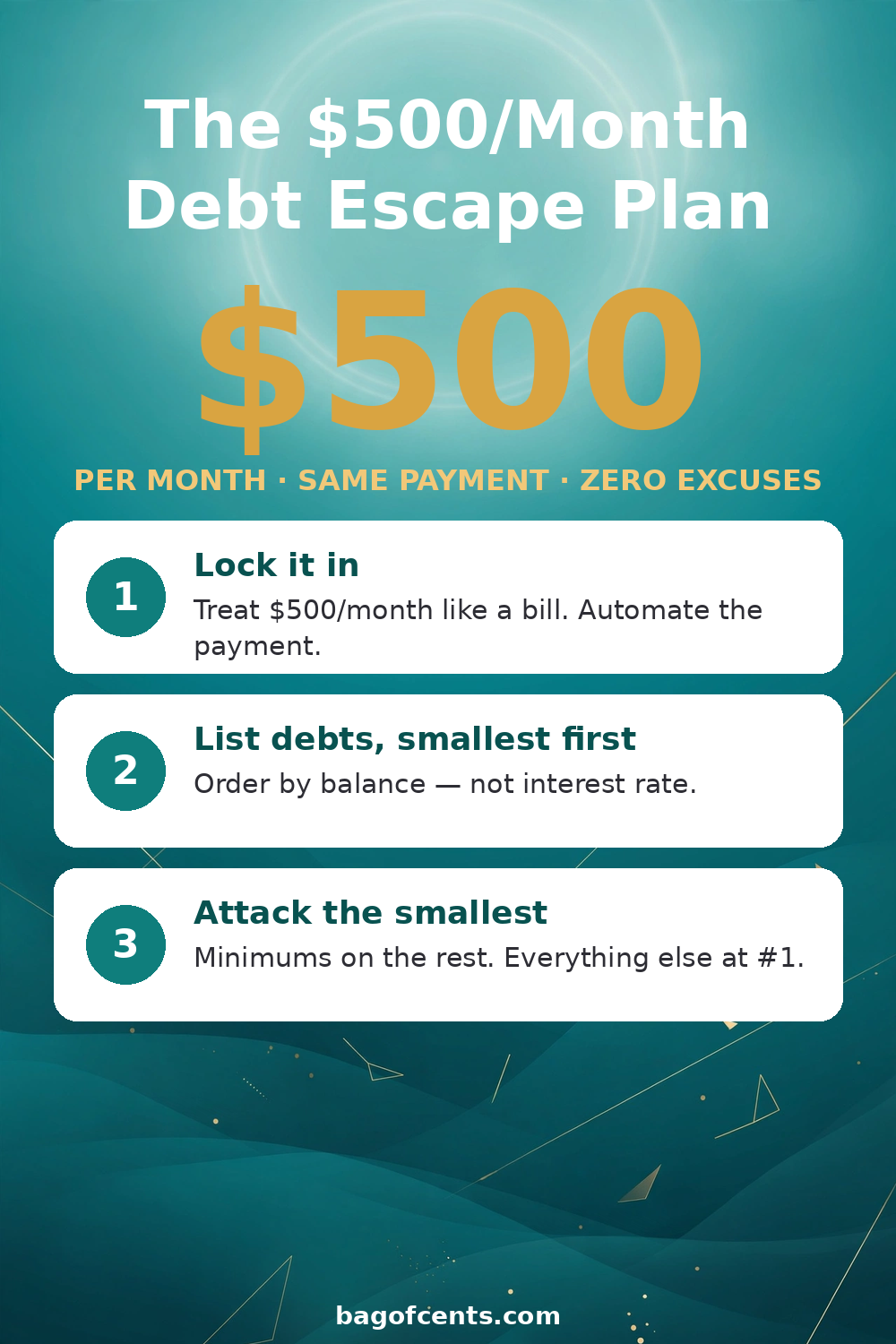
That's the Debt Escape Plan. It works at any fixed amount. This walkthrough uses $500 a month as the example, but the mechanics are identical at $300, $200, or $100. The amount matters less than the structure: minimums on everything, the entire remaining stack aimed at the smallest balance, repeat until the balances are gone.
Why Minimums-Only Is a Trap (The Interest Snowball)
Before the plan, you need to see the enemy clearly. Minimum payments are designed to keep you paying, not to get you out.
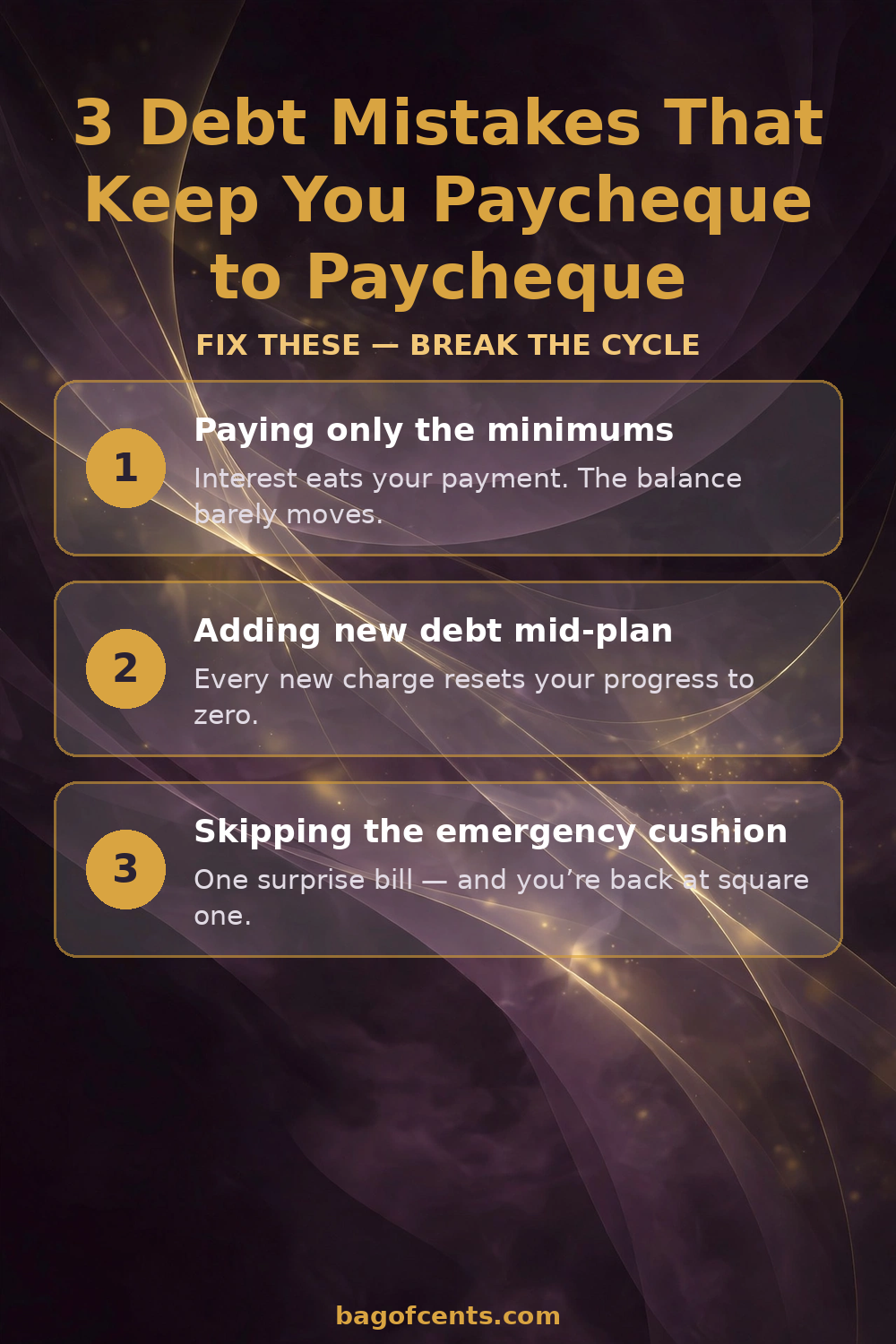
Take a $3,000 credit card balance at 20% interest with a $60 minimum payment. Pay just the minimum every month and you'll be paying for roughly six and a half years — handing over around $1,700 in interest on a $3,000 balance.
Now add just $30 a month — one dollar a day — to that same payment. The payoff drops to under four years, and the interest falls to roughly $950. That single dollar a day, redirected from somewhere small, saves hundreds in interest and reclaims years of your financial life.
Scale it up and the picture gets uglier. A $7,200 spread of card debt at minimum payments can easily cost $8,000 to $10,000 in interest and take the better part of a decade to clear. Interest snowballs when you only pay minimums because the minimum barely covers the month's interest — the principal shrinks by a few dollars while the interest meter keeps running. Every month you pay minimums-only, you're mostly renting your own debt.
The Debt Escape Plan breaks that cycle with one change: a fixed monthly debt payment that's bigger than your total minimums, aimed entirely at one target at a time.
What the Debt Escape Plan Is
Four rules, no exceptions:
- Pick your fixed number. Find one fixed amount you can pay toward debt every single month — in this example, $500. It must be at least slightly above your total minimum payments. (We'll cover how to find it below.)
- Pay every minimum, every month. Every balance gets its minimum payment on time. No late fees, no penalty rates, no exceptions.
- Aim the entire remainder at the smallest balance. Total debt payment minus total minimums equals your attack stack. All of it goes to the smallest balance until it's gone.
- Roll the freed minimum into the next target. When a balance hits zero, its minimum payment joins the attack stack. The snowball grows; the timeline shrinks.
This is the debt snowball order — smallest balance first — chosen deliberately for tight budgets. When money is tight, motivation is fuel, and nothing fuels a tight-budget plan like killing an entire balance in the first few months. The math-optimized order (highest interest first) saves a bit more interest on paper, but a plan you abandon in month four saves nothing.
Step 1: Find Your Fixed Number
Your fixed number is the total you'll pay toward debt every month — minimums plus attack stack combined. Finding it takes ten honest minutes:
- List every debt with its balance, interest rate, and minimum payment.
- Add up the minimums. That's your floor — say it comes to $151.
- Find the gap. Look at last month's spending and find what can move. The average Canadian household leaks $100 to $200 a month on subscriptions, fees, and forgotten renewals alone. One cancelled subscription, one renegotiated bill, one month of packed lunches — that's often $100 to $350 found without touching anything that matters.
- Set the number and protect it. Minimums ($151) plus found money ($349) equals your $500. Treat that $500 like rent: non-negotiable, paid first, every month.
Be conservative. A $400 plan you sustain for two years beats a $600 plan you abandon in March. You can always raise the number later — the plan is built to absorb raises.
If your minimums alone exceed what you can pay, that's a different situation: call a nonprofit credit counselling agency (like Credit Counselling Canada) before the balances grow. This plan is for people who can cover minimums and find something above them.
Step 2: List Debts Smallest to Largest and Aim
Order doesn't follow interest rates here — it follows balance size, smallest first. The psychology is the strategy: early wins keep tight-budget plans alive.
Our example household carries three balances:
| Debt | Balance | Rate | Minimum |
|---|---|---|---|
| Store card | $900 | 28.99% | $25 |
| Visa | $1,800 | 21.99% | $36 |
| Mastercard | $4,500 | 19.99% | $90 |
| Total | $7,200 | — | $151 |
Fixed payment: $500. Attack stack: $500 − $151 = $349, aimed entirely at the store card.
Month 1: $25 minimum + $349 attack = $374 hits the store card. The other two get their minimums. Month 2: same. Month 3: same — and the store card is gone, with only about $60 in interest paid instead of the hundreds a minimums-only crawl would have cost.
Now the snowball rolls: the store card's $25 minimum joins the attack stack. New attack: $349 + $25 = $374 aimed at the Visa ($1,800). At $374 + $36 minimum = $410 a month, the Visa falls in about five months (months 4–8), with roughly $150 in interest versus the slow bleed of minimums.
Then the full force turns on the Mastercard: $500 a month, every month, minimums already covered inside that number. The remaining balance — roughly $4,300 after eight months of minimums and interest — clears in about ten more months.
Total timeline: roughly 18 months. Total interest: roughly $1,500 to $1,800.
Compare that to minimums-only on the same $7,200: total minimums of $151 a month, interest compounding at 20–29% on balances that barely shrink. That path stretches past seven years and costs roughly $8,000 to $10,000 in interest — five times the interest, four times the time. The difference between the two paths isn't income. It's $349 a month, aimed.
(All figures are rounded illustrations — your rates, minimums, and timeline will differ, but the shape of the math is the same for every household: fixed payment plus smallest-first targeting collapses both the timeline and the interest.)
Step 3: Automate It So Willpower Isn't Required
Tight budgets run on thin willpower margins. Automate the plan so it survives your worst week:
- Auto-pay every minimum for at least the minimum amount, scheduled a few days before each due date. This is the firewall — late fees and penalty interest are plan-killers.
- Auto-transfer the attack stack to the target balance on payday. If your bank allows multiple credit card payments, schedule the extra as a separate automatic payment labeled for the current target.
- One calendar reminder a month: "check the snowball." Balances shift, a target gets close — a two-minute monthly check keeps the aim correct.
When a balance hits zero, don't celebrate by spending its minimum — redirect it the same day. The snowball only grows if the freed payment stays in the plan.
Step 4: Handle the Inevitable Wobbles
A plan built for real life needs rules for real life:
- A bad month happens: pay all minimums, pause the attack stack, resume next month. The plan bends; it doesn't break. One paused month costs a little time, not the plan.
- A windfall arrives: tax refund, bonus, birthday cash — at least half goes to the current target. Windfalls are the snowball's secret accelerator.
- A new balance appears: the car repair goes on a card. Fine — it enters the list at its balance size, the plan re-sorts, and life continues.
- The itch to pay the big one first: resist it until the small ones are gone. The interest difference between orders is real but small; the motivation difference is enormous.
5 Mistakes That Kill Tight-Budget Debt Plans
1. Stopping the minimums on "low priority" debts. Every missed minimum triggers late fees and can spike your rate to a penalty APR near 30%. The plan's math assumes all minimums are paid. No exceptions.
2. Setting the fixed number from your best month. Same trap as irregular-income budgeting: a $500 plan built on overtime month collapses in a normal month. Set it from a normal month. Raise it later when it's easy.
3. Closing cards the moment they're paid off. Closing your oldest card can hurt your credit utilization ratio and shorten your credit history. Pay it to zero, cut it up or freeze it in ice — literally, the freezer trick works — but leave the account open.
4. Celebrating a killed balance by spending. The most dangerous moment in any debt plan is the first zero balance. That freed $25 a month feels like a raise. It's not — it's ammunition. Redirect it the same day.
5. Running balances back up mid-plan. The plan clears $900 in three months; the cleared card whispers. If you can't trust yourself yet, remove saved card numbers from online stores and carry one low-limit card for true needs only.
Debt Escape Plan FAQ
What if I can only find $100 above my minimums?
Then your fixed number is minimums + $100, and the plan works exactly the same way — just slower. A $251 fixed payment on the example debts still kills the store card in about four months and still beats minimums-only by years and thousands. The structure is the strategy, not the amount.
Smallest balance or highest interest — which is really better?
Highest interest (the avalanche) saves more interest mathematically — usually a few hundred dollars on balances like these. Smallest balance (the snowball) gets you a fully paid-off account fastest, and for tight budgets that early win is often the difference between finishing and quitting. This plan chooses the snowball deliberately. If you're highly disciplined and motivated by math, run the same plan in highest-interest order — the mechanics don't change.
Should I use a balance transfer card too?
If you qualify for a 0% promotional rate, moving the highest-rate balance can save real interest — but only if the transfer fee (usually 1–3%) is less than the interest you'd save, and only if you don't run the old card back up. It's an accelerant for the plan, not a replacement for it.
What about my credit score while I do this?
Paying down balances lowers your utilization ratio, which helps your score. Paying every minimum on time protects your payment history, the biggest scoring factor. Most people see their score improve as the plan progresses — especially after the first balance hits zero.
When do I start saving instead of attacking debt?
Keep a small starter buffer (even $500–$1,000) so surprises don't become new debt — then attack. Once high-interest debt (roughly anything above 7–8%) is gone, split new money between remaining low-interest debt and savings. Don't wait until you're fully debt-free to start saving; do keep the attack stack focused until the expensive debt is dead.
Final Thought
Nobody escapes debt with the budget they wish they had. They escape with the budget they actually have — one fixed number, paid every month, aimed at the smallest balance first.
$500. Minimums covered. $349 aimed. Eighteen months instead of seven years. Thousands in interest that stays in your pocket instead of the bank's. That's not a fantasy for a different household; it's the arithmetic of the one you're living in right now.
Pull out your statements tonight. List the balances smallest to largest, add up the minimums, and find your fixed number. Month one starts with a single aimed payment — and the plan does the rest.
Want to see your own numbers? The free debt payoff calculator runs your exact balances through the snowball and shows your debt-free date — comment DEBT and it'll land in your DMs.
Liked this? Take it further.
Getting out of debt is easier with a system — and the free 52-Week Savings Challenge Tracker builds the savings habit alongside your payoff plan, one small weekly deposit at a time, up to $1,378 in a year.
Join the Bagofcents weekly money tips email. Unsubscribe anytime.
Happy Budgeting!
Stanley
Leave a Reply