
Balance Transfer Cards: The 0% APR Debt Hack
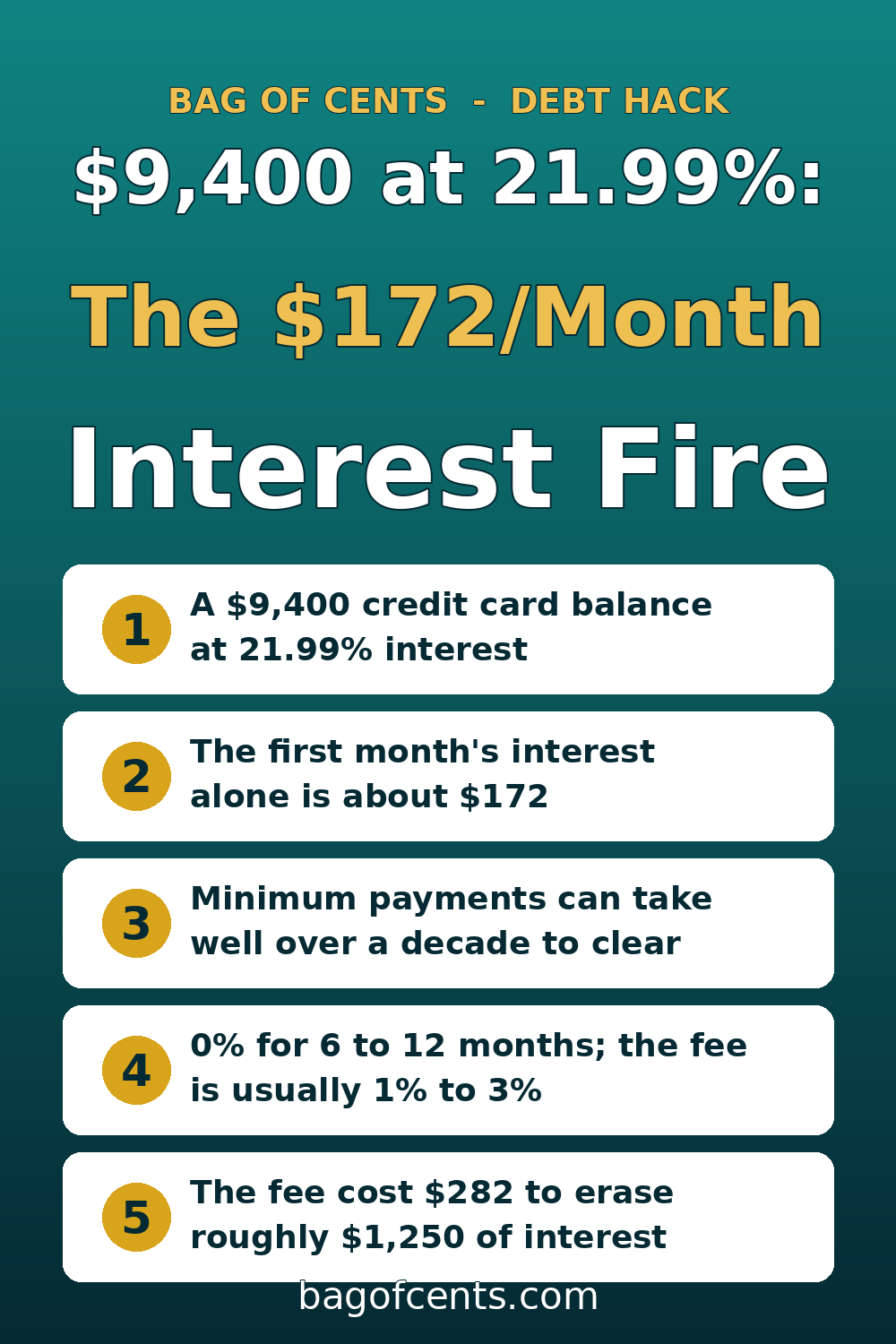
Here’s the math that makes most Canadians wince: a $9,400 credit card balance at 21.99% interest, paid at the minimum each month, can take well over a decade to clear — and the total interest paid can exceed the original debt. Month after month, most of your payment gets eaten by interest charges, while the balance barely moves.
A balance transfer card flips that equation for a limited time. It moves your debt onto a card that charges 0% interest for a promotional period — usually 6 to 12 months at Canadian banks. During those months, every dollar of your payment attacks the principal instead of feeding interest. Used properly, it can cut your payoff time by months and save you close to a thousand dollars on a typical balance.
What a Balance Transfer Card Actually Is
A balance transfer card is a credit card with an introductory offer: move balances from your other cards onto it, and the transferred amount is charged little or no interest for a promotional window. In Canada, the most common offers are 0% for 6, 10, or 12 months, sometimes 1.99% or 2.99% for a similar stretch. After the promo ends, whatever is left rolls onto the card’s regular rate — typically 19.99% to 22.99% — just like any other balance.
The catch is the balance transfer fee: usually 1% to 3% of the amount you transfer. A 3% fee on a $9,400 transfer adds $282 to what you owe. That stings a little — until you compare it to the interest you’d have paid in the same months. The fee is almost always far smaller, which is exactly why the math still works.
One more detail: the promo rate usually applies only to the transferred balance, not to new purchases. Some cards charge the full regular rate on new spending from day one, with no grace period, while your transfer sits at 0%. Treat a balance transfer card as a debt-burning machine, not a spending card. Put it in a drawer — or freeze it in your banking app — and don’t touch it for purchases.
How to Run a Balance Transfer in Canada: The 7 Steps
### 1. Know where you stand
Pull up every credit card and line-of-credit statement and write down three numbers for each: balance, interest rate, and minimum payment. You’re looking for high-rate balances you can’t realistically clear in two or three months — a $9,400 balance at 21.99% is the classic candidate, while a $1,200 balance you’ll pay off next payday doesn’t need a transfer. Most 0% offers go to applicants with good credit (generally mid-600s and up); a soft check on your banking app won’t hurt your score.
### 2. Compare real offers, not headlines
A “0% for 12 months” headline tells you maybe a third of the story. Compare the transfer fee (1% vs 3% changes the math), the promo length, the regular rate that kicks in afterward, and the card’s annual fee. A no-fee card with 0% for 10 months and a 1% fee can beat a 12-month offer with a 3% fee and a $120 annual fee — run both. Canadian banks refresh these promos constantly, so compare current offers at the time you apply.
### 3. Apply for the new card first
Apply for the balance transfer card before touching anything else — you need the account open to receive the transfer. This triggers a hard credit inquiry, a small and temporary dip in your score. Once approved, note your credit limit: you can only transfer up to it, and many banks cap transfers at a percentage of it.
### 4. Request the transfer
Most issuers let you request the transfer during the application or afterward through online banking or a phone call. Two rules that trip people up in Canada: you cannot transfer between cards from the same bank — it must go to a different issuer’s card — and the transfer amount plus the fee must fit inside your new credit limit, so leave breathing room.
### 5. Keep paying the OLD card until the transfer lands
Transfers typically take 5 to 10 business days to post. Your old balance is still earning interest — and a missed payment there still counts as a missed payment. Keep making at least the minimum on the old card until you see a $0 balance with your own eyes. This is the single most skipped step, and it costs people late fees plus penalty interest for nothing.
### 6. Build the payoff schedule — then pay it like a bill
Take the total transferred amount (balance plus fee) and divide it by the number of promo months. That is your monthly target: on a $9,400 transfer with a 3% fee ($282), the total is $9,682, or $806.83 a month over 12 months. Set it as an automatic payment for a few days after your paycheque lands — automation removes willpower from the equation.
### 7. Don’t close the old card right away
A zero-balance old card is useful: it keeps your available credit high, which helps your credit utilization ratio, and it preserves the account’s age. Just stop using it for spending. Close it only if the annual fee isn’t worth keeping — and only after the transfer is fully posted and settled.
The Real-Numbers Example
Let’s run the full comparison on that $9,400 balance at 21.99% APR with a 12-month, 0% balance transfer offer and a 3% fee.
Without the transfer: you pay $806.83 a month toward the balance at 21.99%. The first month’s interest alone is about $172. At that pace it takes roughly 13.2 months to clear, and the total paid comes to about $10,650 — roughly $1,250 of it pure interest.
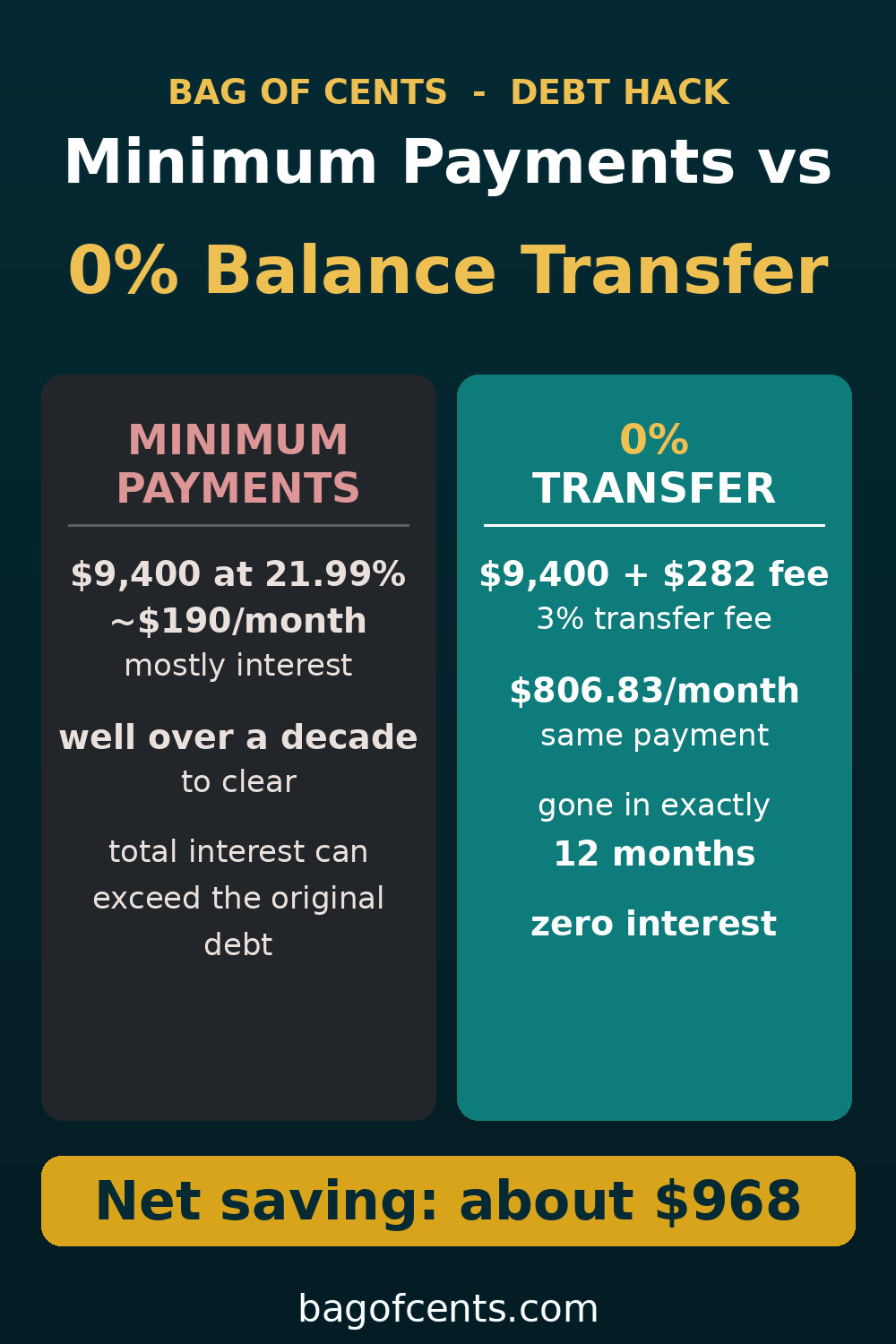
With the transfer: $9,400 moves to the new card, plus the 3% fee of $282, for a total of $9,682 at 0%. Paying the same $806.83 a month, the balance is gone in exactly 12 months. Total paid: $9,682 — zero interest. The fee cost $282 to erase roughly $1,250 of interest, a net saving of about $968, and you’re debt-free more than a month sooner.
The contrast is even starker against minimum payments. At a typical 2% minimum on $9,400, you’d pay roughly $190 a month to start — and most of it would go to interest. Minimum-payment math on a balance like this can drag on for well over a decade, with total interest running into the thousands. The transfer’s real power isn’t just the dollars saved; it’s that every payment visibly shrinks the balance, which is what keeps people motivated to finish.
5 Mistakes That Erase the Savings
1. Making new purchases on the transfer card. New purchases often earn no grace period and get charged the regular rate from day one, while your payments may be applied to the 0% balance first — leaving the expensive purchases to accrue interest. The card is for old debt only. Use a different card, or debit, for everything else.
2. Missing a single payment. Many promos include fine print: miss one payment and the 0% rate can be cancelled, replaced immediately with the regular rate on the whole remaining balance. Set automatic minimum payments at the very least.
3. Treating the promo as extra time instead of a deadline. Twelve months at 0% feels generous in month one and brutally short in month nine. People who coast for half the promo period often hit month ten with a big balance left, which then starts accruing interest at 22.99%. Divide the total by the promo months on day one and pay that amount like a bill.
4. Running the old card back up. Clearing $9,400 onto a new card while quietly rebuilding the old card’s balance is how people end up with two large balances. If you don’t trust yourself with the old card, cut it up (keep the account open for the credit history) or remove it from online checkouts.
5. Ignoring the regular rate and the fee. A 0% headline with a 3% fee, a $120 annual fee, and a 24.99% back-end rate can be worse than a 1.99% offer with a 1% fee and no annual fee, depending on your timeline. Never apply on the headline alone — add up fee, annual fee, and post-promo rate for your specific schedule.
Frequently Asked Questions
Will a balance transfer hurt my credit score? Expect a small, temporary dip from the hard inquiry and the new account — that’s normal and usually recovers within a few months. The transfer itself often helps your score over time: paying down a large balance lowers your credit utilization ratio, a major scoring factor, and on-time payments build positive history. What hurts is applying for several cards at once or missing payments.
How long do 0% offers usually last in Canada? Six to twelve months is the standard range at Canadian banks and credit unions. Confirm the exact end date in writing — promo periods are measured from account opening or from the transfer date depending on the issuer, and the difference matters.
Can I transfer the balance more than once — from one 0% card to another? Yes, and some people chain promos: when the first 0% period ends with a small balance left, they transfer it again to a fresh offer. It works, but each transfer adds another fee and another hard inquiry, and the offers won’t always be there when you need them. Treat chaining as a backup plan, not the main strategy.
Can I still use my old card after the transfer? Yes. The old account stays open with a zero balance unless you close it, which helps your credit utilization and account age. Just don’t rebuild it — a zero-balance card that gets spent back up is the most common way this strategy fails.
What happens to anything I don’t pay off before the promo ends? It starts accruing interest at the card’s regular rate — usually 19.99% to 22.99% — on whatever remains. If you’re approaching the deadline with a meaningful balance left, that’s the time to look at a second transfer offer or switch to an aggressive payoff plan on the remainder.
Final Thought
A balance transfer card is one of the few debt tools that gives you time without charging you for it. The 0% window is a pause button on interest — and on a $9,400 balance, pressing it can mean the difference between $1,250 in interest and a $282 fee. The card doesn’t do the work for you, though. It just makes your payments count for more, if you stop spending on it, pay on time, and treat the deadline like the deadline it is.
If you’re carrying a high-rate balance you can’t clear in a few months, pull out your statements tonight. Write down the balances, the rates, and the monthly interest each one is costing you. Then compare: a transfer fee once, or that interest every single month. When the numbers favour the transfer, the rest is discipline — and a calendar reminder for the promo end date.
Liked this? Take it further.
If this article got you thinking about where your money goes, the free 52-Week Savings Challenge Tracker is a great next step — a simple week-by-week plan that builds your savings to $1,378 by year end, one small deposit at a time.
Join the Bagofcents weekly money tips email. Unsubscribe anytime.
Happy Budgeting!
Stanley
Leave a Reply